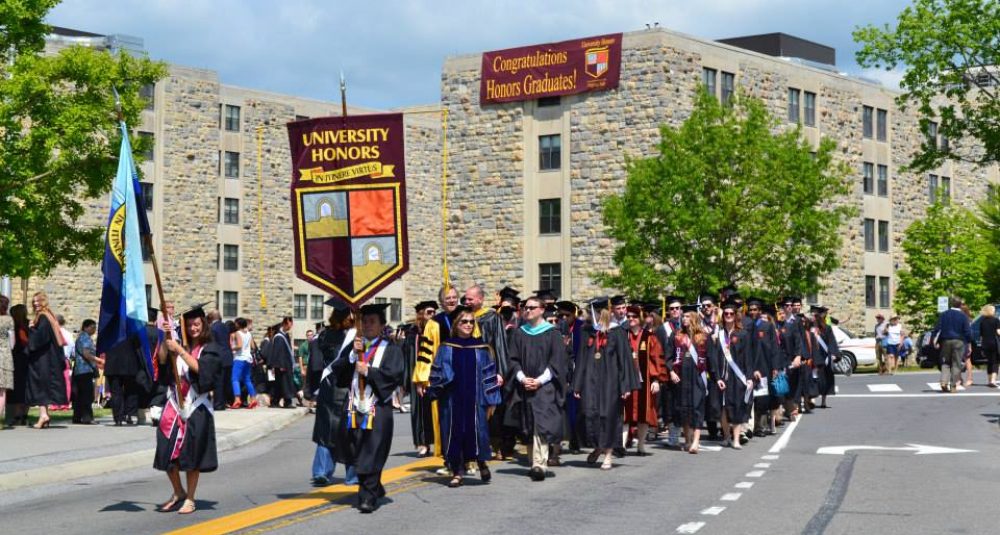
William and Mary Creates an Inclusive Path to “Highest Honors”

The William and Mary Scholars Undergraduate Research Experience: Excellence with a Mind Towards Equity, by Anne H. Charity Hudley, Cheryl Dickter, and Hannah Franz of The College of William and Mary. ahchar@wm.edu

Editor’s Note: On other pages, we note that the College of William and Mary, like UC Berkeley, does not have a separate honors college. The entire college could be considered an “honors” experience given the relatively small size of the undergraduate population and the record of high achievement that every student brings to the campus. But while other public institutions pursue an honors path that to some extent separates honors students from non-honors students, especially during the first two years of study, the William and Mary Scholars Program seeks out students who can benefit from more inclusiveness and participation. Read more from the authors, below….

In 2014, U.S. News & World Report listed the College of William and Mary as the top public institution with a strong commitment to undergraduate teaching. In 2013, The Journal of Blacks in Higher Education reported that William and Mary had the smallest gap between white and black students’ graduation rates of all public institutions.

From 2003-2013, William and Mary has been successful in increasing the diversity of our undergraduate student body, growing from 14% students of color in 2001 to 30% today, including 7.1% Black or African American students and 9.1% Hispanic/Latin students. One contributor to this achievement is the William and Mary Scholars Award. This award was established in 2002, and uses institutional resources to provide over forty in-state merit scholarships per enrolling class to academically distinguished students who have overcome unusual adversity and/or are members of groups who contribute to campus diversity.

In addition to academic merit, the selection process for William and Mary Scholars takes into account consideration of diversity, adversity and financial need. The William and Mary Scholars Award has been successful in drawing outstanding students to the College of William and Mary. In the past five years, two of the five Ann Callahan Chappell Award winners for the most outstanding Phi Beta Kappa initiate at The College of William and Mary were African-American women who were William and Mary Scholars.

By taking into account both academic achievement and the lingering impact of educational inequality, William and Mary is able to address Frank Bruni’s observation–that “honors colleges in some ways replicate, within a public school, the kind of stratified, status-conscious dynamic at play in the hierarchy of private schools”–by attracting strong students without furthering the divide. (The Bruni column was generally supportive of honors colleges.)

In order to fully support students chosen for the scholarship and to provide even greater access for students who are historically underrepresented, The William and Mary Scholars Undergraduate Research Experience (WMSURE) was created in 2010. This program provides formalized mentoring, programming, and increased research opportunities in order to nurture the academic skills and leadership potential of all students at the College of William and Mary, particularly those from underrepresented backgrounds. While the program supports the William and Mary Scholars, it is not exclusive to only them.

WMSURE provides weekly workshops and comprehensive advising and mentoring on a regular basis, all of which engage scholars throughout all four years of their college experience. The program has several unique features when compared to honors programs at other universities.

First, the program is led by tenured faculty with noted reputations for research excellence, which provides students with consistent advising and mentoring relationships with faculty at the college who are knowledgeable about many different areas of academic achievement and can help to demystify the academy for the scholars.

Second, the program is also personalized around each student’s academic and professional goals, with a focus on finding the right resources for each student based on their individual research and academic interests.

Finally, WMSURE is research-based, in that data are consistently collected regarding students’ academic and personal needs to ensure that appropriate programming and services are provided and to measure academic and social success and challenges. Our evidence shows that prior to the creation of WMSURE, underrepresented students were less informed about research at William and Mary, were less likely to engage in research, and were less likely to have a mentor.

Today on our campus, students who participate in WMSURE are more likely to engage in research, more likely to consider graduate school, feel more supported, are more likely to have an articulated mentor, and are more likely to feel supported in their academic endeavors.

What Students Face

Underrepresented students face multiple challenges which may affect their access to academic success upon arriving on campus, including solo status, stereotype threat, impostor syndrome, colorism, and microaggressions. In WMSURE, we address these challenges for underrepresented scholars in the academy. In particular, we detail how such experiences can negatively impact academic performance, self-esteem, overall well-being, and sense of belonging. Then, we give students multiple tools for use in confronting challenges in a comprehensive manner that attends to both academic and social needs. We have an emphasis on community-based learning and using research for the public good.

The Office of Admissions makes decisions about the William and Mary Scholar Award. But we tell students: If you receive a William and Mary Scholarship award, you should be proud of your accomplishments and all that you bring to the William and Mary community. But we also recognize that achievements in high school and standardized test scores do not even begin to tell your story. What makes you WMSURE? You do. The fact that you are here at William and Mary, one of the top ten public universities in the country makes you WMSURE. How do you become part of WMSURE? You just have to show up!

And show up they do. We see between 20-40 people at our weekly workshops, and just as many appear in WMSURE faculty office hours, in lab meetings, in dress rehearsals, and in other campus activities.

Our inclusive approach mitigates the gatekeeper effect and under-matching—students who could have been in honors or more challenging courses, or at a magnet school—but were not referred or declined to attend them because they received inaccurate or incomplete information.

WMSURE students have published with faculty, written honors theses, presented at national and international conferences, and contributed to books, including the book Highest Honors that is being written by WMSURE program chairs Anne Charity Hudley and Cheryl Dickter, along with graduate assistant Hannah Franz, so that more students may be privy to the insights of the undergraduate hidden curriculum, the unwritten and often unintended lessons that students learn in college.

Highest Honors: A Guide to Undergraduate Research prepares students for undergraduate research in college. The text is designed to help students take full advantage of the academic resources and experiences that the university setting has to offer so that students will actively be on the path to achieving highest honors/summa cum laude. The book is designed to appeal to all first and second year college students and as such, has a specific focus on the experiences of students who are underrepresented in the academy. Highest Honors provides students with detailed research-based tools that will prepare them for the social and academic transition from high school classes to college research.

The Issue of “Elitism” in Honors Colleges and Programs

It is close to a given that whenever the subject of public university honors programs receives widespread attention in the media, many comments from readers point to the alleged unfairness–the “elitism”–of such programs. Some readers, understandably, lament the disproportionate allocation of resources to a relatively small number of students, arguing that the resources should benefit all students.

Comments along these lines appeared most recently in response to Frank Bruni’s New York Times column on honors programs. The opening of the new Honors Living/Learning Residence at Rutgers Honors College likewise brought forth the expression of similar views.

First, as to the basic charge of elitism, the term clearly applies if it is used to characterize the official membership of highly qualified students in honors colleges and programs. In general, they are among the top 5-10 percent of the entire student body, based on high school gpa’s and standardized test scores.

Second, it is true that specific components of honors programs, especially honors “benefits,” serve to set honors students apart from the overall student body. Prominent among these benefits are special honors dorms and one form or another of priority registration for honors students. (But some honors programs, most notably those at UW Madison, do not provide separate housing because of a conscious effort to avoid charges of elitism.)

Third, all honors programs offer smaller class sections to their students, especially during the first and second years of study. In order to provide these sections, academic departments must sacrifice “production” ratios in the interest of staffing these smaller classes.

If Professor A normally teaches three sections of microeconomics, each with an enrollment of 100, and then replaces one of these with an honors section of 20 students, the production ratios of both Professor A and the econ department are a little less impressive in the provost’s eyes. The emphasis on “productivity” in public universities has become a sort of mantra in the eyes of many critics of state universities, many of them on the political right.

After conceding the above, the justification of special treatment actually depends on  (1) whether public honors programs yield sufficient benefit to the whole university to warrant the emphasis they receive; (2) whether their target audience–honors students–really deserves special support, as do other groups (athletes, under-represented ethnic and geographical groups, low-income students, first-generation students, students requiring remedial classes); (3) whether the state and region benefit enough from the continuing presence of honors students; and (4) whether honors programs fill a need by providing slots for high-achieving students, in the absence of a sufficient number of places at, well, elite colleges.

The fact is, many honors colleges and programs allow motivated and proven non-honors students to take honors classes. As former Penn State Schreyer Dean Christian Brady wrote in a recent article on this site, honors can be a “gateway” to transfer and non-honors students who find, after their first year or two in college, that they want to embrace greater challenges. (Dr. Brady is now Dean of the new Lewis Honors College at the University of Kentucky.)

Similarly, the University of Georgia’s Center for Undergraduate Research Opportunities, though under the banner of the school’s outstanding honors program, actually serves any undergraduate who wants to join in the excitement and promise of undergrad research. Another excellent program, Honors Carolina at UNC Chapel Hill, invites non-honors students with a strong academic record to participate in honors classes.

Dr. Jeffrey Chamberlain, Dean of the Hicks Honors College at the University of North Florida, agrees with Dean Brady that “Honors raises the game for the whole university. I am told repeatedly how good it is to have Honors students in non-Honors classes (and Honors students never take all of their classes in Honors).  Furthermore, Honors students help non-Honors students in every imaginable way—Honors students are math and science tutors, writing consultants, even RAs, so they contribute to student success across the board.” And, by the way, at a savings to the university.

Some states, such as South Carolina and Alabama, look to honors colleges to attract bright students to the state–and to keep such students from leaving the state to attend college. Avoiding a brain drain from a state or a region is, in its own way, an effort to maintain equity and to support and sustain the state’s economy.

Finally, what should a student do if there is a shortage of places at highly selective colleges and the student has the same credentials as those who are lucky enough to enter the selective schools? We have shown that, despite what some observers claim, there really are not enough places in public and private colleges for all the brightest students in this nation. Is it not fair–equitable, even–to provide places in public honors programs?

Honors News is a regular (not always daily) update, in brief, of recent news from honors colleges/programs and from the world of higher ed. Occasionally, a bit of opinion enters the discussion. These brief posts are by John Willingham, unless otherwise noted.

The New Yorker on the Real Value of a College Education

The title of New Yorker writer John Cassidy’s insightful article in the September 7 issue of the magazine is College Calculus–What Is the Real Value of a College Education? The use of the word “calculus” is more than a nod to the subject many college students dread; it is also an accurate term for the subtlety and complexity facing students and parents as they try to sort out what makes the increasingly expensive college experience worthwhile.

Cassidy describes the evolution of concepts that have defined the value of a college degree.  Once upon a time a degree, in almost any subject, from almost any college, was a “signal” of achievement, the degree itself providing sufficient entree to a broad range of vocations as well as to widespread respect in society.

Then came the concept of “human capital,” a term defining the instrumental value of a degree. The more one learned in a discipline with vocational promise, the more one’s “capital” increased.

But how does either term apply now in a nation where about half of the citizens aged 25 to 34 possess some form of college credential? The “signal,” once loud and clear, has become attenuated as it has spread. And even the idea of human capital, still ascendant, is subject to the whims of a world economy in which today’s dream vocation is tomorrow’s robotic solution. Added to this is the demand by employers for the lowest cost employees, with the most recent take on what is sure to be a passing bit of expertise. We want you now, they say, knowing that once your moment has passed–or your pay has risen–you will be gone.

The signal that the degree now conveys for all too many graduates is that they are likely to be more employable than people without degrees for jobs that in fact…do not require a degree.

Are there exceptions? Yes, but they are reassuring to only a few. Graduates of the most prestigious colleges still carry a strong signal to employers and the world. Is this because the graduates are in fact better educated, more articulate–or just more efficient cognitive machines?

Citing the work of Lauren Rivera of the Kellogg School of Management at Northwestern, Cassidy writes that the “recruiters didn’t pay much attention to things like grades and majors.” Instead, as Rivera says, “It was not the content of education that elite employers valued but rather its prestige.”

So prestige alone works if a student can get into a college that rejects 80-95 percent of its applicants, with about three-fourths of those rejected applicants actually possessing the requisite ability to succeed at those institutions. And this at a time when many colleges gin up the number of applicants to they will look more selective by rejecting almost all of them.

No wonder many parents and students opt for the seemingly safer “human capital” approach. Cassidy writes that Peter Cappelli of Penn’s Wharton School is skeptical about this concept of value, too, his work showing that only about a fifth of recent STEM grads find jobs in their fields.

“The evidence for recent grads suggests clearly that there is no overall shortage of STEM jobs,” Cappelli said. (Here we should add that most engineering grads are, for the time being, much more in demand than “overall” STEM degree holders, many of whom have degrees in biological sciences.)

Faced with this situation, even students among “the talented tenth” need to plan very carefully. With no pretense of capturing the calculus of Cassidy’s informative piece, we argue that students should develop what we will call, inelegantly, “differentiators.” Unable to win the lottery of gaining admission to a super prestigious college, where the signals are a legacy to grads who may or may not be individually deserving, students can still develop a formula for developing real, lasting skills and knowledge that might make them more balanced and successful in their lives. In the end, the seeming disadvantage of not gaining the automatic cred of a degree from Harvard, Berkeley, Stanford, MIT, Virginia, or Yale could turn into an array of advantages, all of them earned.

  • Go to the best public or private college that you can afford, really afford.
  • If there is an honors college or extensive honors program, apply.
  • If you are an engineering or tech major, regard the liberal arts, sciences, and social sciences as critical elements in your development.
  • If you are a humanities or social/behavioral science major, regard math and the sciences as critical elements in your development.
  • Give serious thought to pursuing a minor that contributes to your personal growth or provides more career potential.
  • Take advantage of seminars and discussions. Learn to think about what you say, understand and accept criticism, and anticipate arguments against your own.
  • Pursue an honors option that includes a thesis or a capstone project. It’s more work, but that’s the point. They are hard evidence of persistence, depth, and sophistication. They are “signals.”

At the end of his article, Cassidy quotes Cappelli, the Wharton scholar, and the quote is worth remembering:

“To be clear, the idea is not that there will be a big financial payoff to a liberal arts degree,” Cappelli writes. “It is that there is no guarantee of a payoff from very practical, work-based degrees either, yet that is all those degrees promise. For liberal arts, the claim is different and seems more accurate, that it will enrich your life and provide lessons that extend beyond any individual job. There are centuries of experience providing support for that notion.”

Honors News is a regular (not always daily) update, in brief, of recent news from honors colleges/programs and from the world of higher ed. Occasionally, a bit of opinion enters the discussion. These brief posts are by John Willingham, unless otherwise noted.

Rutgers Honors College: A New Home–and a New Living/Learning Community

Beginning this fall, 530 first-year students will begin their honors experience in the brand new, state-of-the art Honors College Living/Learning Community (LLC). The facility is also the administrative home of the Honors College and provides classroom and conference space as well.

Dean Matt Matsuda tells us that “our new living/learning facility houses all first-year students in the Honors College as well as our administrative and advising offices, six seminar rooms, plentiful lounge and study areas for programming, and three live-in faculty apartments.”

Rutgers honors dormArts and Sciences and other honors programs at Rutgers will continue operations on various  Rutgers-New Brunswick campuses, but freshman entrants from now on will share the first-year residential experience at the new LLC, a fact that provides cohesion, mentoring, and lots of mutual reinforcement for the new students.

The Honors LLC is located in the heart of the College Avenue Campus, the oldest of the five New Brunswick campuses and site of the original university. The College Avenue Campus is home to the Student Union, Health Center, the school of Arts and Sciences, and many academic departments.

At at time when as many as 75 percent of applicants to the most elite colleges are capable of succeeding at those schools–while only 5-10 percent are accepted–public honors programs are an increasingly important option. (Arguments that as many of 80 percent of high achieving students can find a place in elite colleges are extremely suspect. Please see Is It True That 80% of Elite Students Are Accepted by Elite Colleges?)

Below are excerpts from a great piece on the new college and LLC, written by Adam Clark of NJ Advance Media.  One of the key points in the piece is that Rutgers, like many other public honors colleges and programs, is trying to give high achieving students in the state a public in-state option that takes into account the special abilities the students bring to the university.

By Adam Clark…

As an honors student in high school, Amanda Fraticelli loved the atmosphere of being surrounded by top students, she said.

Fraticelli, of Toms River, said she was motivated by the way students challenged one another to do better academically. While some of her high school friends went to Ivy League universities and Fraticelli picked Rutgers University, the incoming freshman doesn’t expect that challenging atmosphere to change too much.

“I like knowing that everyone else (here) cares as much as I do,” Fraticelli said as she moved into her dorm room on Thursday.

In Fraticelli’s residence hall, some students might care even more.

Thursday marked the official opening of The Rutgers-New Brunswick Honors College, an $84.8 million, 170,000 square foot complex where the best and brightest of New Jersey’s state university will live alongside some school faculty and the academic dean.

All 530 honors college stdents, with an average SAT score more than 600 points higher than the state average [of 1526], moved into the building that also houses the offices of their academic advisors and honors college administrators.

“It’s a transformational moment in terms of honors education here,” said Paul Gilmore, the honors college’s administrative dean. “It’s a way that we are making the state, the region, the nation aware of what an incredible resource Rutgers is.”

Rutgers is one of dozens of state universities nationwide investing in honors colleges as a way to compete with elite colleges to attract the state’s brightest students. The honors programs often offer upgraded housing, smaller classes and other perks to draw in top undergraduates.

In recent years, Rutgers has stepped up its efforts to recruit high-achieving students, starting a new scholarship program for applicants with top SAT scores and high school grade point averages. The efforts come as New Jersey remains one of the country’s largest exporters of college students — sending more freshmen to out-of-state colleges than most other states in the nation.

Rutgers has long had honors programs for students from certain campuses or schools. But the new honors college for the first time brings together the top students of all academic majors under one roof.

For some students, earning a spot in the honors college is simply a perk. They had planned to attend Rutgers anyway but like the idea of being surrounded by students with similar academic goals, they said.

The fact that the honors college is the newest residence hall on the College Avenue campus made the decision easier students said.

The double rooms come with the same amenities as other on-campus housing, plus carpeted floors and air conditioning. Some rooms at the end of the hall have a view of the Raritan River.

Unlike the large, group-style bathrooms in more traditional college dormitories, the honors college has smaller bathrooms throughout each floor.

On the ground floor, seminar rooms will host some of the first-year classes. An indoor-outdoor fireplace anchors a lounge and patio space.

Students have to pay slightly more to live in the honors college housing, which is only for freshmen, but they are also allowed to stay in their rooms over school breaks.

For parents, that fact that students will be living in a building with in-house academic advisors is a relief, they said.

“It gives us a better feel for how she is going to survive her first year,” said Fernando Fraticelli, Amanda’s father.

Administrators hope students not only survive but help make the honors college a showcase for the university, Gilmore said. Rutgers sees the program as a recruiting tool that will help attract the best student from New Jersey and beyond, he said.

SaraAnn Stanway, an Ocean Township High School graduate who scored a 2270 out of 2400 on the SAT, said she understood the honors college is beneficial both for the students and for Rutgers.

“It’s exciting that Rutgers made it for us, but what makes it ever better is that we get to make it for Rutgers,” Stanway said. “We have the opportunity to make the honors college prestigious and extraordinary, and I can’t wait to be part of it.”

Payscale 2015-2016: Early Career Salaries, by University, Grad and Professional Degrees

The latest PayScale report contains a lot of extremely useful information about salaries of college grads.  But the list below, with more than 250 rows,  shows the early career pay, by graduate degree and institution because so many current and prospective honors students will end up pursuing graduate and professional degrees.

The salaries listed are for JD’s, MBA’s, Masters, and Ph.D.’s, with the last two degree types showing pay for degree holders working mostly in government and private industry. Many of these have earned Masters and Ph.D.’s in STEM disciplines.

Please note that several universities, public and private, have entries for all four categories above .

<

Degree TypeUniversity and Professional SchoolEarly Pay
MBAMassachusetts Institute of Technology (MIT) - Sloan School of Management131000
MBAUniversity of California, Berkeley - Haas School of Business123000
MBAYale University - School of Management123000
MBAWharton School of the University of Pennsylvania122000
MBAUniversity of Chicago - Booth School of Business122000
JDHarvard Law School118000
MBAStanford University Graduate School of Business118000
MBANorthwestern University - Kellogg Business School117000
MBAHarvard Business School114000
MBADartmouth College - Tuck School of Business111000
MBAUniversity of Virginia (UVA) - Darden School of Business111000
PhDStanford University111000
PhDMassachusetts Institute of Technology (MIT)105000
PhDCarnegie Mellon University (CMU)105000
MBAColumbia Business School104000
MBACornell University - Johnson Graduate School of Management (JGSM)104000
MBAUniversity of California at Los Angeles (UCLA) - Anderson School of Management103000
PhDHarvard University103000
MBADuke University - Fuqua School of Business102000
PhDUniversity of California - Santa Barbara (UCSB)102000
MBAUniversity of Notre Dame - Mendoza College of Business101000
PhDUniversity of California - Berkeley101000
MBAUniversity of Michigan - Stephen M. Ross School of Business100000
MBACarnegie Mellon University (CMU) - Tepper School100000
MBABabson College - F.W. Olin Graduate School of Business96900
PhDCalifornia Institute of Technology (Caltech)95600
MBAVanderbilt University - Business School94800
MBANew York University (NYU) Leonard N. Stern School of Business94700
MBAUniversity of Texas (UT) - Austin McCombs School of Business94600
PhDRensselaer Polytechnic Institute (RPI)94000
MBAGeorgetown University McDonough - School of Business93300
PhDUniversity of Illinois at Urbana-Champaign (UIUC)93100
PhDPrinceton University92700
PhDGeorgia Institute of Technology92300
PhDCornell University - Ithaca, NY92000
JDUniversity of California - Hastings College of Law91700
MBAUniversity of North Carolina at Chapel Hill (UNC) - Kenan-Flagler Business School91600
PhDColumbia University90300
PhDUniversity of California - Los Angeles (UCLA)90200
Master'sUnited States Naval Postgraduate School89800
PhDPurdue University - Main Campus89500
PhDUniversity of California - Irvine (UCI)89500
PhDUniversity of Houston (UH)89400
PhDArizona State University (ASU)89200
MBAGeorgia Tech - College of Management88800
PhDUniversity of Massachusetts (UMass) - Amherst Campus88500
MBAUniversity of Southern California - Marshall School of Business88300
PhDUniversity of Michigan - Ann Arbor88100
PhDUniversity of California - Davis (UC Davis)87900
JDUniversity of Houston Law Center87400
MBAUniversity of Minnesota - Carlson School of Management86900
PhDUniversity of Texas (UT) - Austin86900
MBATexas Christian University (TCU) - Neeley School of Business86700
MBASanta Clara University - Leavey School of Business86600
PhDUniversity of Wisconsin (UW) - Madison86600
PhDUniversity of Minnesota - Twin Cities86100
MBABoston University - School of Management85900
PhDUniversity of Florida (UF)85900
MBAVillanova University - Villanova School of Business85800
MBABoston College - Wallace E. Carroll School of Management85500
PhDUniversity of California - San Diego (UCSD)85300
PhDJohns Hopkins University85200
MBAEmory University - Goizueta Business School85100
MBAUniversity of California Davis (UC Davis) - Graduate School of Management85000
PhDRice University84900
PhDUniversity of Rochester84700
MBAUniversity of Washington (UW) - Foster School of Business84200
MBABrigham Young University (BYU) - Marriott School of Business84100
PhDYale University84100
Master'sUniversity of Nebraska Medical Center83800
MBAWake Forest School of Business83800
Master'sStanford University83400
PhDPennsylvania State University (Penn State) - Main Campus83300
PhDUniversity of Southern California (USC)83200
PhDNorth Carolina State University (NCSU)82900
PhDVirginia Polytechnic Institute and State University (Virginia Tech)82500
MBAUniversity of California Irvine (UCI) - Paul Merage School of Business82400
PhDTexas A&M University - Main Campus82400
PhDUniversity of Utah82300
PhDUniversity of Maryland - College Park82100
PhDDuke University82100
MBASouthern Methodist University (SMU) - Cox School of Business81900
PhDUniversity of Colorado - Boulder (CU)81900
PhDMichigan State University (MSU)81900
MBAUniversity of California San Diego (UCSD) - Rady School of Management81700
PhDOhio State University (OSU) - Main Campus81600
JDGeorgetown University Law Center81500
JDSanta Clara University School of Law81300
MBAOhio State University (OSU) - Fisher College of Business81100
Master'sCarnegie Mellon University (CMU)81000
JDUniversity of Texas at Austin School of Law80900
Master'sMassachusetts Institute of Technology (MIT)80900
PhDUniversity of Virginia (UVA) - Main Campus80900
PhDUniversity of Notre Dame80700
MBAUniversity of Connecticut (Uconn) - School of Business80600
PhDUniversity of Central Florida (UCF)80600
MBAThunderbird, The American Graduate School of International Management80500
PhDUniversity of Pennsylvania80400
JDUniversity of California at Los Angeles (UCLA) - College of Law80300
PhDUniversity of Pittsburgh - Main Campus80200
JDBrooklyn Law School80100
MBAKelley School of Business, Indiana University80000
MBAUniversity of Illinois at Urbana-Champaign (UIUC) College of Business80000
Master'sSanta Clara University79700
MBAUniversity of Maryland - Robert H. Smith School of Business79700
PhDAuburn University79500
PhDBoston University79400
MBAGeorge Washington University (GWU) - School of Business79200
MBAThe University of Iowa - Henry B. Tippie College of Business79200
PhDUniversity of Washington (UW) - Main Campus79000
MBATulane University - A.B. Freeman School of Business78700
Master'sSan Jose State University (SJSU)78500
PhDUniversity of Arizona78300
PhDUniversity of Illinois at Chicago78300
PhDIndiana University (IU) - Bloomington78200
MBAPepperdine University - Graziadio School of Business and Management77900
JDPepperdine University School of Law77700
MBABentley University - McCallum Graduate School of Business77600
JDGeorge Washington University Law School77100
PhDUniversity of Tennessee77100
JDBoston University School of Law76800
MBAUniversity of Wisconsin (UW) - Madison School of Business76800
PhDIowa State University76800
MBAUniversity of Pittsburgh - Katz Graduate School of Business76600
PhDWashington State University (WSU)76600
JDMcGeorge School of Law76300
PhDClarkson University - Potsdam, NY76300
JDUniversity of Southern California Law Center and Law Library76200
JDFordham University School of Law76200
Master'sKettering University76200
MBAVirginia Commonwealth School of Business76000
PhDUniversity of North Carolina at Chapel Hill (UNC)75800
MBAWashington University - Olin Business School75600
JDSouthern Methodist University School of Law75500
MBAUniversity of Rochester - Simon School of Business75100
Master'sUniversity of South Alabama75000
JDUniversity of California at Berkeley School of Law74900
PhDRutgers University - New Brunswick Campus74800
MBAFordham University - Gabelli School of Business74700
MBAThe College of William and Mary - Mason School of Business74700
JDUniversity of Miami School of Law74600
Master'sCornell University - Ithaca, NY74500
PhDUniversity of Connecticut (UConn) - Main Campus74500
JDUniversity of Washington (UW) School of Law74000
MBARutgers Business School74000
MBAPurdue University - Krannert School of Management73900
Master'sGeorgia Institute of Technology73800
MBAUniversity of Delaware - Alfred Lerner College of Business and Economics73800
JDSt. John's University School of Law, New York73700
MBANortheastern University - D'Amore-McKim School of Business73400
JDSeton Hall University School of Law73300
MBAMichigan State University - Broad College of Business73300
MBACUNY Bernard M Baruch College - Zicklin School of Business73200
JDUniversity of San Diego (USD) School of Law73100
Master'sStevens Institute of Technology73000
MBALehigh University College of Business and Economics72900
JDEmory University School of Law72700
MBAUniversity of Arizona - Eller College of Management72400
MBAPennsylvania State University (PSU) - Smeal College of Business72300
MBASuffolk University - Sawyer School of Management72100
Master'sRochester Institute of Technology (RIT)71900
MBAArizona State University (ASU) - W. P. Carey School of Business71900
MBAUniversity of Massachusetts (UMass) - Boston Campus71900
MBALoyola Marymount College of Business Administration71800
PhDNorthwestern University71700
MBAJohns Hopkins University - Carey Business School71400
PhDVanderbilt University71300
JDLoyola Law School71200
Master'sWorcester Polytechnic Institute (WPI)71100
JDUniversity of North Carolina (UNC) School of Law71000
MBAGeorge Mason University - School of Management71000
MBAUniversity of Colorado Boulder (UCB) - Leeds School of Business70900
MBAUniversity of Arkansas - Sam M. Walton College of Business70900
JDUniversity of Illinois College of Law70700
Master'sPurdue University - Main Campus70700
MBAOklahoma State University (OSU) - Spears School of Business70700
MBACase Western Reserve University - Weatherhead School of Management70600
MBAUniversity of Miami School of Business (Florida)70500
MBAUniversity of Georgia (UGA) - Terry College of Business70500
Master'sManhattan College70400
Master'sNYU Polytechnic School of Engineering70200
Master'sUniversity of California - Berkeley70100
Master'sMissouri University of Science and Technology (S&T)70000
MBAAmerican University - Kogod School of Business70000
Master'sEmbry-Riddle Aeronautical University (ERAU) - Daytona Beach, FL69900
MBAUniversity of Texas at Dallas - Naveen Jindal School of Management69900
MBAClarkson University - Clarkson School of Business69700
MBAUniversity of Houston (UH) - C.T. Bauer College of Business69600
PhDColorado State University (CSU)69400
Master'sUniversity of Texas at Dallas69300
MBATexas State University - San Marcos Campus69200
Master'sMedical University of South Carolina69100
MBAUniversity of Florida (UF) - Warrington College of Business69100
JDSeattle University School of Law68900
JDUniversity of Connecticut (UConn) School of Law68700
MBADuquesne University - A.J. Palumbo School of Bus Admin and John F. Donahue Grad School of Bus68700
JDDetroit College of Law at Michigan State University68600
MBADrexel University - Bennett S. LeBow College of Business68600
Master'sMichigan Technological University68500
MBATexas A&M University - Mays Business School68500
MBAUniversity of South Carolina - Darla Moore School of Business68400
JDAmerican University Washington College of Law68300
MBAUniversity of St. Thomas - Opus College of Business68300
Master'sColorado School of Mines68200
Master'sGannon University68200
Master'sUniversity of California - Irvine (UCI)67900
Master'sVanderbilt University67900
MBASan Francisco State University (SFSU) - College of Business67900
MBAClemson University - College of Business and Behavioral Science67800
Master'sPrinceton University67700
Master'sLehigh University67700
Master'sUniversity of Michigan - Dearborn Campus67700
Master'sTufts University67700
Master'sIllinois Institute of Technology (IIT)67500
MBASan Jose State University (SJSU) - College of Business, and Lucas Graduate School of Business67500
JDUniversity of Florida (UF) Levin College of Law67400
Master'sUniversity of Southern California (USC)67400
Master'sPennsylvania State University (Penn State) - Great Valley Campus67400
JDTemple University School of Law67300
Master'sRensselaer Polytechnic Institute (RPI)67300
Master'sCalifornia Polytechnic State University (CalPoly) - San Luis Obispo67300
Master'sClarkson University - Potsdam, NY67200
Master'sUniversity of Colorado at Colorado Springs67200
MBAWayne State University - Detroit, MI67100
Master'sUniversity of Alabama - Huntsville Campus67000
Master'sTexas A&M University - Main Campus67000
MBAUniversity of New Haven67000
MBADePaul University - Kellstadt Graduate School of Business66900
Master'sNortheastern University66800
MBAOakland University - Rochester Hills, MI66700
MBAWestminster College - Salt Lake City, UT66700
JDUniversity of Minnesota Law School66600
MBAUniversity of Kansas - School of Business66500
JDUniversity of Denver College of Law66400
Master'sNew Jersey Institute of Technology (NJIT)66400
PhDFlorida State University (FSU)66400
Master'sUniversity of California - San Diego (UCSD)66300
Master'sIdaho State University (ISU)66200
MBASan Diego State University (SDSU) - College of Business Administration66200
MBASt. Xavier University66200
JDNew England School of Law66100
Master'sDuke University66100
Master'sBowie State University (BSU)66100
JDTulane Law School65700
MBATemple University - Fox School of Business and Management65700
MBAUniversity of Utah - David Eccles School of Business65600
Master'sJohns Hopkins University65500
Master'sUniversity of Colorado - Boulder (CU)65500
Master'sNorth Carolina State University (NCSU)65500
MBASUNY Albany - School of Business65500
JDJohn Marshall Law School - Chicago, IL65400
Master'sUniversity of California - Santa Barbara (UCSB)65400
Master'sUniversity of Houston (UH)65400
Master'sPhiladelphia University65300
JDCalifornia Western School of Law65200
Master'sUniversity of Massachusetts (UMass) - Lowell Campus65200
MBAFlorida State University (FSU) - College of Business65200
MBAGeorgia State University - J. Mack Robinson College of Business65100
MBASeattle University - Albers School of Business and Economics65100
Master'sBentley University65000
Master'sPurdue University - Calumet Campus65000
MBACalifornia State University East Bay (CSUEB) - College of Business and Economics65000
MBALoyola University of Chicago - Quinlan School of Business65000
MBAUniversity of Denver - Business School65000
>


Honors News: Best Campus Food!

Some critics of universities maintain that many schools spend too much on benefits for students: fancy residence halls, sprawling rec centers, and dining facilities that bear no resemblance to the old military-style “mess” halls of the past. Today, we are setting aside the arguments pro and con and focusing on one just one thing: Food!

Each year, The Daily Meal rates the dining facilities at major colleges and universities, with an emphasis on sustainability and the quality and variety of meals. Below is a list of the public universities that made the Top 75 list this year. Also included are excerpts from the Daily Meal profiles.

UMass Amherst—“You will never be bored eating at UMass Amherst. Events throughout the year include Local Chicken Dinner Day, Flavours of Canada, Pistachio Day, and Spring Dinner, and menu options range from Irish coffee bread pudding with Kahlúa sauce to chicken breast schnitzel with chipotle salsa.”

James Madison—“James Madison University definitely knows the importance of fun, which is why they throw events like Madipalooza, an outdoor spring festival, farm-to-fork dinners, and annual farmer’s markets, held four times throughout the fall. And even though the food in the dining halls is delicious, students also have access to multiple national chains, like Quiznos, Starbucks, and Red Mango, right on campus.”

Georgia—“Snelling Dining Commons is open 24 hours —a popular tradition for students is “Late-Night Snelling,” also known as “Snellebrating.” And improvement is definitely on the mind at University of Georgia. The new Bolton Dining Commons has interactive cooking platforms and options like breakfast all day, regional and international cuisine, and hand-spun milkshakes.”

UCLA—“UCLA is also committed to sustainability, and has received an award from PETA for being the most vegan-friendly campus. Mouthwatering offerings on campus include seafood pizza, chicken and dumplings, and chicken chili verde, and an in-house bakery provides almost all breads and baked goods.”

Miami Ohio—“Miami University boasts multiple conveniently located dining locations all around campus, including two 24/7 locations, a ‘50s-style diner in the student union, and a convenience store selling snacks and standard groceries.”

UC San Diego—“The chefs at UCSD are professionally trained by award-winning culinary schools, and the dining services have won a whole bunch of awards for food quality and taste. Embracing the Mexican heritage of the area, UCSD has an on-campus food truck called Torero Tu Go, which serves savory dishes like chicken skewers and skirt steak tacos.”

South Carolina—“Nine executive chefs are at the helm of the University of South Carolina’s dining program, which is made up of three “all-you-care-to-eat” dining halls and 27 on-campus retail locations… don’t be surprised to see chef Corey Green serving his famous leg of lamb with mint sauce, steak fries, and béarnaises!”

UC Berkeley—“…Berkeley is one of the best food towns in the country. But don’t worry — the food served on campus is likely to be better than anything you can get at a restaurant, with options like blackened fried catfish, red pepper and spinach pizza, and jerk chicken sandwiches.”

UC San Diego—“The school uses a bio-digester to reduce waste and turn it into energy. In fact, the University of San Diego was the first college campus in the country to install a bio-digester, and we think that’s pretty impressive. As for late-night dining, you’re covered with the campus food truck, or you could go to any of the 17 off-campus locations that accept University of SD Campus Cash.”

Purdue—“The dining services at Purdue have partnered with the student-run farm, which provides local produce like fresh herbs and tomatoes. On top of that, each student is given a reusable to-go cup at the beginning of the year and using it gives him or her discounts at dining locations around campus.”

Virginia Tech—“The Farms and Fields project provides local and organic meals, including apple chutney and Cheddar panini made with local cheese, and locally made, organic bread.”

UConn—“One of the University of Connecticut’s goals is to have all of their dining facilities green-certified, and they are well on their way to achieving that goal…The dining services also runs a Farm Fresh Market, where most of the food is sourced locally from the two student-run gardens.”

Georgia Tech—“ Don’t expect to find any dining halls at Georgia Tech, however; this past spring they were re-imagined from the top down and are now called community restaurants. Recipes were rewritten to include more fresh, house-made items; the culinary process was refined to be sustainable at every level; and fresh-baked pastries and desserts were added.”

UC Davis—“To start off, dining hall fare includes dishes like falafel lentil cakes, mandarin chicken salad, and white chocolate raspberry scones.”

Houston—“There are more than 30 dining locations on University of Houston’s campus, including Cougar Woods, a nut-free facility for students with severe allergies. Basically, whatever you want, you can get it at U of Houston.”

UC Santa Barbara—“Every quarter, UCSB’s dining services has a Green Chef Competition to educate students on sustainability as well as to entertain.”

UNC Chapel Hill—“There are 24 on-campus eateries and two main dining halls, at which you’ll find a regular schedule of special events and programming ranging from days highlighting ingredients like white pumpkin and kohlrabi to weekly tastings and samplings…”

Delaware—“UDel’s dining services help students along by serving delicious and healthful options like homemade butternut squash and apple soup, black and white sesame chicken, and herb-crusted flounder. All the nutritional information is also available online, and with 15 eateries on campus…”

Ball State—“At Ball State, seven professional chefs prepare scratch-made dishes in small batches, and menus rotate on a four-week schedule. Everything from salad dressings to house-smoked ribs is prepared in-house, and everything from sandwiches and salads to wraps, pizzas, pastas, stir-fries, and nachos is entirely customizable.”

Washington—“The UW farm grows fresh produce right on campus and dining services sells what they harvest at the District Market…An extra bonus is the fact that there are 15 dining options on campus…”

Cal State Chico—“A recipe contest gives students a chance to see their food featured in dining halls, while events like National Eggs Benedict Day and Black History Month Soul Food Night are popular.”

UC Irvine—“The university often hosts popular local food trucks at campus festivals as well as events like Mediterranean Night and the Lunar Festival.”

Honors News is a regular (not always daily) update, in brief, of recent news from honors colleges/programs and from the world of higher ed. Occasionally, a bit of opinion enters the discussion. These brief posts are by John Willingham, unless otherwise noted.

Penn State Schreyer Dean: Honors College is a Gateway and Incubator for ALL Students

Editor’s Note: The following guest article is from Christian M.M. Brady, Ph.D., Dean of Schreyer Honors College at Penn State University. The College is a recognized leader in honors education, and one of only seven to receive a five mortarboard rating in A Review of Fifty Public University Honors Programs.

“Honors programs and colleges are each as distinctive and unique as the college or university of which they are a part.” This is how I begin every presentation I make to prospective students and their parents. There is no one set definition of what an honors program is, other than that all programs have the general goal of enhancing and enriching a student’s academic experience. The mission, vision, character, nature, and experience of each program or college will vary widely even as they all achieve that single goal.

I have had the great pleasure to be the director Tulane University’s Honors Program and I am now in my tenth year as dean of the Schreyer Honors College at Penn State University. I have also been a part of and led reviews of numerous other honors programs and colleges around the country. This combination of intimate working experience and the opportunity to survey the national landscape has led me to the personal conviction that honors education should be built upon two pillars resulting in an “osmotic incubator.”

Osmotic

“Accessibility,” “permeability,” and “leaven” are all terms I have used to describe this attribute. I remained a pre-med student long enough to know that “osmosis” is the process by which molecules can pass through a membrane from one region to another. Honors education may be thought of in these terms, to a certain extent, taking in students at different stages while at the same time the college should be making contributions to the rest of the university.

In the Schreyer Honors College (SHC), as in all programs, resources are limited and therefore so is the number of students we can enroll. At Penn State we are able to enroll up to 300 first-year students as Schreyer Scholars. The total first-year enrollment at Penn State [all campuses] is nearly 20,000 students so this represents a very small percentage of the whole. It is the nature of honors programs that they are small in size so that the impact upon the students can be maximized, but that makes it all the more imperative that they be a mechanism for taking in students after their first year.

The “Gateway” entrance to the SHC was already in place at Penn State long before my arrival and it is an excellent solution to the challenge of finding the right size for an honors college. Students who have achieved a minimum GPA of a 3.7 may apply for admission into the SHC and in this manner those students who only “hit their stride” once in college can also have access to the benefits of an honors experience.

Aside from financial concerns, the primary constraint for any honors program is ensuring that our students will have the faculty support and direction they need. The Gateway selection is determined by the student’s major department; thus the department is able to ensure that they do not accept more students than they can supervise and support through their academic career, which culminates in an honors thesis.

I also believe that this egalitarian approach is in keeping with the ethos of Penn State, a land-grant institution that remains committed to the mission of providing access to education for all citizens of our commonwealth. Through the Gateway process we are able to recognize those students who have had a stellar academic career since arriving at Penn State and give them an opportunity further to excel.

This osmotic property of honors education should not be limited to enrollment. We also strive to have a positive impact in the Penn State community, moving outwards into the rest of the university. I believe that honors education should never be a “cloistered” community, set aside with few coming in and even less going out. Rather we seek to collaborate with colleges, institutes, programs, and student organizations to make a real and positive impact on our community. When we invite major speakers, such as last year when we hosted Earvin “Magic” Johnson for our Shaping the Future Summit, we set aside a dinner or reception for a smaller group of students and faculty, but the primary event is always for the entire community, both within Penn State and our geographic region.

The same is true in terms of pedagogy. Small honors courses with committed students allow for faculty to try out new and different learning and instruction techniques. We also make sure that once our honors students have enrolled in courses, any available seats in honors classes are available to all students at Penn State. They have to meet the same standards as our honors students, but they also receive the same education in the classroom. This is often how many of our Gateway Scholars begin their honors path at Penn State. Honors classes are also often the site of great innovation that benefits the entire university. This role of being a test-bed leads to my second pillar of honors education: we should be the incubator of innovation within the university.

Innovative Incubator

The concept of a tech or business “incubator” is known to most by now. These are programs, communities, or groups that provide the resources and capital necessary for entrepreneurs to move their ideas to products. We have a student organization at Penn State that strives to be just such a place for our students, Innoblue. I am their adviser, but a number of Scholars, both alumni and current students, are a part of this exciting enterprise. This concept is also how I view our role in education, “to improve educational practice and to be recognized as a leading force in honors education nationwide” (from the SHC Vision statement).

Honors education is a place where we, our students and faculty, can experiment, try different teaching methods, subjects, and curricula. This can happen because we have a great combination of engaged and creative faculty and highly motivated students. Our small size means that we can be nimble. Our faculty can try something new, knowing that our students will be able to give them instant, critical, and valuable feedback. If it works, great! We have a new course or program. If not, that is OK as well. We will have the information needed to know whether we can simply tweak it and get it right or if it really is not going to work after all. Finally, if it really works and is scalable we can take that to the rest of the university and everyone will be enriched.

This is what I believe honors education should be, an “osmotic incubator” that allows for great ideas and people to flow through enriching not only our students but our entire community. It makes for an exciting environment, full of new and nimble minds with committed and excited participants. In other words, it is why I love my job.

Texas A&M BBA Honors Program: Selective and Rigorous

The state of Texas is fortunate to have two flagship schools whose business honors programs are among the best four-year choices for extremely talented applicants who know from the get-go that business will be their chosen career.

In a previous profile of the UT Austin Business Honors Program, we noted that the average SAT score of BHP students was higher than students at Penn’s famed Wharton School.

The Texas A&M BBA Honors Program is also highly selective. Although the minimum requirement is 1300 SAT or 30 ACT plus a high school rank in the top 25%, the average scores and gpa’s of 2014 applicants were 1423 SAT and a high school rank in the top 3.75%. Since the the A&M BBA Honors Program is smaller than the UT Austin BHP, the selectivity percentage is even lower than for UT: In 2914, BBA Honors had 850 applications and enrolled only 76 students.

Once enrolled, students must complete a minimum of 30 hours of honors coursework to graduate with business honors. The 30 hours include 9 hours of required courses, 15 hours of business common body of knowledge courses, and 6 additional hours of the student’s choice.

Students must also maintain a 3.5 cumulative gpa; attend a minimum of 4 of the 70 professional development events offered each year; and complete an internship for credit and a summer reading assignment each year.

The Mays Business School also has merit scholarships available; BBA Honors students receive strong consideration for these awards.

“Our graduates take on challenging positions with well-respected companies, including major energy companies such as ExxonMobil and Shell, consulting firms such as Bain & Co. and Boston Consulting Group, banks such as Goldman Sachs and JP Morgan Chase, retailers such as Wal-Mart and Nordstrom, and professional services firms such as PwC and Deloitte,” according to the BBA Honors site.

“Graduates also have found employment by not-for-profit organizations such as the Financial Accounting Standards Board and Teach for America as well as governmental agencies such as the Department of Homeland Security.”

The number of BBA Honors grads who complete graduate or professional school is very impressive:

“Within five years of earning a BBA in Business Honors, 70% of our graduates are enrolled in or have completed a graduate program, including those in business, law, and medicine. Our graduates go on to top graduate programs at Harvard, Stanford, Rice, Georgetown, Johns Hopkins, Columbia, Vanderbilt, George Washington, William and Mary, New York University, the Wharton School of Business, and the University of Texas School of Law.”

The program also offers exciting opportunities for studying abroad. The Center for International Business Studies not only offers study abroad programs geared for business students but has classes in international business, foreign internships, and scholarships for studying abroad.

Honors News is a regular (not always daily) update, in brief, of recent news from honors colleges/programs and from the world of higher ed. Occasionally, a bit of opinion enters the discussion. These brief posts are by John Willingham, unless otherwise noted.

Thoughts on NY Times Letters about Honors Colleges

Honors News: August 25, 2015

Below are excerpts from two letters to the editor published by the New York Times in response to Frank Bruni’s positive August 9 column about honors colleges and programs. Again, our thanks to Mr. Bruni for his kind remarks about A Review of Fifty Public University Honors Programs and for his support of honors colleges and programs as a strong option for talented students. Our comments follow both excerpts.

To the Editor:

“Frank Bruni argues correctly that honors colleges at many public universities give students the chance to get a superb education at a moderate price (“A Prudent College Path,” column, Aug. 9). But he might have expanded his argument further in addressing the value of honors colleges as they have evolved in recent years at private as well as public universities.

“Contrary to the general belief that an honors college is an elitist program for only the best students, many honors colleges now offer an array of intellectual and cultural resources to all students who choose to take advantage of them…

“Some of our programs are open only to the highest-achieving students, but others — involving research, fellowship mentoring and interdisciplinary coursework — are open to all. These programs allow students to receive a wide-ranging liberal arts education while still completing a focused major and preparing for the workplace or graduate school.”

PAULA MARANTZ COHEN
Dean, Pennoni Honors College
Drexel University
Philadelphia

To the Editor:

“Honors programs for a select few at public universities institutionalize blatant academic elitism and hypocrisy rather than diminish them. All college courses should be ‘honors courses,’ demanding and providing rigorous academic and intellectual experiences for everyone who attends college…

“Rather than casting 80 percent of the student body overboard into an intellectually mediocre classroom environment, reel back these students so that they, too, can experience what the university considers the best for the best.”

PHIL AVILLO
York, Pa.
The writer is emeritus professor of history at York College of Pennsylvania.

Responses:

Dean Cohen is correct in saying that many honors colleges and programs in private universities such as Drexel are essential for giving talented students an opportunity to participate in honors-specific courses and experiences, while also providing access to undergraduate research, fellowship mentoring, and even access to some honors classes.

The same is true of honors programs in public universities. An outstanding example is the University of Georgia Honors Program, which oversees the Center for Undergraduate Research Opportunities (CURO), a highly effective vehicle for promoting research excellence for all undergraduates, not just honors students. It is no coincidence that UGA, mainly through its honors program and research emphasis, is one of the national leaders in producing Goldwater Scholars. These outstanding undergraduates in the STEM disciplines are often selected later on for prestigious postgraduate scholarships.

Professor Avillo suggests that honors colleges and programs are guilty of “blatant elitism” and take resources away from the overall student population. This is a familiar attack on honors programs, and of course he is correct in saying that honors programs require extra university resources to provide smaller class sections for honors students, honors residence halls, and other special programs. And in some cases, honors students may be considered “elite” in a negative way. The question is: are these extra efforts justifiable?

(Here’s a great article on our site by Dean Christian Brady of Penn State’s renowned Schreyer Honors College. Dean Brady describes how honors programs can become more egalitarian and benefit the whole university.)

It is our view that the two main justifications for honors colleges and programs:

1. Most public and private honors programs at major universities require applicants to have very strong high school gpa’s along with standardized test scores in the top 8-9% nationwide. Our research suggests that in the current battle among colleges to enhance their selectivity profiles, many of these bright students are not finding places in the most elite private institutions.

In order for these students to find a learning environment that, in some ways, offers classes and other experiences that resemble those in elite colleges. Without the thousands of slots for these students in both public and private honors programs, the students would likely succeed anyway–but would they be challenged, or find a group with similar interests as freshmen, or go on to the best graduate and professional schools?

2. If you are one of the students described above and find that your dream private college has rejected you for whatever mystical reason, would you want to travel hundreds or thousands of miles and pay higher tuition to find a college that will offer you the challenges and opportunities you need, indeed deserve based on your qualifications? If given the right option, would you stay in your home state, or at least nearby?

Most students would say yes. And, sometimes, their state legislatures would like for them to stay in-state in order to avoid the “brain drain” that occurs when such students cannot find the type of education they desire in their home state. The fact is that no state right now, and probably in the foreseeable future, can magically create a UC Berkeley, Michigan, UCLA, UVA, UNC Chapel Hill, or a William & Mary. Or a UW Madison, Washington, UT Austin, or Illinois. But a state can, with additional support from donors, build honors colleges and programs.

Honors News is a regular (not always daily) update, in brief, of recent news from honors colleges/programs and from the world of higher ed. Occasionally, a bit of opinion enters the discussion. These brief posts are by John Willingham, unless otherwise noted.

Honors News: August 24, 2015

Princeton Review’s “Great Schools for…Business, Engineering”

Each year, The Princeton Review analyzes the number of students by major in more than 2,000 colleges and consults with in-house admissions experts to come up with a series of “Great Schools for…”, well, 20 of the most popular majors.

Today, we will list the public universities on two of the 20 lists: Business/Finance and Engineering. All schools will be listed in alpha order. In the case of Engineering, it is noteworthy that Michigan Tech and the Missouri University of Science and Technology, neither as well known as flagship and land-grant schools, both made the list.

Business/Finance

Arizona State

Cal State–Stanislaus

Christopher Newport

City University of NY–Baruch and Brooklyn

Florida State

Indiana

Iowa State

Miami Ohio

Ohio University

Portland State

Arkansas

UC Berkeley

UCLA

Florida

Houston

Illinois

Michigan

UT Austin

UT Dallas

Virginia

Engineering

Georgia Tech

Michigan Tech

Missouri Univ of Science and Tech

Montana Tech of Univ of Montana

Penn State

Purdue

Texas A&M

UC Berkeley

UCLA

UT Austin

UW Madison

Virginia Tech

Honors News is a regular (not always daily) update, in brief, of recent news from honors colleges/programs and from the world of higher ed. Occasionally, a bit of opinion enters the discussion. These brief posts are by John Willingham, unless otherwise noted.