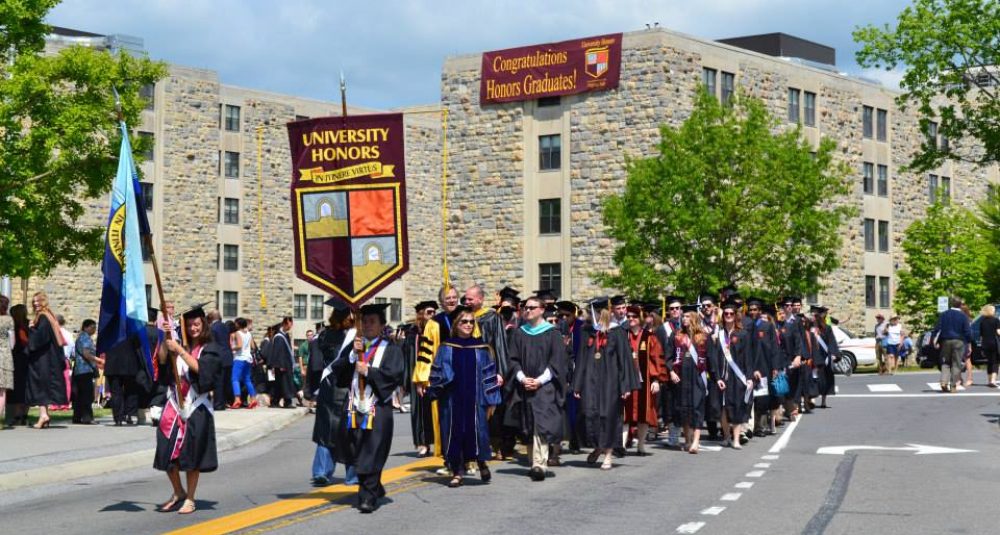
Aspiring honors students typically can list an impressive array of accomplishments to go along with their high test scores and GPAs. These are often sufficient to merit their admission to honors programs throughout the nation.
From all the evidence we have seen in the process of reviewing 50 leading public university honors programs, the great majority of honors students do not rest on their high school laurels but continue to contribute and excel through their college careers, and beyond.
Probably the majority of honors students display their virtuosity through a mastery of the full range of subject areas–science, math, foreign languages, and writing–along with a background of community involvement and artistic accomplishment, say, in music.
Not so many come to their honors colleges and programs with a commitment that is strong enough to encompass subject mastery and community involvement and participation in varsity athletics. With full course loads and multiple majors (in many cases), the time and energy required to compete at the varsity level at a major I-A university is a challenge for even the most gifted honors student.
Meet Aubri Carman, who just graduated from the University of Arizona Honors College summa cum laude, after arriving at UA as a varsity soccer player. Following her graduation as salutatorian at Mountain Pointe High School in Tempe, Aubri won a prestigious Flinn Scholarship that gave her a “full ride” at the Arizona public university of her choice. Only 20 Flinn scholarships were awarded in 2008, out of more than 550 highly-qualified applicants.
Aubri chose the University of Arizona and competed on the varsity level in soccer. But a passion for biochemistry and biophysics took over around her second year at the university. “I came in as an NCAA Division 1 women’s soccer player, focused solely on athletics,” she says, “but then decided to go on another path and focus more on academic pursuits. I got involved, made key contacts through The Honors College and was able to pursue all the things I was passionate about.”
The following excerpt from a University of Arizona piece completes Aubri’s story–up to now–though it does not mention that she was named the outstanding senior in the UA Honors College in 2012. The piece was in recognition of her selection as one of two winners of the prestigious Merril P. Freeman award.
“Aubri Carman is a Flinn Scholar graduating Summa Cum Laude with honors with degrees in both biochemistry and molecular biophysics and molecular and cellular biology. She has minors in Spanish, political science and chemistry. She is the Outstanding Senior for the chemistry and biochemistry program and was honored with the Pillars of Excellence Award.
“She served as a student ambassador for the department of chemistry and biochemistry and as a member of the department’s peer mentoring program. She works at C.A.T.S Academics where she is a tutor for UA student-athletes and at the Honors College she plans activities for Flinn Scholars and recruits new students. She is also an active in the Mortar Board, a senior honor society.
“Carman has conducted research in three different laboratories on campus. She studies molecular and proteomic approaches to characterizing pediatric staphylococcus aureus bloodstream infections. She is also a Galileo Circle Scholar and a Michael A. Wells Research Scholar and her work has been submitted for publication in the journal, Clinical Infectious Diseases.
“She has taken graduate level courses at the Mel and Enid Zuckerman College of Public Health and helped with the planning of the inaugural New Frontiers in Global Health Leadership Forum.
Thanks to support from the Flinn Foundation, Carman has traveled extensively gaining valuable experiences in the health-care field. In South Africa, she worked with Child Family Health International as a clinical volunteer. In Costa Rica, she served as a global health ambassador for the Foundation for International Medical Relief of Children performing routine tasks at a small primary care clinic and organized a six-week nutrition and exercise outreach initiative for women.
“An avid athlete, she organized a 3 vs. 3 soccer tournament fundraiser to benefit Grassroot Soccer, an organization that uses the power of soccer to educate youth in Sub-Saharan Africa about HIV. She also volunteers at The University of Arizona Medical Center in the pediatric ward.
She [has been awarded] a Fulbright Scholarship, where she would conduct public health research with Grassroot Soccer in Zambia. Having gained admission to several medical schools, she looks to become a doctor and gain a master’s degree in public health.”
Aubri will probably always be an athlete, but her commitment has grown and flourished as an honors student, and it is a commitment that will continue to serve humanity.
Questioning stereotypes is an important part of the college experience, as UW Honors students learned yet again by attending classes with former prison inmates.
Below is the latest in our series of campus news articles that speak to the influence that honors students and programs have on their universities and larger communities. Previously, we published another story about students in the University of Oregon’s Clark Honors College who attended classes in prison with inmates who wanted to pursue higher education.
This post is an excerpt of an article by Catherine O’Donnell, who writes for the University of Washington News and Information service.
When Dolphy Jordan was 16, he was sentenced to 26 years in prison for first-degree murder, and served 21. He spent much of it in a six-by-nine-foot cell because that was the usual space for an inmate.
When discharged two years ago, Jordan was hungry for education.
During winter quarter, Jordan and other former inmates like him were in a class with people equally hungry for education: honors students at the UW.
And now the group, 10 former prisoners and eight honors students, has become the Post-Prison Community Collaboration Project. As part of its work, the group in April put on “People with Convictions,” an evening in Kane Hall featuring a discussion of prison life, a dramatic presentation and a dance performance that includes former prisoners.
“The Post-Prison class grew out of jury duty that became a life-changing event,” said Claudia Jensen, a UW affiliate professor who specializes in Russian music but ran the class as part of the Honors program.
Things started in February 2011, when Jensen’s husband, Brad Clem, was a juror in a case of three young men charged in a drug deal that included assault. He and Jensen were struck by the disparities between the young men and their own children who were about the same age but had had many more opportunities. This led Clem and Jensen to a post-trial conversation with defense attorney James Bible, and eventually to the Post-Prison Education Program, where they now volunteer as tutors.
The program helps former inmates with post-secondary education, and includes wraparound services – help with things like books, rent, groceries and child care.
Jensen, 57, taught her first honors course in spring 2011. She was struck by similarities between those students and the ones in the Post-Prison Program: “They want to get every drop out of their education. Everything I assign, they read; everything I ask, they do.”
Jensen suggested the post-prison class to Julie Villegas, associate director of the UW Honors
Program, and Rachel Vaughn, now director of the UW’s Carlson Leadership and Public Service Center, who supported and helped plan it.
Lizzie Reid, 47, is a member of the Post-Prison class and its resulting collaborative. She served three sentences, a total of almost five years, on drug charges. Reid is now in her fourth semester at Green River Community College in Auburn. She’s nailed a 4.0 average each semester, aiming for the University of Washington, a law degree and a career as a public interest attorney.
In a series of reflections for the class, Reid wrote that the grades “helped me to have more faith in myself, and to begin believing that things could truly be different.”
Jensen and the students recently submitted a 13-page summary of the Post-Prison class to the Harvard Educational Review for an upcoming book on the school-to-prison pipeline. Reid contributed an essay about how an abusive childhood made her lose interest in education. It grew out of one of her reflections.
Having availed himself of the Post-Prison Education Program, 39-year-old Jordan attends South Seattle Community College, aiming for bachelor’s and master’s degrees in social work and a career helping kids at risk.
“I’ll be able to relate to kids,” he said. “Convey my experience so as to prevent them from making the same mistakes I did.” Meantime, Jordan works part-time as volunteer coordinator for the Post-Prison Education Program.
Both UW and Post-Prison students realized they have the same dreams about education making their lives rich and good. They also got rid of stereotypes. Some honors students were wary of associating with people who had served time but wound up organizing such things as a girls’ night out, not part of the class but rather, on their own. The former prisoners had wondered whether they’d be accepted, whether they’d fit in college. “But I found that I could fit. I did,” said 42-year-old Gina McConnell.
Ben Horst, a 20-year-old UW honors student, wrote about things he didn’t expect: “We both came here to learn, we wind up teaching each other more than we ever thought possible. We shattered stereotypes from the moment we sat down.”
In our continuing series that shows how honors students influence their universities and beyond, we include the following from UMass Amherst. The story shows the importance of undergraduate research programs, such as the research assistantships offered at UMass.
“The 2008 Sichuan earthquake was the deadliest earthquake to hit China since 1976. It had a magnitude of 7.9. On May 12, 2008, during the quake’s two-minute long main tremor, nearly 80% of the buildings in Wenchuan County were destroyed. Hardest hit were the poorer, rural villages where many of the buildings were constructed before the 1976 Tangshan earthquake when seismic design codes were introduced. Six months after the earthquake, the central government announced that it would spend $146.5 billion USD over a three-year period to rebuild the areas affected.
“Civil engineering major Zhiren Zhu ’13, who calls both Amherst and Beijing home, cites this earthquake as the primary motivation for pursuing his field of study. He recalls watching news reports and noticing that although thousands of school buildings and hospitals had collapsed, structurally strong government office buildings were left standing. He explains,”Strong structures can be created, but they were not affordable. Thus, I wished to create a smarter structural system that can be applied to every ordinary house around the world and save more lives from natural disasters.” He aspires to create safe, sustainable, and affordable structural systems built to withstand inevitable natural disasters.
“Noting the poor structural integrity of schools and hospitals and the severe geological and hydrological problems caused by construction of dams on the Yangtze River and the Yellow River, Zhiren says, “…society wants to see rapid development of infrastructures, [and] engineers often sacrifice safety and sustainability.” Structures are being built, he observes, but not necessarily designed. In the hope to someday address these problems and similar ones all over the world, Zhiren chose to attend UMass Amherst and enter Commonwealth Honors College.
“Although intrigued by structural engineering, Zhiren also has a genuine interest in the fields of environmental and water resources engineering and enthusiastically welcomes opportunities that require him to apply his knowledge to real-life situations. The chance to complete a Commonwealth Honors College Research Assistant Fellowship that combines his interests in engineering and the environment has truly been integrative, challenging, and rewarding for Zhiren.
“Attending a research university and completing a rigorous honors curriculum is not simply a résumé-builder for this ambitious student, passionate musician, and dedicated international student orientation leader. Having lived in Japan, Norway and China as well as the United States growing up, Zhiren was constantly adapting to new environments. Now, in his own way, Zhiren is contributing directly to the community where he lives and studies.
“Zhiren applied for and was awarded a $1,000 Research Assistant Fellowship to study wastewater treatment under the guidance of Professor Chul Park for a project called, “The Development of New Wastewater Treatment Technology for Reduction of Sludge and Nutrients.” Zhiren is part of a research team that plans to present a pilot-scale demonstration of improved wastewater treatment technology to officials at the Amherst Wastewater Treatment Plant.
“Disposal of sludge generated during wastewater treatment most often occurs through incineration or ocean-dumping, methods which can lead to ocean water contamination, air pollution, and global warming. Zhiren Zhu and Professor Park agree that currently there are few alternatives for basic methods of sludge treatment. Together, they are developing a new process that has been shown to reduce sludge generation and remove nutrients such as nitrogen and phosphorus.
“Zhiren explains, ‘Since interactions between microorganisms are the most natural and sustainable means of nutrient removal, we would like to use algae instead of chemicals to achieve our goal” and believes that now is the time for “engineers to consciously emulate nature’s genius and treat nature as our mentor.’
“With growing global concerns over the impacts of climate change, environmental degradation, and resource competition, students like Zhiren Zhu advance basic infrastructures to improve the environment and life quality of human beings. He admits, ‘Civil engineers may not be able to create iPhones or rockets, but we can still influence people’s lives by providing better quality water, safer traffic systems, stronger buildings and a cleaner environment.’
“Zhiren’s parents are both university professors in China and he predicts that he will follow in their footsteps and become a professor himself someday. ‘I simply can’t imagine a life without school,’ he says. “It just feels perfect to learn something every day and get to understand the world better.’
The well-known Kiplinger Best Value Report gives us one measure of how our universities compare when it comes to delivering a college education at a cost that has strong value in relation to the quality of the school. The Kiplinger Report looks at cost from the perspective of net student expenses for tuition, fees, etc. The Report is very useful in that respect. The Report appears to track other national rankings when it comes to the quality side of the equation.
But many visitors to this site want to know whether outstanding public universities can really compete with the private elites, especially the Ivy League schools. So we will offer a comparison that uses as a measure of quality the two most prominent postgraduate fellowships, in terms of the total numbers awarded: the National Science Foundation (NSF) Graduate Research Fellowship Program grants and the Fulbright Student Fellowship grants. The measure of cost we will use is the amount expended by the universities for each degree granted. We are emphasizing quality and efficiency, rather than quality and consumer expense.
(Summary and Statistics Are at End of Post)
The NSF grants go to more that 2,000 students each year, and about 1,600 students receive the Fulbright grants annually. These awards give us the largest statistical sample that illustrates how institutions public and private compare in at least this one measure of quality. While private elite universities dominate many of the awards given out by private foundations and trusts (Rhodes, Marshall, Gates/Cambridge), the NSF and Fulbright awards, in addition to being far more numerous, must adhere to federal guidelines that reinforce the need for transparency and objectivity.
It is difficult to say exactly how much the best honors programs contribute to excellence within their host universities, but we do know that honors students, as a group, bring the highest test scores and GPAs to their schools, energize honors and non-honors classes, and enhance the reputations of their universities. We also know that honors students benefit greatly from smaller class size and more faculty contact, both key elements in the success of private elites.
After following 50 leading honors programs for many months, we also see that students who are in university-wide honors programs or departmental honors are also those that compete the best for prestigious undergraduate and postgraduate scholarships, which often are seen as a measure of quality.
(We must note that we have included UC Berkeley in the lists below, although UC Berkeley does not, strictly speaking, have a university-wide honors program. The university takes the position that excellence is pervasive on the campus, just as it is in many private elites. Few would argue the point, and certainly we would not.)
The data we use for the cost per degree, by institution, is from the Chronicle of Higher Education. The average cost per degree is for all degrees awarded, undergraduate and graduate, and does not include expenditures for research.
The data for the fellowships comes directly from the National Science Foundation and the Fulbright U.S. Student Program. We selected the 13 public universities that earned the most NSF and Fulbright grants, respectively, and compared them to all eight Ivy League universities along with other private elites that earned the most grants. As a group, these few universities earned almost 40% of all the NSF grants during the two years of 2011 and 2012, and a similarly high percentage of Fulbright grants in 2010 and 2011.
Summary: Students from the public universities earned 778 NSF grants during the two years, and students from the private elites won 723. Out of the total awards to the 26 schools, the public universities earned 51.8% and the private elites won 48.2%. The average institutional cost per degree granted for the public universities in this group is $102,947. The average institutional cost per degree granted for the private universities in this group is $324,505.
Students from the public universities earned 418 Fulbright Student grants during the two years, while students from the private elites won 489 awards. Out of the total awards to the 26 schools, the public universities won 46.1% and the private universities won 53.9%. The average institutional cost per degree granted for the public universities in this group is $108,537. The average institutional cost per degree granted for the private universities is $262,201.
As striking as these comparison are, some of the public universities that have achieved such a high degree of excellence at relatively low cost are the very schools that have been the focus of “reformers” who are bent on focusing on cost savings at the expense of quality. For example, these critics/reformers might say that a cost per degree of approximately $105,600 is outrageous given that the average cost per degree nationwide for four-year public universities is $68,617. And we agree that it is important for students to have access to an inexpensive college education.
But the point here is that, within the broad range of public universities, there must be room for excellence, and excellence does not come cheaply, even if it does come at a relatively low cost at our leading public universities. (In fact, a very few high-performing public universities do come close to or even beat the average cost of $68,617, but they do so mainly by economies of scale in combination with lower regional labor costs.)
Rather than expecting outstanding public universities to achieve impressive results while spending no more than the average that is spent for all state universities, regardless of quality, we should compare the best public universities to the best private universities in order to find a more realistic assessment of their qualitative return on the public investment.
Beneath the data: The much higher expenditures per degree for the private universities are partly a function of their providing a very low student to faculty ratio university-wide, resulting in a high percentage of small classes. All of the private elites have undergraduate enrollments that are much larger than any of the honors programs within the public universities listed below. So a lot of the high cost per degree granted comes from providing small classes to 4,000–8,000 students, or even 14,000 in the case of Cornell.
The average size of the 50 honors programs that we follow is approximately 1,800 students, and they, too, offer small classes. This feature of honors education is great equalizer, and it must be achieved at the same time that the universities are providing a solid education for their typically quite large total undergraduate populations (average of about 25,000 in our group). The honors programs at their best provide smaller versions of the private elite experience for the students fortunate enough to join them.
Another factor is that the institutional costs per degree granted, as shown below in detail, apply to the university as a whole. If the costs were broken down separately for honors students in the public universities, those costs per honors degree granted would rise; however, not all awards are won by honors students, and the extra costs for honors housing, programming, and faculty are already included in the overall costs. Nevertheless, the differences in costs between the private elites and the public elites are not quite as dramatic as the average figures suggest, but the differences still remain very large.
Still another consideration is that the costs per degree are subject to regional cost of living influences. Part of the high cost of public and private universities operating on the East and West coasts, and in parts of the upper Midwest, are affected by the higher cost of living and the greater prevalence of collective bargaining practices. These factors are present especially near the major cities of New York, Boston, Philadelphia, Los Angeles, Seattle, and Detroit.
Another matter of note is that the UC campuses generally rely less on honors programs and small classes to produce research stars than they do on highly selective overall admissions requirements and the superior quality of faculty. UC Berkeley is the most striking example of this model, particularly evident in the NSF category, in which Berkeley’s success is remarkable.
NSF Fellowships and Cost Per Degree Granted, by Institution, 2011 and 2012
1. UC Berkeley: total grants (165) cost per degree granted ($97,934)
2. MIT: total grants (115) cost per degree granted ($341,769)
3. Harvard: total grants (82) cost per degree granted ($343,004)
4. Cornell: total grants (78) cost per degree granted ($151,211)
5. Stanford: total grants (76) cost per degree granted ($345,440)
6. UT Austin: total grants (73) cost per degree granted ($88,150).
7. Washington: total grants (66) cost per degree granted ($133,636)
8. Princeton: total grants (61) cost per degree granted ($371,620)
9. Georgia Tech:total grants (59) cost per degree granted ($83,823)
9. Michigan: total grants (59) cost per degree granted ($129,206)
11. Wisconsin: total grants (57) cost per degree granted ($92,402)
11. Caltech: total grants (54) cost per degree granted ($618,681)
11. Yale: total grants (54) cost per degree granted ($502,748)
14. Columbia: total grants (52) cost per degree granted ($226,200)
15. Brown: total grants (45) cost per degree granted ($202,217)
15. Florida: total grants (45) cost per degree granted ($66,767)
15. Illinois: total grants (45) cost per degree granted ($86,083)
18. UCLA: total grants (44) cost per degree granted ($155,681)
19. Maryland: total grants (43) cost per degree granted ($75,806)
20. UC Davis: total grants (42) cost per degree granted ($116,134)
21. UC San Diego: total grants (40) cost per degree granted ($127,401)
21. Arizona: total grants (40) cost per degree granted ($85,829)
23. Duke: total grants (34) cost per degree granted ($287,850)
24. Chicago: total grants (33) cost per degree granted ($267,725)
25. Penn: total grants (25) cost per degree granted ($264,802)
26. Dartmouth: total grants (14) cost per degree granted ($292,754)
Fulbright Student Fellowships and Cost Per Degree Granted, by Institution, 2010 and 2011
1. Michigan: total grants (69) cost per degree granted ($129,206)
2. Yale: total grants (59) cost per degree granted ($502,748)
3. Stanford: total grants (49) cost per degree granted ($345,440)
4. Northwestern: total grants (48) cost per degree granted ($178,716)
5. Chicago: total grants (46) cost per degree granted ($267,725)
6. Columbia: total grants (41) cost per degree granted ($226,200)
7. Washington: total grants (40) cost per degree granted ($136,636)
8. Arizona State: total grants (38) cost per degree granted ($61,520)
8. Harvard: total grants (38) cost per degree granted ($343,004)
10. Boston College: total grants (37) cost per degree granted ($106,401)
11. Cornell: total grants (35) cost per degree granted ($151,211)
12. Princeton: total grants (34) cost per degree granted ($374,620)
13. North Carolina: total grants (33) cost per degree granted ($137,719)
14. Johns Hopkins: total grants (32) cost per degree granted ($269,246)
15. UC Berkeley: total grants (31) cost per degree granted ($97,934)
16. Maryland: total grants (30) cost per degree granted ($75,806)
17. Rutgers: total grants (30) cost per degree granted ($133,842)
18. Arizona: total grants (29) cost per degree granted ($85,289)
19. George Washington: total grants (28) cost per degree granted ($86,190)
19. Illinois: total grants (28) cost per degree granted ($86,083)
21. Pitt: total grants (26) cost per degree granted ($103,393)
22. Penn: total grants (25) cost per degree granted ($264,802)
23. Wisconsin: total grants (24) cost per degree granted ($92,402)
24. UCLA: total grants (21) cost per degree granted ($155,681)
25. Minnesota: total grants (19) cost per degree granted ($118,476)
26. Dartmouth: total grants (17) cost per degree granted ($292,754)
As noted elsewhere on this site, the private elites–Harvard, Yale, Princeton, Stanford, etc.–typically dominate the best-known prestigious postgraduate scholarships and fellowships, such as the Rhodes and Marshall awards.
But when it comes to earning research fellowships from the National Science Foundation (NSF), students at major public research universities hold their own against the private elites. The NSF Graduate Research Fellowship Program awarded almost 2,100 grants in 2011, each with a value of more than $40,000. The grants are good for up to three years of graduate research at an accredited university of the student’s choice.
Indeed, the University of California, Berkeley, led all schools in winning NSF grants in 2011, and by a wide margin. In fact, the entire UC System has a much better track record with NSF grants than with other prestigious awards.
“The program recognizes and supports outstanding graduate students in NSF-supported science, technology, engineering, and mathematics disciplines who are pursuing research-based master’s and doctoral degrees at accredited US institutions,” according to the NSF site.
In 2011, almost 40 percent of the NSF grants went to students from only 26 universities. Students from the eight Ivy League schools plus Stanford, MIT, Caltech, Duke, and Chicago earned 361 NSF grants in 2011, and students from the 13 public universities with the most awards won 410 grants. Granted, the private elites have much smaller undergraduate enrollments than the public universities, but they are also much more selective overall.
Even if UC Berkeley totals are not included, the leading universities of the 50 we follow on this site compete almost evenly with the private elites for NSF grants. Although we did not include NSF grants in our recent book, A Review of Fifty Public University Honors Programs, we will probably do so in the next edition. This could result in some significant changes in rankings.
The good news for public higher education is that the best public research universities are delivering on the promise of excellence to their brightest students, many of whom are drawn to the universities because honors programs give them special opportunities to thrive.
While it costs a great deal to educate science, technology, engineering, and math students, and to provide smaller classes through honors programs, the contributions the students make to their states and to the entire nation are essential to public health, the national economy, and even to national security.
Below is a list of all 26 universities, pubic and private, along with the number of NSF grants for 2011. (Note: there could be very minor errors in this list. Please notify the editor if your total is off by even one award.)
Both Kiplinger and the Princeton Review present a top 10 list of the best values in public education–the state universities that provide a very high level of quality at a reasonable sticker price or at a price that is offset by financial aid.
Each list has eight universities among the 50 we follow on this site, although they are not the same eight schools. Four universities among the 50 are on both lists: North Carolina, Florida, Virginia, and Georgia.
There are significant differences between the two lists, no surprise considering how much their respective methodologies differ. But one thing is clear: the University of North Carolina at Chapel Hill is the top value in just about anybody’s book.
UNC Chapel Hill tops the Kiplinger and Princeton lists, nothing new for the university, since it has been ranked number one by Kiplinger for 12 straight years. Being on either list among the top 100 is a high honor in itself, but being in the top 10 is an outstanding indicator of value.
The Princeton list places much more emphasis on what students actually believe about the schools they are attending, although the list also relies on some of the same stats as Kiplinger: admissions requirements, financial aid, tuition, etc. One major difference is that Kiplinger includes three University of California campuses on its list, and Princeton has none.
Below is a list of leading public universities that are on both lists:
UNC Chapel Hill–Kiplinger (1), Princeton (1)
Florida–Kiplinger (2), Princeton (7)
Virginia–Kiplinger (3), Princeton (2)
William & Mary–Kiplinger (4), Princeton (6)
New College of Florida–Kiplinger (5), Princeton (3)
Georgia–Kiplinger (6), Princeton (8)
Below are the schools that are on the Kiplinger top-10 list only:
UC Berkeley–(7)
Maryland–(8)
UCLA–(9)
UC San Diego (10)
And here are the schools that are on the Princeton top-10 list only:
Binghamton–(4)
Wisconsin–(5)
Washington–(9)
UT Austin–(10)
According to the Princeton Review, four of the 50 universities we currently follow on this site are among the top 20 in the country when it comes to providing career counseling and placement assistance to new graduates.
The University of Florida ranks number one in the nation in this category, among all major universities, public and private.
Here is the list of the top 20:
1. University of Florida
2. Northeastern University
3. Penn State University
4. University of Texas at Austin
5. Barnard College
6. Claremont McKenna College
7. Rochester Institute of Technology
8. Bentley University
9. Clemson University
10. University of Richmond
11. Missouri University of Science and Technology
12. Spelman College
13. Yale University
14. Cornell University
15. Lafayette University
16. University of Missouri
17. Worcester Polytechnic Institute
18. American University
19. Southern Methodist University
20. Franklin W. Olin College of Engineering
The contributions of honors students to their universities are certainly recognized by honors professionals, but the contributions often cited are increased average test scores, more awards–such as the Udall Scholarship for undergraduates–and higher graduation rates.
Well, Iowa State Honors student Casey Fangmann clearly qualifies, but the interesting thing about Casey is that his contributions to the university are not only directly related to the Udall award he earned this year but also literally hit his fellow students where they live. See the story below by ISU writer Jessica Miller:
By Jessica Miller
May 1, 2012
AMES, Iowa — An Iowa State University student has been named a 2012 Udall Scholar by the Udall Foundation. Casey Fangmann, a senior in industrial engineering from Toddville (formerly of Cedar Rapids), is one of 80 students in the nation to win the prestigious scholarship. The award was announced by the University Honors Program, which coordinates nominations and applications.
Fangmann is well known at Iowa State for his work with The GreenHouse Group, which created a recycling program for the university’s residence halls. During his term as president (2009-10), The GreenHouse Group won the Governor’s Iowa Environmental Excellence Award with ISU Dining, ISU Department of Residence and Facilities, Planning and Management) and the ISU Live Green! Award.
A member of the University Honors Program, Fangmann won the Lockheed Martin Corp. Award, an Iowa State College of Engineering award for engineering excellence, and the engineering college’s Building a World of Difference Renewable Energy Scholarship, which is sponsored by Black & Veatch. And he received Iowa State’s award for top student leaders on campus, the Student Affairs Outstanding Challenger Award. He was one of the top five candidates for America’s Next Eco-Star Competition.
Established by Congress in 1992, the Udall Foundation awards scholarships to undergraduate students who show promise of making significant contributions — through scientific advances, service or community action — to environmental, natural resource or Native American issues.
Scholars are selected for their participation in campus activities, research or service. Fangmann was selected from a field of 585 candidates nominated by 274 universities and colleges throughout the United States. Only about 15 percent of those nominated are named Udall Scholars.
“Students chosen for this highly selective scholarship will move into a broad range of environmentally related careers in law, regulation, policy, conservation and research,” said Dana Schumacher, an assistant director of the University Honors Program.
As president of The Green Umbrella — a student organization that serves as voice of sustainability at Iowa State — Fangmann coordinated 40 campus and community sustainability events for the 40th anniversary of Earth Week in 2010.
“My career goal is to infuse sustainable practices into industrial settings by identifying the environmental and financial benefits associated with process improvement opportunities,” Fangmann wrote in his application. “I aspire to motivate the next generation of managers in industry to develop a culture that embraces sustainability as a key element in the business model.”
Fangmann has interned three summers with Rockwell-Collins in Cedar Rapids, most recentlyworking with its Global Sustainability Team.
The 2012 Udall Scholars will assemble in August in Tucson, Ariz., to receive their awards and meet policymakers and community leaders in environmental fields, tribal health care and governance. Each Udall Scholar receives a scholarship of up to $5,000.
The Hertz Awards are surely among the most prestigious academic awards that a student can earn: only 15 are awarded each year, chosen from 600 highly-qualified applicants, and the awards have a five-year monetary value of $250,000.
The Hertz Foundation says that its fellowships for “gifted young leaders” are “considered to be the nation’s most generous support for graduate education in the applied physical, biological, and engineering sciences,” and you can, so to speak, take that to the bank.
Fellows have the freedom to innovate in their doctoral studies without university or research restrictions. “The Hertz Foundation nurtures these remarkable scientists and engineers as they develop and explore their genius,” said Foundation President Dr. Jay Davis. “We help genius find itself.”
The Livermore, California Foundation says that for “nearly a half century, the Hertz Foundation has fostered the scientific and engineering strength of the nation by finding the best and brightest from those disciplines. During the past decade, there has been a major shift of the candidates towards those who apply physical and computational tools to the problems of biomedicine and health.”
The Foundation noted that at least 30 students were worthy of the awards, but funding required keeping the total actually awarded to 15. The Foundation plans to extend its fund-raising efforts to provide additional support.
Included in this 50th cadre of Hertz Fellows (2012) are six students from public universities, including four from the universities whose honors programs we follow. Three of these are present or former students in honors programs: Anjali Datta, University of Texas Plan II-Engineering Program; Grant Newton Remmen, University of Minnesota Honors Program; and Yun William Yu, General and Departmental Honors, Indiana University. Kelly Dare Moynihan is a Distinguished College Scholar in Engineering at the University of Texas.
The cadre for 2011 included students from Georgia Tech, the University of Kansas, and the University of Wisconsin.
Here is the complete list of 2012 winners:
Cheri Marie Ackerman, Chemistry, University of California, Berkeley
Nicholas Ranieri Boyd, Computer Science University of California, Berkeley
Allen Yuyin Chen, Bioengineering, Massachusetts Institute of Technology Anjali Datta, Electrical Engineering, University of Texas, Austin
Arvind Kannan, Chemical Engineering, California Institute of Technology
Brian Lawrence, Mathematics ,California Institute of Technology
Max Nathan Mankin, Chemistry, Harvard University Kelly Dare Moynihan, Biomedical Engineering, University of Texas
Austin Vyas Ramanan, Bioengineering, Massachusetts Institute of Technology Grant Newton Remmen, Physics/Astrophysics, University of Minnesota
Jonathan Robert Russell, Biotechnology, Harvard University
Jacob Noah Steinhardt Computer Science, Massachusetts Institute of Technology
James Ryan Valcourt, Quantitative Biology/Bio-Engineering, Princeton University
Christian T. Wentz, Bioengineering, Massachusetts Institute of Technology Yun William Yu Applied Mathematics Indiana University, Bloomington
However much we dislike college rankings that equate quality with “outcomes” such as the highest salaries or mention in Who’s Who, practical considerations are a major part of almost every student’s plans.
The story below by Dana Blohm of the Daily Tar Heel describes how students writing senior honors theses at UNC Chapel Hill have their eyes on research and on the future.
By Dana Blohm
April 11, 2012
Abby Lewis spent her summer doing research for her honors thesis. But instead of heading to Wilson Library, she went to Paris.
While it might be an unconventional way to research for the extensive project, the senior said she was able to analyze unpublished French memoirs, reaching past what she would have been able to accomplish just at UNC.
“To go abroad by myself was challenging, but it was rewarding to have that experience,” she said.
About 340 seniors chose to write honors theses this year, with the most coming from the psychology department, said Jessie DeHainaut, program assistant for Honors Carolina.
In recent weeks, students have been presenting their final theses and defending them against panels.
Senior economics major Jamie Isetts said students must be passionate about their topics to complete the challenging process.
“The most difficult part was realizing how to balance what you wanted to do and what I was able to do with the resources I had,” Isetts said.
Several seniors said they were forced to change their topics due to unforeseeable circumstances.
“I came into it with a clear idea about what I wanted to write and that set me back in a lot of ways,” Lewis said. “Once I stepped back and saw what I had, there was a different paper there.”
Assistant director of University Career Services Laura Lane said students benefit from writing theses in a number of ways.
Lane said writing an honors thesis helps to develop the number one skills employers are looking for — communication.
“For anyone contemplating going into academia, it’s a must,” said economics professor Mike Aguilar, an honors theses adviser.
Many honors thesis students also commented on reaching a new level of research that they were unable to learn in school.
“I think writing my thesis definitely helped me get into graduate school because I can say that I’ve already done in-depth research,” Lewis said.
Students must choose an adviser in their department. Many had relationships with their advisers before starting their theses. “It really helps to know the student ahead of time,” Aguilar said.
Professor Tim Carter said he gets as much out of advising students as they get from him.
“It’s a fabulous opportunity to engage in cutting edge information with a smart student,” he said. “It’s one of the best parts of our jobs as faculty members.”
Senior Chris Nickell, who has Carter as an adviser, said the end product is worth all the work. “To see an argument take shape, and to now have the capacity to talk about the topic on a new level is really rewarding,” he said.
But Isetts said students’ motivations should be genuine, and not just for the recognition.
“Don’t do this honors thesis unless you do it for yourself,” she said.
“Don’t do it to get the honors or it will be a soul-sucking process. It’s for you, so make it your own.”