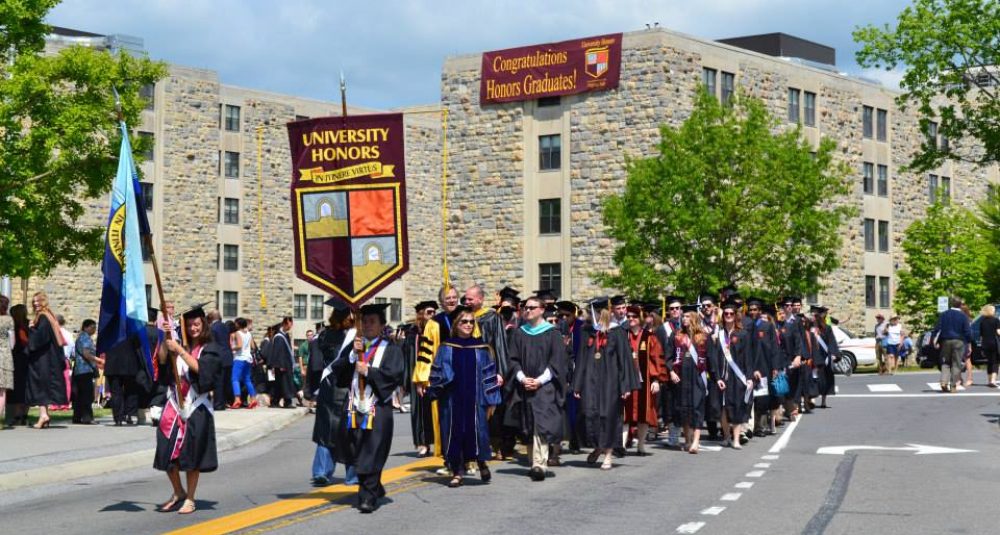
Honors Programs Plus Strong Merit Aid: Ohio State Honors

Editor’s Note:  This is the first post in a new, lengthy series that will highlight ten or more public university honors colleges and programs that are (1) excellent academically and (2) offer substantial merit aid either through the honors program or the university as a whole.

We begin the series with The Ohio State Honors And Scholars Program because it meets the criteria above and because we have been unable to review it in our two previous books. The program is coordinated by an honors team but delegates much of the course programming to major departments. The result is great for honors students but extremely difficult for us to measure for rating purposes.

The decentralized approach allows for the program to work with more than 5,000 students, making the program one of the largest in the nation.

Before a discussion of highly competitive merit awards for OSU students, it should be said that the University Honors Program is extremely selective despite its large enrollment. Our estimate of the average new SAT score for current students is 1470-1490, with an average ACT of 32-33. This equates to roughly the top 10% of OSU students.

While the university-wide six-year graduation rate is about 83%, the honors grad rate is about 91-92%. University Honors students can choose from 250-300 courses each term. More than a thousand first-year students enroll each fall. About 60% of first-year students (more than a thousand) choose among three main honors residence halls. Each residence has its own honor-related programming. Two of the residences are air-conditioned. The remainder of first-year honors students reside in other university residence halls, many of which have living/learning themes.

Merit Scholarships

The Honors Program coordinates the Eminence Fellowship, the most lucrative and prestigious award at the university. Eminence Fellows receive a “full ride” to OSU. In 2917, there were 17 fellows, all members of the honors program.

Given the high selectivity of the honors program, it is no surprise to find that fellows typically rank in the top three percent of their graduating classes and have an ACT composite score of 34 or higher or SAT combined Critical Reading and Math score of 1520 or higher.

Yet even impressive stats do not guarantee a fellowship. “Eminence Fellows demonstrate academic achievement, intellectual curiosity, high regard for humanity, and significant involvement both on and off campus.” Measuring factors such as a “high regard for humanity” is difficult, and so is the winnowing of fellowship applicants: more than 1,200 apply and only 17 fellowships were awarded in 2017.

On the other hand, the university awards about 300 Morrill Scholarships each year. The scholarships require both strong academic qualifications and characteristics that contribute to the diversity of the university.

Here, diversity means more than a racial or ethnic profile. The “targeted” students include not only ethnic and racial minorities but also first-generation, low-income, and Ohio Appalachian students. In addition, the awards may go to students whose gender is not typical of the major (e.g., women in engineering), or whose major is atypical but desirable (e.g., agriculture). Notably, Agriculture is one of the disciplines that offer many honors courses via the University Honors Program.

It is important to understand the three levels of Morrill awards:

Distinction equals the value of the cost of attendance for both Ohio residents and nonresidents, or a “full ride.” Only about 25 of the 300 Morrill awards are at the Distinction level. One hundred students are invited to interview for the 25 awards. Recipients likely need ACT 33 or new SAT ~1500 along with an extremely high class rank and achievements.

Prominence equals free tuition for out-of-state students.

Excellence: Equals the value of in-state tuition for Ohio residents.

The minimum stats for Prominence or Excellence awards are about 28 ACT or new SAT ~1320.

It is also possible to receive a Maximus Scholarship based mostly on stats and then be considered, usually later, for a Morrill or even Eminence award. The Maximus minimum stats requirement is high (top 3%, 32 ACT or 1450 new SAT) but not related to diversity goals as far as we can tell. The award approximates half the cost of in-state tuition, or about $5,000.

Finally, Provost and Trustees awards are $2,500 and $1,500 a year, respectively. The Provost minimum requirement is top 10%, 30 ACT, or new SAT of 1390. The minimum requirement for Trustees is top 20%, 29 ACT, or new SAT 1350 or higher.


Wyoming, Northern Arizona U to Greatly Expand Honors Colleges

Editor’s Note: The creation and expansion of honors colleges is a major development in higher education. Below are two examples, each from the university’s public information departments.

Aiming to recruit more high-achieving high school graduates and enrich its undergraduate experience, the University of Wyoming is taking initial steps to expand its Honors Program.

The concept of transitioning the existing Honors Program to an Honors College was favorably received by the UW Board of Trustees last week, and the university administration plans to present a full proposal to the board at its May meeting.

“Our Honors Program has a long and rich history, and we see tremendous opportunity to make it an even more vibrant and influential part of the university,” Provost Kate Miller says. “Transitioning to an Honors College would raise its profile, allowing us to attract, retain and add value to the experiences of some of our finest students and faculty at an even higher level than we do now.”

Among the plans are moving the Honors Program from its current location to the Guthrie House — former home of the UW Foundation — on the south end of the UW campus; changing the position of Honors Program director to Honors College dean; and expanding honors enrollment and programming.

Slightly more than 900 UW students are currently part of the Honors Program, which provides coursework, advising and scholarships for high-achieving students who commit to take certain courses, maintain a grade-point average of at least 3.25 and complete a senior capstone project. Students graduate with an honors minor in a variety of fields.

The proposal expected to go before the trustees in May calls for changing the honors minor to a concurrent major or part of a major in all fields of study; gradually expanding the Honors College faculty and staff to accommodate more students; and, in general, developing a curriculum that would better prepare students for professional or graduate school success.

“The competition for high-achieving high school graduates in Wyoming and the region is becoming more intense, and most of our competitors for these students now have honors colleges, which is a national trend,” Miller says. “We feel strongly that this would be beneficial for the entire university as well as the state.”

The UW Faculty Senate is considering the Honors College plan, which stems from multiple reviews of the Honors Program and a steering committee report completed in December.


The Arizona Board of Regents approved construction of Northern Arizona University’s Honors College Living and Learning Community at its meeting in Tucson last week.

The 204,656-square-foot building, which is going up at University Drive and Knoles Drive, includes bedrooms, classrooms, a student advising center and study areas. It is a state-of-the-art building designed to be a place where Honors College students can live, study, congregate and collaborate with others who are passionate about learning and creating. The project will cost more than $56 million.

“We are pleased to see an increasing number of top-performing students choose NAU, and programs like the Honors College play a major role in attracting and engaging these students,” President Rita Cheng said. “This facility is an example of our commitment to make NAU home for the region’s best and brightest.”

The Honors College is the oldest honors program in Arizona, and it continues to grow; enrollment increased by 24 percent for the 2016-2017 school year. NAU recently changed the Honors Program into an Honors College, allowing for greater recruitment and retention opportunities for the top talent in the state.

Participation in the Honors College allows undergraduate students to take specialized courses, including a capstone course, access the Honors Writing Center and do research. Establishing classes specifically for Honors students provides them the opportunity to break out of traditional classroom settings and mentor their peers.

Wolf Gumerman, director of the Honors College, said students are put on flexible and rigorous pathways to help them achieve their educational and career goals, offering access to research and a thesis, internships, faculty mentors and more.

“For high-achieving students, the benefits are amazing,” he said. “Our classes are smaller and more discussion-based, and the new curriculum is really driven by the students’ interests.”

Preliminary work to address infrastructure began in the fall, with construction beginning this summer. With the addition of the Honors community, which is scheduled to open in fall 2018, and SkyView, which opens this fall, NAU will add nearly 1,300 on-campus beds in less than 18 months, allowing the university to remain in the top 1 percent of universities nationwide providing on-campus housing.

“I am excited to see the Honors Residential College move forward and break ground next week,” said Rich Payne, executive director of Housing and Residence Life. “This facility will help NAU recruit and retain highly motivated scholars to the Honors College and provide a new high-profile home to students, dedicated faculty and staff where students will enjoy rich in and out of classroom activities and interactions in state-of-the-art surroundings.”

Southeast, West Coast Colleges: Top Public Values in Kiplinger Report

The Kiplinger Best Value College Index methodology emphasizes a “quality” side in relation to the “cost” side of a university. The quality side includes selectivity, retention, and four-year grad rates, while the cost side takes tuition, fees, merit aid, need-based aid, and post-graduation debt into account.

For the 16th straight year, UNC Chapel Hill leads as the best public value for both in-state and out-of-state (OOS) applicants.

The Southeast and Mid-Atlantic account for 10 of the top 25 best public value schools. West coast universities in the UC system along with the University of Washington account for another half dozen in the top 25.

In the middle, so to speak, are traditionally strong publics including Michigan, UW Madison, Illinois, UT Austin, Minnesota, and Ohio State.

Acceptance rates vary widely among the top value schools, from a low of 15 and 17 percent at UC Berkeley and UCLA respectively, to a high of 66 percent at Illinois.

Other publics with relative low acceptance rates include Michigan (26 percent); Cal Poly (31 percent); Georgia Tech (32 percent); UC Santa Barbara (33 percent); UC San Diego (34 percent); and UC Irvine and UT Austin (39 percent).

Below are the top 25 in-state public values, with the OOS ranking and Acceptance Rate listed as well.

University In State OOS Accept Rate
UNC Chapel Hill 1 1 30
Virginia 2 2 30
UC Berkeley 3 7 15
William and Mary 4 6 34
Michigan 5 13 26
UCLA 6 14 17
Florida 7 3 48
Maryland 8 10 45
Georgia Tech 9 15 32
Georgia 10 11 53
UW Madison 11 18 49
Washington 12 24 53
UT Austin 13 26 39
UC Santa Barbara 14 28 33
Binghamton 15 8 42
Illinois 16 20 66
UC San Diego 17 31 34
NC State 18 9 50
New College Florida 19 21 61
Minnesota 20 4 45
Cal Poly 21 17 31
Ohio State 22 19 49
UC Irvine 23 44 39
Clemson 24 29 51
Miami Ohio 25 33 65

Stamps Scholarships Are Only for Certain Colleges, and They Are not Need-Based

The Stamps Family Charitable Foundation partners with visionary colleges and universities to award multi-year scholarships that enable extraordinary educational experiences.

Scholars receive annual awards that range from $72,000 to $5,000 (four-year awards total an average of $288,000 – $20,000) with additional funds for enrichment activities such as study abroad, academic conferences, and leadership training. The Stamps Family Charitable Foundation and partner schools evenly share the costs of the awards.

The unique benefit that all Stamps Scholarships include is an enrichment fund, an additional monetary fund for Scholars to use in their academic and professional development. They may use the award to study or volunteer outside the United States, conduct research, or participate in a leadership program or academic conference. We like to think of this part of the award as the “dream fund.”

Where to Apply

Applying for a Stamps Scholarship is easy: just apply to one or more of our partner schools. If you qualify, you’ll automatically be considered for a Stamps award. The majority of our partner colleges and universities don’t require a separate application for the Stamps Scholarship, but the application deadline and award process varies from school to school along with the amount of the award. Expect an interview (or two or three) to be part of the process.

Visit the website of the school or schools of your choice to find out more about their unique application process and deadlines.

The Stamps Foundation, with its partner schools, seeks students who demonstrate academic merit, strong leadership potential, and exceptional character.  We support exceptional young people with promise and vision who are eager to make their contribution to the world and have the work ethic to make their dreams a reality.

Leadership development is at the core of the Stamps Scholarship program. Leadership potential is also a key part of the selection criteria for receiving a Stamps award. And, Stamps Scholars receive a separate financial award to participate in leadership activities of their choosing.

The Stamps Foundation welcomes and supports students from all backgrounds and areas of study. Financial need is not a consideration. At some of our partner schools, international students are eligible for the Stamps Scholarship. Students should check directly with the program that they are interested in to view eligibility requirements.

Stamps Scholarships are not transferable to other colleges or universities.

Selection Process

A student must apply directly to one or more of our partner schools to be considered for the Stamps Scholarship.

At certain schools, the Stamps Scholarship Program is part of an umbrella program for scholars, such as the Foundation Fellows at the University of Georgia or the Carolina Scholars at the University of South Carolina.

In many cases, students who apply by certain deadlines (often the early or ‘scholarship’ deadline) using the normal freshman application for admission will be automatically considered for the Stamps Scholarship.  In some cases, however, our partner school may request a separate application for consideration of the Stamps Scholarship.

Speak with an admissions counselor or visit the website of the school or schools of your choice to find out more about their unique application process and deadlines.

Colleges Offering Stamps Scholarships:

Barry
Caltech
Chicago
Connecticut
William and Mary
Dartmouth
Elizabethtown
Florida
Georgia Tech
LSU
Mercer
Miami Ohio
Morehouse
Oberlin
Purdue
Ohio St
Tulane
Air Force Academy
West Point
Naval Academy
UC Berkeley
UCLA
Illinois
Georgia
Maryland
Univ of Miami
Frost School of Music, Univ of Miami
Michigan
Mississippi
Missouri
Notre Dame
Oregon
Pitt
South Carolina
USC
UT Austin
Virginia, Darden School of Business
Virginia, Jefferson Scholars
Washington
Wisconsin
Virginia Tech
Virginia-Maryland Vet Medicine
Wake Forest
Washington Univ St. Louis


Univ of Arizona Honors College to Open New Center in 2019

Editor’s Note: The following item is from the University of Arizona.

Tucson, AZ – April 11, 2017 –The University of Arizona Honors College will be moving into new facilities that will enhance the student experience for The University of Arizona’s top students.

Development of the facilities, to be located on Mabel Avenue between Park Avenue and Santa Rita Avenue, is expected to be completed by 2019. They will include a four-story building that will support contemporary residential, academic, and administrative needs with cutting-edge technology, a new recreation center, and a parking garage. It will also be the first Residence Life facility to have both dining and housing options.

Innovative classrooms, community creative spaces, and more personal living areas will create a centralized space for Honors students, faculty, and staff. The hope is that the facilities will not only allow students a more challenging, beneficial academic experience, but provide greater co-curricular and community-building opportunities that are so important to a holistic student experience.

“The current Honors College facilities are spread across four buildings at disparate locations on campus,” Honors College Interim Dean, Elliott Cheu, says. “A new building will bring together the students, staff and faculty under one roof.”

The need for new facilities became a focus for the college when it began looking at ways to improve the Honors student experience. New visions for academics, engagement programs, and recruitment processes made it apparent that new facilities would be needed.

“We will be able to significantly increase the interaction and collaboration between students, staff and faculty that will greatly enhance the Honors experience,” Cheu says.

A sense of community has always been one of the strengths of the Honors College, and even though the building will not be completed until 2019, current students are excited for what it will bring.

“Right now, upperclassmen are somewhat disconnected from underclassmen. A central space will bring all Honors students together,” Madison Richards (Honors Class of ’18) says.

Even though she will graduate before the new Honors facilities are completed, Richards believes future Honors students will benefit from the new building.

If you have interest in learning more about the new vision for the college, you can visit https://www.honors.arizona.edu/honors-path-future.

PSU Schreyer Honors College Has New Dean

Dean Peggy Johnson

Penn State announced in late April that Peggy Johnson, a professor and former head of the Department of Civi and Environmental Engineering, has been named dean of Schreyer Honors College.

Johnson, who holds a doctoral degree in civil engineering from the University of Maryland, joined the Penn State faculty in 1996. Her work has focused on hydraulic engineering, bridge scour, resilient infrastructure, stream restoration, reliability analyses, and river mechanics according to the university website. She is heavily involved in her field, and has accumulated numerous honors over the course of her career —the most recent being the 2016 Hans Albert Einstein Award, presented by the American Society of Civil Engineers.

In 2006 Johnson was appointed department head of Penn State’s civil and environmental engineering program, a position she occupied for until going on sabbatical 2015. She returned in January 2016 to teach undergraduate and graduate-level engineering courses while remaining active in the world of engineering research, according to the university website.

Johnson will replace Kathy Bieschke, who served as interim dean of the college for almost 10 months after former dean Christian Brady stepped down as dean last spring.

Johnson was selected after a nearly year-long search conducted by the administration, and was one of four candidates to be evaluated in part by an interview that involved current Schreyer students.

“There are so many exciting possibilities associated with this position,” Johnson said in a statement. “The commitment of Penn State and the Schreyer Honors College to outstanding scholarly activity is clearly very strong. I am looking forward to working with an exceptional group of students and alumni, and collaborating with colleagues across the university to strengthen and advance an already strong reputation in honors education at Penn State.”

More than 1,800 students are currently enrolled in the Schreyer Honors College, which was founded in 1980 and renamed in 1997.

University Honors College at Pitt Appoints New Dean

Janine Faust | Staff Writer, Pitt

June 7, 2017

(Photo courtesy of Pitt)

Pitt announced researcher and medical doctor Brian A. Primack as the new dean of the University Honors College Monday.

Primack will succeed Edward Stricker as the third Bernice L. and Morton S. Lerner Chair and dean of the UHC, beginning July 1. Primack’s primary responsibilities as dean will be overseeing the financial and administrative operations of the UHC, which is currently in its 31st year.

Pitt provost and senior vice chancellor Patricia E. Beeson said in a press release that she believes Primack will be able to ensure the Honors College persists in being the intellectual core of the Pitt community.

“Under Dr. Primack’s leadership, I am confident that the University Honors College will continue to serve as the center of gravity for our most academically engaged and curious undergraduate students and as a hub of intellectual activity for our entire university community,” Beeson said. “His broad and inclusive vision is well-matched to our aspirations for the UHC and the University.”

Stricker, who has served as dean since 2011, will be returning to a teaching position in the Department of Neuroscience this fall as he first declared when he announced in June 2016 that he was planning to step down.

Students active in the UHC complained in 2012 that he had shifted UHC policies away from the emphasis that the first dean and founder of Pitt’s UHC, G. Alec Stewart, placed on intellectual curiosity. Students wrote a letter to Stricker expressing their concerns.

“For us, the promise of an institution that promotes intellectual curiosity as its core value is what made the choice to come to Pitt so easy,” the letter said. “Nonetheless, we are deeply concerned that the value of intellectual curiosity is being de-emphasized at the service of achievement-oriented principles.”

Stricker responded to complaints by claiming that the Honors College was not solely a vehicle for pure intellectual curiosity.

“[Intellectual curiosity] is incidental but true,” he told The Pitt News in November 2012. “I wouldn’t say it’s the only thing [the UHC] does or the most important.”

According to the position profile for the University Honors College dean, Primack’s other duties will include collaborating with the UHC community to develop and implement new plans, recruiting faculty from across the University to engage with students, and promoting the UHC to current and prospective students and families. The dean is also expected to teach at least one honors course each year.

Primack is a Pitt alumnus, having earned a Master of Science in clinical science in 2008 and a Ph.D. in translational science in 2011. Primack also practiced medicine at various medical centers including UPMC hospitals and the student health services centers at both Pitt and Carnegie Mellon.

During his time at the University, Primack has founded Pitt’s Center for Research on Media, Technology and Health in 2012 and earned numerous awards for his work. He is currently a professor of medicine, pediatrics and clinical and translational science and the Leo H. Criep Endowed Chair in Patient Care in Pitt’s School of Medicine. He is also an assistant vice chancellor for research on health and society in the School of Health Sciences.

Chancellor Patrick Gallagher praised Primack’s appointment in a press release Monday, stating that his diverse academic and professional experiences and dedication made him the right pick for the job.

“As dean, Brian’s multidisciplinary dexterity — coupled with his commitment to collaborating and leading — will ensure that our Honors College continues to serve as a defining force in our University’s mission to leverage new knowledge for society’s gain,” Gallagher said.

New Honors Deans at Univ of North Florida, TAMU-Kingsville

Dr. Jeff Chamberlain will be the inaugural dean of the newly created Hicks Honors College, starting in August.

The Hicks Honors College was a university program; however, the current Honors Director, Dr. Jeff Michelman helped elevate the program to a college. Michelman will return to the Coggin College of Business faculty as a professor.

Chamberlain served as the director of the Frederik Meijer Honors College at Grand Valley State University in Allendale, Michigan for the last 10 years. He also worked as a professor of history at the University of St. Francis in Joliet, Illinois. His interests include social, political, intellectual, and ecclesiastical history of Tudor/Stuart and Georgian England.

Dr. Chamberlain holds a Ph.D. from the University of Chicago.


Dr. Thomas M. Spencer has been selected as the sole finalist for the position of Dean for the Honors College at Texas A&M University-Kingsville. His appointment is pending approval from the Chancellor of the Texas A&M University System.Dr. Thomas Spencer

Spencer has served as the Director of Honors Student Affairs at Eastern Illinois University’s Sandra and Jack Pine Honors College since 2012. His duties there have included overseeing the day-to-day administrative matters for some 500 honors students; coordinating 24 departmental honors programs; and managing 190 scholarships worth approximately $1 million annually.

During his time at Eastern Illinois University, its Honors College’s share of the incoming freshman class increased to more than 12 percent for three straight academic years from 2014 to 2016. Spencer helped create and develop the Pine Honors College Housing Community in 2014. He has also been in charge of social media for the Pine Honors College since 2013, among other accomplishments.

Prior to his time at Eastern Illinois University, Spencer was Director of the Honors Program at Northwest Missouri State University and a tenured Professor of History. He oversaw the Honors Program there from 2008 to 2012, and was a faculty member from 1997 to 2012.  His scholarship includes the publication of three books and several articles.

Spencer is active in the National Collegiate Honors Council (NCHC) and has made a number of presentations as well as led workshops for Honors administrators at the NCHC Annual Meeting. He served on the NCHC External Relations Committee from 2010 to 2013 and currently serves on the NCHC Teaching & Learning Committee.

Spencer received a Ph.D. in History from Indiana University, Bloomington; an M.A. in History from the University of Missouri-Columbia; and a B.A. in History from Trinity University, San Antonio.

Appalachian St Honors College Names Dr. Jeff Vahlbusch New Dean

BOONE, N.C.—After an extensive national search, Dr. Jefford Vahlbusch has accepted the position of dean of The Honors College at Appalachian State University effective July 17. Dr. Vahlbusch comes to Appalachian from the University of Wisconsin – Eau Claire, where he currently serves as the Director of the University Honors Program.

“Dr. Vahlbusch demonstrated measurable successes in catalyzing the honors program at the University of Wisconsin – Eau Claire,” Provost Darrell Kruger said of the new dean. “Over the course of his term there, he built a thriving and diverse program dedicated to intellectual, personal, and professional growth of the students. We are very pleased to have such a qualified and experienced leader join our faculty.”

Vahlbusch is charged with providing a vision and strategic direction for The Honors College and will act as an advocate and leader for honors education across the campus and beyond.

During his nearly eight years as director of the honors program at the University of Wisconsin-Eau Claire, the number of students in the program and the number of honors courses offered more than doubled, and the enrolled students of color increased from 2.51 percent to 11.57 percent.

Vahlbusch earned his Ph.D. in Germanic languages and literatures, his master’s in German literature and philology, and his bachelor’s in German and English literature from the University of Michigan in ’98 ’82 and ’79, respectively.

He has taught at Berea College, Berea, Kentucky; Washington College; Chestertown, Maryland; Miami University, Oxford, Ohio; and University of Michigan, Ann Arbor. He was a lecturer at Johannes Gutenberg–Universität, Mainz, Germany.

About The Honors College
More than 750 students are enrolled in Appalachian’s Honors College, which attracts high-achieving students who are in the top 5 to 10 percent of their graduating high school class. The program develops independent and creative thinking, promotes open and provocative discussion, and nurtures a cultured and caring exchange of ideas. The college’s enhanced academic experience prepares students for leadership roles in their career as well as for graduate or professional school.

About Appalachian State University
Appalachian State University, in North Carolina’s Blue Ridge Mountains, prepares students to lead purposeful lives as global citizens who understand and engage their responsibilities in creating a sustainable future for all. The transformational Appalachian experience promotes a spirit of inclusion that brings people together in inspiring ways to acquire and create knowledge, to grow holistically, to act with passion and determination, and embrace diversity and difference. As one of 17 campuses in the University of North Carolina system, Appalachian enrolls about 18,000 students, has a low student-to-faculty ratio and offers more than 150 undergraduate and graduate majors.

Georgia St Honors College Gets $200k Grant for Human Rights Initiative

ATLANTA—The Georgia State University Honors College will endow the Herndon Human Rights Initiative with a $200,000 grant from the Rich Foundation.

The initiative will use teaching and research on the Herndon legacy to enhance community understanding of historical and modern-day human rights issues.

Born into slavery in 1858, Alonzo F. Herndon imagined a better life and worked tirelessly to build it. He achieved business success unprecedented in his day, first as a barber and later as founder and president of Atlanta Life Insurance Company. His only son, Norris, committed financial resources to the student-led Committee on the Appeal for Human Rights in Atlanta and the modern civil rights movement in general. Herndon’s contributions were critical, yet quiet and behind the scenes.

More than 150 years after Alonzo Herndon’s birth – and 90 years after the formation of the Atlanta Life Insurance Company – the Honors College occupies the company’s former home at 100 Auburn Ave. The Honors College is committed to educating its students and surrounding community about Alonzo and Norris Herndon’s lives, their values and character, and their role in the modern Civil Rights Movement.

The Herndon Human Rights Initiative focuses on four major components:

  • Herndon Human Rights course
  • Digital mapping project
  • Lecture series
  • Student scholarships

“The Georgia State University Honors College is making a difference in our community thanks to the generous and continuing support of the Rich Foundation trustees,” said Larry Berman, founding dean of the Honors College. “Their decision to endow in perpetuity the Herndon Human Rights Initiative will allow generations of young Honors College students to make a difference in the human rights challenges of the present and future.”