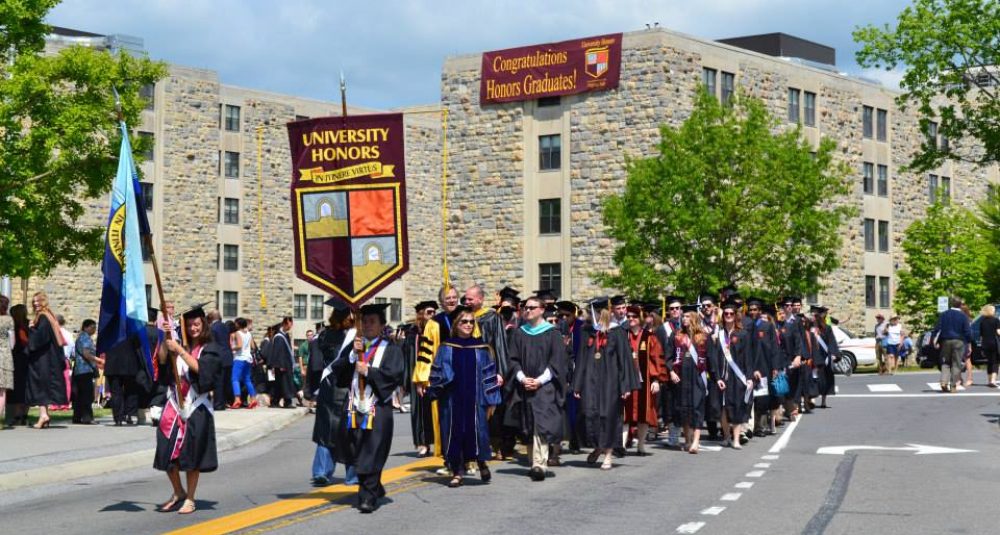
The New College of Florida, located in Sarasota, is the official public liberal arts college for the state, and with only about 800 undergraduates enrolled, the entire campus functions in much the same way as a relatively small honors program at a larger university.
New College is not, strictly speaking, an honors college. But with an estimated average SAT in the 2000 range and average GPA of about 3.75, it is as selective as many major research university honors colleges and programs, and the curriculum and extremely flexible options appear to have some of the same elements as Echols Scholars enjoy at the University of Virgina along with tutorial choices that are similar to Ohio University’s Honors Tutorial College.
Like Echols scholars, all students at New College can create their own, individual curriculum, with a choice of forty majors and additional choices for double concentrations. Classes are with very small–about 12 students–or one on one, in the tutorial format that is associated with Ohio U.
And there’s one other thing you should know about New College: there are no grades.
Students receive lengthy and detailed narrative evaluations of their performance in course work and tutorials. Does this hurt New College students when they apply to graduate and professional schools?
The answer appears to be no. “About 80 percent of New College alumni go on to graduate school within six years of graduating,” the college reports. “For the 2010 graduating class, 86 percent of graduates who applied to a Ph.D. program were accepted, and 100 percent who applied to law school got in! It’s no wonder that The Wall Street Journal ranked New College the nation’s no. 2 public feeder school for elite law, medical and business schools.”
Another key feature of New College is that Kiplinger’s Best Values in Public Colleges ranks New College at number 5 as an in-state public college value, and at number 19 as an out-of-state value.
One thing that students should consider is very small size of the college. On the plus side, there is the flexibility, the individual instruction, the research opportunities, and excellent options for studying abroad, especially in language-related study. New College students have an extraordinarily high rate of success in attaining Fulbright Student Fellowships, to go with the excellent prospects for placement in graduate and professional schools.
But on the other side of the ledger, the small campus is also like a very small town, and some small towns can seem confining. One factor that may offset the small size is that about 80 percent of students live on campus.
“New College’s Pei Campus is the center of residential life, the college says, “with eight out of a total of nine residence halls located there. Along with the dorms, Hamilton ‘Ham’ Center, Palm Court, the Fitness Center and other recreational facilities form a student village where academics and campus life seamlessly intertwine and ‘learning occurs around the clock.'”
“Designed by internationally-renowned architect I.M. Pei, New College’s Pei Residence Halls opened in 1965 and accommodate more than 250 students in double and triple-occupancy rooms, each with its own private bathroom. Community spaces and laundry rooms in the Pei buildings are located in each of the three quads, and the outdoor Palm Court around which the rooms are grouped is a focus of New College student life. Pei rooms are spacious, measuring approximately 15′ x 15.’
“All of the rooms have recently, and some feature covered porches or large balconies, providing additional living space. The clustered construction, communal spaces and orientation around Palm Court affords Pei residents a strong sense of community.”
Dining options include the student-run Four Winds Cafe, located on the Bayfront section of campus, a market cafe with sandwiches and traditional entrees, and a deli.
And we shouldn’t neglect to mention the nearby beaches.
“Lido Key offers quiet North Lido Beach, the popular Lido Beach with parking and restrooms, and South Lido Beach, which has BBQ grills and picnic tables under Australian Pines. Boutique stores and restaurants can be found on St. Armands Circle.
“Siesta Key Beach, named America’s #1 beach and known for its powdery white sand, has volleyball nets, tennis courts and picnic area. Every Sunday at sunset there’s a drum circle. Siesta Village offers restaurants and nightlife. Turtle Beach, on the southern end of the island, is quieter with coarser sand and beach dunes.
“Or head up north to Anna Maria Island for a change of scenery. There are many restaurants and funky shops along the beautiful beaches. Check out the island’s annual Bayfest, too.”
Editor’s Note: There is a full, updated profile and detailed rating of Macaulay Honors College in our book, INSIDE HONORS. You can see a list of the highest rated honors programs here.
Students who are residents of New York State have the unique opportunity of qualifying for free tuition and other benefits at the Macaulay Honors College, which is affiliated with eight senior colleges of the City University of New York. Admission to Macaulay for state residents not only makes them Macaulay Scholars with free tuition but also presents to them the Big Apple in all its fascinating dimensions.
Out-of-state students who meet CUNY New York State residency requirements can also receive the full tuition scholarship. And for those who do not qualify for the free tuition support, CUNY provides one of the best values in higher education. In addition, the student will receive all of the enhanced benefits of a Macaulay education.
Macaulay students study at the following CUNY campuses: Baruch College, Brooklyn College, City College, Hunter College, John Jay College, Lehman College, Queens College, and the College of Staten Island (CSI). There are special honors housing packages at City College and Hunter College. All the other colleges have residence options. Macaulay Honors College is housed in an elegant, renovated brownstone located in the Upper West Side, near Central Park and the Lincoln Center for the Performing Arts.
In addition to free tuition, Macaulay students receive a $7,500 Opportunities Fund “to pursue global learning, internships, and other service and learning opportunities”; a MacBook Pro laptop; a “Cultural Passport” that permits free or discounted admission to arts, cultural, and educational institutions across the city; and specialized advising through the Macaulay Advising Program (MAP).
The laptops are an integral part of Macaulay’s plan to enable students to participate in social and academic programs at campuses other than their home campuses and to prepare and present e-portfolios of their college work, with the help of Instruction Technology Fellows (ITF’s) assigned to each of the honors seminars. “ITFs are CUNY doctoral students in a wide range of academic disciplines, carefully selected for their familiarity and experience using technology both in the classroom and in research,” according to the Macaulay site.
Admission to Macaulay is selective, with an average SAT score of 1410 and grade average of 93.9. In addition, co-curricular activities, essays, and letters of recommendation are required. The acceptance rate was 29% for the Class of 2016; approximately 540 freshmen will be entering Fall 2013.
The honors curriculum for the first two years is focused on the city of New York itself:
“Seminar 1 introduces Macaulay Scholars to the arts in New York City and the Cultural Passport. During the semester, students attend theatrical, operatic, and musical performances, exhibitions of visual art, and other highlights of the current cultural season, and help to create the annual “Snapshot of New York City” exhibition.”
“During Seminar 2, Macaulay Scholars investigate the role of immigration and migration in shaping New York City’s identity–past, present, and future. Visits to archives, interviews, mapping and walking tours allow students to create the collaborative Neighborhood Websites, presenting their research through audio, video, photography, and other media.”
“In Seminar 3, Macaulay Scholars analyze issues in science and technology that have an impact on contemporary New York. Students work together to create scientific posters and presentations for a Macaulay-wide conference of their peers and others in the Macaulay community.”
“The purpose of Seminar 4 is to analyze the ongoing interplay of social, economic, and political forces that shape the physical form and social dynamics of New York City. Throughout the semester, students engage in a team research project, sometimes including Public Service Announcement Videos, to be presented at a model academic conference.”
Macaulay’s upper-level seminars encourage students to integrate course work and their own primary research, in a richly collaborative and supportive interdisciplinary setting. Recent topics include Sexuality and American Culture, Imagining the End of the World, The Future of Education, Religion and Public Policy, and Women and Global Public Policy Since the 1960s.
As for off-campus opportunities in New York City, Macaulay students benefit from special access to network with New York’s most dynamic firms.
“Macaulay students often use some of their $7,500 Opportunities Fund to develop customized programs that enable them to explore different professional paths, or to gain additional hands-on experience in fields they wish to pursue in graduate school or professionally after college.”
Examples of recent internships are New York Life, HBO, The New York Historical Society, The Earth Institute Center for Environmental Sustainability (EICES), NYU Langone Medical Center, BBC Worldwide Americas, The New York State Office of the Attorney General, US Trust, Free Arts NYC, The Department of Consumer Affairs (DCA), and Northwestern Mutual.
Over 90% of Macaulay students intend to study abroad. Again, they can use their Opportunities Fund, outside fellowships, and additional resources CUNY makes available to them to pursue a wide range of semester and year-long study abroad programs, at universities around the globe.
Students might analyze marine life in the Galapagos, study drama at Trinity College of Dublin, learn Arabic at Bosphorus University in Istanbul, or study mathematics at the City University of Hong Kong.
Other examples of recent study-abroad locations are the following: Argentina, Australia, Austria, Barbados, Brazil, China, Chile, Costa Rica, Cuba, Czech Republic, Denmark, Ecuador, Egypt, England, France, Germany, Greece, Guatemala, Ireland, Israel, Italy, Japan, Korea, Lithuania, Morocco, Netherlands, Puerto Rico, Russia, Singapore, South Africa, Spain, and Turkey. Macaulay students have studied on every continent with the exception of Antarctica.
Macaulay graduate, David L.B. Bauer of City College, became something of an undergraduate “brainiac” celebrity, who chose Macaulay over the Ivies after he won the Intel Science Talent Search as a high school student in 2005. A winner of Goldwater, Rhodes and Truman Scholarships while at Macaulay, Bauer focused on research in clinical medicine at the Wellcome Trust Centre for Human Genetics (WTCHG) at the University of Oxford, where he worked during his junior year at CCNY. Bauer is currently a DPhil candidate in clinical medicine at Oxford.
A second Rhodes scholarship was awarded to a Macaulay student in October, 2011 to Zujaja Tauqeer (Macaulay and Brooklyn College ’11). Zujaja, who graduated with a BA/MD, is studying the history of medicine in a two-year program at Oxford.
Public universities are increasingly subject to productivity measures as a means of justifying continuing revenue support, such as it is, from the states. One such measure is “credit hour productivity,” which represents the ratio of total student credit hours taught per faculty member.
For example, a faculty member who teaches large lecture classes will receive “credit” for teaching hundreds of student hours, while some faculty who teach small honors seminars may receive credit for hours earned by, say, 15 students. In many public universities, funding for departments and even larger divisions is based in part on the total number of credit hours that are taught.
Sometimes, credit hour productivity is also a factor in tenure and promotion evaluations, providing yet another source of pressure to apply the productivity model to instruction.
Unfortunately, this model is inimical to what is probably the strongest feature of honors education: small, interactive classes, similar to those at the best liberal arts colleges and elite private institutions.
Therefore, a big challenge for many honors directors is to find a way to persuade deans and department chairs to utilize weighted systems as a way of giving approximate productivity credit to faculty for teaching honors classes.
Many research institutions already weight their systems so that faculty who teach graduate courses, which typically feature small, seminar-sized classes, receive augmented credit for teaching the courses, based in part on the time and supervision required when working with advanced students who are engaged in research and in-depth writing or laboratory assignments.
Alternatively, some universities give the same productivity credit for teaching lower-division honors courses as they do for teaching upper-division courses, and also give the same credit for teaching upper-division honors as they do for teaching graduate courses.
In the end, the decision to use productivity weighting comes down to the willingness of the institution to acknowledge the value-added impact of honors programs to the university as a whole–and then reward that value by implementing sufficient productivity credits to induce faculty and departments to participate fully in honors education.
The absence of such support is, sadly, evidence that the students who choose a university because of the honors program are far more subject to the mass production model in higher education than they would ever expect to be.
In a broader sense, the inadequate support gives many critics of public universities, who often disparage research and excellence in the interest of this very same productivity, yet another victory on their way to reducing the quality and influence of public universities.
The University of Oklahoma at Norman is well-known for the generosity it shows to National Merit Finalists and other applicants of exceptional ability, and the McClendon Honors College at the university appears to be as generous while offering enhanced living and learning opportunities as well.
Although the honors program at OU goes back to 1962, a series of reorganizations that resulted in the Honors College did not occur until 1997. We estimate that the college now enrolls approximately 2,000 students, placing it in the category of “large” programs with enrollments greater than 1,800.
The college requires a minimum SAT of 1330 or a score of 30 on the ACT, along with a GPA of at least 3.75 or a high school class rank in the top 10 percent. Freshman applicants must also submit a 400-500 word essay. Transfer students and those with more than 15 hours of credits at OU may apply if they have a college GPA of at least 3.40.
The honors college is unusual because of the extent of financial grants that it can bestow on especially talented students. Among the scholarships available (even to out-of-state students) through the OU Scholars office are the Award of Excellence Scholarship and the Regents Scholarship, each of which provides a tuition waiver of $2,500 per semester, up to eight semesters, for a total value of $20,000. The awards also provide up to $1,250 for summmer school tuition.
The Honor Scholars awards provide tuition waivers of $1,750 per semester for eight semesters, for a total value of $14,000. University Scholars can receive a $2,500 tuition waiver for one year.
As for non-resident National Merit Finalists, the term “free ride” comes to mind. Here is what OU offers:
“The following scholarship package is guaranteed to every non-resident National Merit Finalist who names OU as his/her college of first choice with the National Merit Scholarship Corporation:
“Oklahoma Academic Scholars Programs $22,000
$2,750 per semester/$5,500 per year for four years to help offset the costs of fees, books, room & board
Funded by the Oklahoma State Regents for Higher Education
Funds will be deposited into billing account
Can be used toward any graduate/professional program at OU if funds remain after completion of undergraduate degree
Must maintain a 3.25 cumulative GPA and be enrolled full-time
“Non-Resident Tuition Waiver (estimated) $55,000
Waives 100% of non-resident tuition
May be used for five years (fall, spring and summer)
Can be used toward any graduate/professional program at OU if funds remain after completion of undergraduate degree
Must maintain a 2.8 cumulative GPA and be enrolled full-time
“Resident Tuition Waiver $10,000
$1,000 each fall and spring semester/$2,000 per year for five years
Can be used toward any graduate/professional program at OU if funds remain after completion of undergraduate degree
Must maintain a 2.8 cumulative GPA and be enrolled full-time
National Merit Cash Stipend $5,000
But once the dollars stop swirling about our heads, the honors college itself has many advantages. The curriculum requires about 25 hours of honors credit, including a thesis. Honors students can choose to live in Boren Hall, where many honors classes are also held and where the honors college offices are housed. Honors classes are generally limited to 22 students or less.
Boren Hall is a traditional double-room, corridor bath dorm, a part of Cate Center, which also has dining facilities. Honors students may also choose to live in the Global Community, in Couch Center; in the National Merit residence in Walker Center; or in the Scholastic, Quiet Lifestyle, Co-ed Upperclass halls. All but Boren appear to be suite-style.
In the most recent issue of the Chronicle of Higher Education, philanthropist Bill Gates says that even though education “has not been substantially changed by the internet” thus far, the future is likely to bring fundamental shifts toward online instruction.
Gates advocates greater use of hybrid courses, defined by the Chronicle as those “in which students watch videos from superstar professors as ‘homework’ and use class time for group projects and other interactive activities.”
Even if such an approach might be effective for some colleges or programs, what applicability might online classes have for honors programs, which emphasize the interactions of students and professors in small classes? Should honors programs be on the cutting edge of integrating online learning with instruction in relatively small classes?
But, if so, how would the effectiveness of such honors experiments be assessed? Gates acknowledges (and laments) that there is a lack of evidence showing “where…technology is the best and where face-to-face is the best.” One big problem, he told the Chronicle, is that higher education “is a field without a kind of clear metric that you can experiment [with] and see if you’re still continuing to achieve [increased learning].
“You’d think people would say, ‘We take people with low SATs and make them really good lawyers.’ Instead they say, ‘We take people with very high SATs and we don’t really know what we create, but at least they’re smart when they show up here, so maybe they still are when we’re done with them.’”
Clearly, “maybe” is not good enough for Gates and other reformers. Here it seems that public university honors programs can help in developing curricula that improve measurable skills and that facilitate the transfer of those improvements to the larger university population, including some students who do not have “very high SAT’s.”
Honors curricula are recognized as being highly effective in developing and improving critical thinking and writing skills, both of which are emphasized by the Collegiate Learning Assessment (CLA) tests used by some colleges to measure improvement in important skills between the freshmen and senior years. (The Gates Foundation has connections with the Council on Assistance to Education (CAE), which develops CLA testing.)
Another advantage of honors programs is that the course work and activities of honors students are never entirely segregated from the larger university and inevitably have an impact beyond honors. Therefore, honors programs are and have been a natural vehicle for the transfer of enhanced instruction to the larger university.
A key element in this process would be the assessment of non-honors students who have frequent classes or projects with honors students in order to understand how the interaction is beneficial. The next, and much more difficult, step would be to determine what parts of the process could be used with similar effectiveness in a hybrid context.
The hybrid model that Gates is exploring can sound a bit like the communication and training structure of an international high-tech company: we watch the CEO in a series of online videos; we note his insights and instructions; and we meet and discuss the ways in which they might be developed, used, and enhanced. Then we are graded according to our progress.
But given the hard choices by some public universities, the use of more online instruction might make the advantages of an honors education more readily transferable to the larger university if online lectures and instruction were incorporated into the curriculum, provided that at least some of the assumed cost savings could then be used to fund more frequent small-group discussions and projects.
The founder of Microsoft also believes that many students are marking time in school because “if you’re trying to get through in the appropriate amount of time, you’ll find yourself constantly not able to get yourself into various required courses.”
The Chronicle asked Gates if, in response to this problem, he might “create pressure to make universities into a kind of job-training area without that citizenship focus of that broad liberal arts degree.”
“But I’m the biggest believer in taking a lot of different things,” he said. “And so, yes, it’s important to distinguish when people are taking extra courses that broaden them as a citizen and that would be considered a plus versus they’re just marking time because they’re being held up because the capacity doesn’t exist in the system to let them do what they want to do. If you go through the student survey data, it’s mostly the latter.”
Whatever effect online instruction may have on university curricula, Gates says that “…obviously, anything that has to do with the universities is going to be figured out by people who have worked in universities, and it’s going to be piloted in universities.”
And in that effort, honors learning innovations could lead the way.
On June 29, both houses of Congress passed a bill to extend federal transportation funding and to continue student loan interest rates at the current level of 3.4 percent, but most media reporting all but ignored the student loan story, and outlets that did cover it did not inform the public about a disturbing downside of the bill.
A notable exception was NPR, which on Saturday brought home the truth of the matter. The report by Claudio Sanchez led with these words: “The House passed a bill Friday to keep the interest rate on government-backed student loans from doubling. It’s a victory for students, but other compromises by Congress could cost them a lot more in the long run.”
This is what is known in the trade as a great lead to a story.
That aside, the facts of the story reveal that to continue the student loan rate at the current level of 3.4 percent, Congress in fact cut or restricted student financial aid in other areas–to the tune of $4.6 billion. In return, the average student borrower will save about $1,000 a year versus what they would have paid if Congress had enacted the 6.8 percent interest rate.
“The total cost to students, according to some estimates, is $18-20 billion extra over the next 10 years,” according to NPR.
Students will now lose the six-month grace period after graduation and be required to begin loan payments immediately after graduation. Graduate students will have to begin paying the interest on their loans while they are still in school.
According to Joel Packer, executive director of the Committee for Education Funding, the bill now has limits on the number of semesters during which needy students can receive Pell grants and makes it more difficult to receive the maximum amount.
Getachew Kassa, legislative director of the U.S. Student Association, told NPR that “in the past year, we’ve had deals where students have basically been robbed. I think the real question to ask is, at what point is this going to stop? Because sooner or later, you take a little bit here, a little bit there — you have nothing else to take away from.”
With tuition continuing to rise at public colleges and universities across the country in order to compensate for the decline in state funding, one group advocating reform seems more interested in fulfilling an ideological agenda than in actually working to find reasonable solutions to the problem.
Public universities can learn a great deal from the business community about how to focus on performance and efficiency, and initiate sensible, beneficial changes. Often, however, media pundits and some academicians co-opt the practical, commonsense arguments and add their own radical ideological twist.
In a recent article in the highly respected Governing magazine (“Public Universities Reach a Tipping Point”), Peter Harkness writes that the “higher education system’s vocal critics are increasing, particularly among conservatives. Political commentator Pat Buchanan is probably the most blunt: Higher education, he asserts, is ‘one of the biggest rackets going today.’
“The academic underpinnings for that critical view come most prominently from Richard Vedder, Harkness continues, “a self-described ‘dyed-in-the-wool conservative’ who is a retired economics professor from Ohio University and director of the Center for College Affordability and Productivity. His message is that state support for higher education is falling fast, so the schools are being forced to privatize, which is a good thing. ‘I’m increasingly thinking the government should get out of the business of higher education,’ he has said…”
In fact, Vedder has been thinking this way for many years. He is an influential critic of public universities, with frequent contributions to the Wall Street Journal and Forbes. He has been a principal force in the annual Forbes’ “America’s Top Colleges” rankings, notable for their preference for private institutions and their emphasis on postgraduate salaries as a strong indicator of quality.
Vedder is also a proponent of the Austrian School of Economics, which, at least in its American manifestations, argues that market forces rule and that government has no business in…well, business, or in just about anything else. This is all well and good, as far as individual views go, but the point here is that the position advocated by Vedder, Pat Buchanan, and others is narrow and ideological in the extreme, to the point where not only the decline but the death of many public universities can be dismissed with a shrug.
On January 12 of this year, Vedder concluded one of his regular pieces for Forbes with these words: “like the market-driven private sector, higher education will face something rarely seen in the past: the creation of obvious winners and losers, with the latter group of schools facing, in many cases, extinction.”
The statement encapsulates the ability of ideological critics to use the language of business while embracing radical solutions. Yes, in business there are “winners and losers” and many business suffer “extinction.” But many in the business community, especially in Texas where Vedder’s attacks on UT Austin and Texas A&M have brought educators and business leaders together in support of the universities, are pragmatic and concerned enough to see that the Darwinian demise of a large number of public universities is not good for the state, the nation–or for business.
And, while failed business are often replaced fairly quickly by new ventures, the same process is unlikely for universities, leaving many fewer to choose from and fewer students able to afford the ones that remain.
(Full disclosure: I am an alumnus of UT Austin.)
Vedder has repeatedly cited the University of Virginia as an institution headed for privatization. And it is true that UVA only receives about 7 percent of its funding from the state and is raising $3 billion in private donations. The UVA student body now resembles those of the Ivy League more than it does those of other public universities, with only 8 percent of students coming from low-income families, versus 20 percent in other Virginia universities.
In an article by Julie Davis Bell for the National Conference of State Legislators, UVA economist David Breneman, a specialist in the economics of education, said that some highly selective and well-funded schools can survive by going the privatization route whole other schools less fortunate have little to gain and a great deal to lose. “The blunt fact,” he said, “is that there are many more of the latter than the former.”
One example of where Vedder’s ideology might lead can be found in the private, for-profit schools that he so frequently promotes. In a March post on the friendly site Mindingthecampus.com about a new report on the concerns of university leaders, he wrote that to him “the most interesting finding is that public and private schools have somewhat different top-level issues they ponder, and that the for-profit schools are clearly more student-centered in their concerns than the not-for-profits, a marked contrast to what to some is conventional wisdom.” [Emphasis in original.]
It is true that the for-profit schools are now doing a better job of retaining students through the first year and of seeing students complete short degree or certificate programs. But when it comes to four-year degrees, the outcome is very different.
At about the same time Vedder was writing his article on “extinction,” the National Center for Education Research found that “a sample of students enrolling at for-profit colleges in 2004 were making, on average, between $1,800 to $2,000 less annually than students attending other types of institutions. Six years after entering college, for-profit students are also more likely to be unemployed — and to be unemployed for periods longer than three months.”
The report also found that students at for-profit schools default at a much higher rate: 26 percent with loans of $5,000–$10,000 in student loans defaulted. At community colleges, the rate was 10 percent and at four-year schools it was 7 percent. Students at for-profit schools with loans of $10,000–$20,000 in loans defaulted at a rate of 16 percent, compared to 3 percent at community colleges and 2 percent at four-year colleges.
As a radical solution, some might like these outcomes, so long as the ideology can be served. But for business and university leaders seeking practical solutions, it doesn’t look so good.
The well-known Kiplinger Best Value Report gives us one measure of how our universities compare when it comes to delivering a college education at a cost that has strong value in relation to the quality of the school. The Kiplinger Report looks at cost from the perspective of net student expenses for tuition, fees, etc. The Report is very useful in that respect. The Report appears to track other national rankings when it comes to the quality side of the equation.
But many visitors to this site want to know whether outstanding public universities can really compete with the private elites, especially the Ivy League schools. So we will offer a comparison that uses as a measure of quality the two most prominent postgraduate fellowships, in terms of the total numbers awarded: the National Science Foundation (NSF) Graduate Research Fellowship Program grants and the Fulbright Student Fellowship grants. The measure of cost we will use is the amount expended by the universities for each degree granted. We are emphasizing quality and efficiency, rather than quality and consumer expense.
(Summary and Statistics Are at End of Post)
The NSF grants go to more that 2,000 students each year, and about 1,600 students receive the Fulbright grants annually. These awards give us the largest statistical sample that illustrates how institutions public and private compare in at least this one measure of quality. While private elite universities dominate many of the awards given out by private foundations and trusts (Rhodes, Marshall, Gates/Cambridge), the NSF and Fulbright awards, in addition to being far more numerous, must adhere to federal guidelines that reinforce the need for transparency and objectivity.
It is difficult to say exactly how much the best honors programs contribute to excellence within their host universities, but we do know that honors students, as a group, bring the highest test scores and GPAs to their schools, energize honors and non-honors classes, and enhance the reputations of their universities. We also know that honors students benefit greatly from smaller class size and more faculty contact, both key elements in the success of private elites.
After following 50 leading honors programs for many months, we also see that students who are in university-wide honors programs or departmental honors are also those that compete the best for prestigious undergraduate and postgraduate scholarships, which often are seen as a measure of quality.
(We must note that we have included UC Berkeley in the lists below, although UC Berkeley does not, strictly speaking, have a university-wide honors program. The university takes the position that excellence is pervasive on the campus, just as it is in many private elites. Few would argue the point, and certainly we would not.)
The data we use for the cost per degree, by institution, is from the Chronicle of Higher Education. The average cost per degree is for all degrees awarded, undergraduate and graduate, and does not include expenditures for research.
The data for the fellowships comes directly from the National Science Foundation and the Fulbright U.S. Student Program. We selected the 13 public universities that earned the most NSF and Fulbright grants, respectively, and compared them to all eight Ivy League universities along with other private elites that earned the most grants. As a group, these few universities earned almost 40% of all the NSF grants during the two years of 2011 and 2012, and a similarly high percentage of Fulbright grants in 2010 and 2011.
Summary: Students from the public universities earned 778 NSF grants during the two years, and students from the private elites won 723. Out of the total awards to the 26 schools, the public universities earned 51.8% and the private elites won 48.2%. The average institutional cost per degree granted for the public universities in this group is $102,947. The average institutional cost per degree granted for the private universities in this group is $324,505.
Students from the public universities earned 418 Fulbright Student grants during the two years, while students from the private elites won 489 awards. Out of the total awards to the 26 schools, the public universities won 46.1% and the private universities won 53.9%. The average institutional cost per degree granted for the public universities in this group is $108,537. The average institutional cost per degree granted for the private universities is $262,201.
As striking as these comparison are, some of the public universities that have achieved such a high degree of excellence at relatively low cost are the very schools that have been the focus of “reformers” who are bent on focusing on cost savings at the expense of quality. For example, these critics/reformers might say that a cost per degree of approximately $105,600 is outrageous given that the average cost per degree nationwide for four-year public universities is $68,617. And we agree that it is important for students to have access to an inexpensive college education.
But the point here is that, within the broad range of public universities, there must be room for excellence, and excellence does not come cheaply, even if it does come at a relatively low cost at our leading public universities. (In fact, a very few high-performing public universities do come close to or even beat the average cost of $68,617, but they do so mainly by economies of scale in combination with lower regional labor costs.)
Rather than expecting outstanding public universities to achieve impressive results while spending no more than the average that is spent for all state universities, regardless of quality, we should compare the best public universities to the best private universities in order to find a more realistic assessment of their qualitative return on the public investment.
Beneath the data: The much higher expenditures per degree for the private universities are partly a function of their providing a very low student to faculty ratio university-wide, resulting in a high percentage of small classes. All of the private elites have undergraduate enrollments that are much larger than any of the honors programs within the public universities listed below. So a lot of the high cost per degree granted comes from providing small classes to 4,000–8,000 students, or even 14,000 in the case of Cornell.
The average size of the 50 honors programs that we follow is approximately 1,800 students, and they, too, offer small classes. This feature of honors education is great equalizer, and it must be achieved at the same time that the universities are providing a solid education for their typically quite large total undergraduate populations (average of about 25,000 in our group). The honors programs at their best provide smaller versions of the private elite experience for the students fortunate enough to join them.
Another factor is that the institutional costs per degree granted, as shown below in detail, apply to the university as a whole. If the costs were broken down separately for honors students in the public universities, those costs per honors degree granted would rise; however, not all awards are won by honors students, and the extra costs for honors housing, programming, and faculty are already included in the overall costs. Nevertheless, the differences in costs between the private elites and the public elites are not quite as dramatic as the average figures suggest, but the differences still remain very large.
Still another consideration is that the costs per degree are subject to regional cost of living influences. Part of the high cost of public and private universities operating on the East and West coasts, and in parts of the upper Midwest, are affected by the higher cost of living and the greater prevalence of collective bargaining practices. These factors are present especially near the major cities of New York, Boston, Philadelphia, Los Angeles, Seattle, and Detroit.
Another matter of note is that the UC campuses generally rely less on honors programs and small classes to produce research stars than they do on highly selective overall admissions requirements and the superior quality of faculty. UC Berkeley is the most striking example of this model, particularly evident in the NSF category, in which Berkeley’s success is remarkable.
NSF Fellowships and Cost Per Degree Granted, by Institution, 2011 and 2012
1. UC Berkeley: total grants (165) cost per degree granted ($97,934)
2. MIT: total grants (115) cost per degree granted ($341,769)
3. Harvard: total grants (82) cost per degree granted ($343,004)
4. Cornell: total grants (78) cost per degree granted ($151,211)
5. Stanford: total grants (76) cost per degree granted ($345,440)
6. UT Austin: total grants (73) cost per degree granted ($88,150).
7. Washington: total grants (66) cost per degree granted ($133,636)
8. Princeton: total grants (61) cost per degree granted ($371,620)
9. Georgia Tech:total grants (59) cost per degree granted ($83,823)
9. Michigan: total grants (59) cost per degree granted ($129,206)
11. Wisconsin: total grants (57) cost per degree granted ($92,402)
11. Caltech: total grants (54) cost per degree granted ($618,681)
11. Yale: total grants (54) cost per degree granted ($502,748)
14. Columbia: total grants (52) cost per degree granted ($226,200)
15. Brown: total grants (45) cost per degree granted ($202,217)
15. Florida: total grants (45) cost per degree granted ($66,767)
15. Illinois: total grants (45) cost per degree granted ($86,083)
18. UCLA: total grants (44) cost per degree granted ($155,681)
19. Maryland: total grants (43) cost per degree granted ($75,806)
20. UC Davis: total grants (42) cost per degree granted ($116,134)
21. UC San Diego: total grants (40) cost per degree granted ($127,401)
21. Arizona: total grants (40) cost per degree granted ($85,829)
23. Duke: total grants (34) cost per degree granted ($287,850)
24. Chicago: total grants (33) cost per degree granted ($267,725)
25. Penn: total grants (25) cost per degree granted ($264,802)
26. Dartmouth: total grants (14) cost per degree granted ($292,754)
Fulbright Student Fellowships and Cost Per Degree Granted, by Institution, 2010 and 2011
1. Michigan: total grants (69) cost per degree granted ($129,206)
2. Yale: total grants (59) cost per degree granted ($502,748)
3. Stanford: total grants (49) cost per degree granted ($345,440)
4. Northwestern: total grants (48) cost per degree granted ($178,716)
5. Chicago: total grants (46) cost per degree granted ($267,725)
6. Columbia: total grants (41) cost per degree granted ($226,200)
7. Washington: total grants (40) cost per degree granted ($136,636)
8. Arizona State: total grants (38) cost per degree granted ($61,520)
8. Harvard: total grants (38) cost per degree granted ($343,004)
10. Boston College: total grants (37) cost per degree granted ($106,401)
11. Cornell: total grants (35) cost per degree granted ($151,211)
12. Princeton: total grants (34) cost per degree granted ($374,620)
13. North Carolina: total grants (33) cost per degree granted ($137,719)
14. Johns Hopkins: total grants (32) cost per degree granted ($269,246)
15. UC Berkeley: total grants (31) cost per degree granted ($97,934)
16. Maryland: total grants (30) cost per degree granted ($75,806)
17. Rutgers: total grants (30) cost per degree granted ($133,842)
18. Arizona: total grants (29) cost per degree granted ($85,289)
19. George Washington: total grants (28) cost per degree granted ($86,190)
19. Illinois: total grants (28) cost per degree granted ($86,083)
21. Pitt: total grants (26) cost per degree granted ($103,393)
22. Penn: total grants (25) cost per degree granted ($264,802)
23. Wisconsin: total grants (24) cost per degree granted ($92,402)
24. UCLA: total grants (21) cost per degree granted ($155,681)
25. Minnesota: total grants (19) cost per degree granted ($118,476)
26. Dartmouth: total grants (17) cost per degree granted ($292,754)
As noted elsewhere on this site, the private elites–Harvard, Yale, Princeton, Stanford, etc.–typically dominate the best-known prestigious postgraduate scholarships and fellowships, such as the Rhodes and Marshall awards.
But when it comes to earning research fellowships from the National Science Foundation (NSF), students at major public research universities hold their own against the private elites. The NSF Graduate Research Fellowship Program awarded almost 2,100 grants in 2011, each with a value of more than $40,000. The grants are good for up to three years of graduate research at an accredited university of the student’s choice.
Indeed, the University of California, Berkeley, led all schools in winning NSF grants in 2011, and by a wide margin. In fact, the entire UC System has a much better track record with NSF grants than with other prestigious awards.
“The program recognizes and supports outstanding graduate students in NSF-supported science, technology, engineering, and mathematics disciplines who are pursuing research-based master’s and doctoral degrees at accredited US institutions,” according to the NSF site.
In 2011, almost 40 percent of the NSF grants went to students from only 26 universities. Students from the eight Ivy League schools plus Stanford, MIT, Caltech, Duke, and Chicago earned 361 NSF grants in 2011, and students from the 13 public universities with the most awards won 410 grants. Granted, the private elites have much smaller undergraduate enrollments than the public universities, but they are also much more selective overall.
Even if UC Berkeley totals are not included, the leading universities of the 50 we follow on this site compete almost evenly with the private elites for NSF grants. Although we did not include NSF grants in our recent book, A Review of Fifty Public University Honors Programs, we will probably do so in the next edition. This could result in some significant changes in rankings.
The good news for public higher education is that the best public research universities are delivering on the promise of excellence to their brightest students, many of whom are drawn to the universities because honors programs give them special opportunities to thrive.
While it costs a great deal to educate science, technology, engineering, and math students, and to provide smaller classes through honors programs, the contributions the students make to their states and to the entire nation are essential to public health, the national economy, and even to national security.
Below is a list of all 26 universities, pubic and private, along with the number of NSF grants for 2011. (Note: there could be very minor errors in this list. Please notify the editor if your total is off by even one award.)
Both Kiplinger and the Princeton Review present a top 10 list of the best values in public education–the state universities that provide a very high level of quality at a reasonable sticker price or at a price that is offset by financial aid.
Each list has eight universities among the 50 we follow on this site, although they are not the same eight schools. Four universities among the 50 are on both lists: North Carolina, Florida, Virginia, and Georgia.
There are significant differences between the two lists, no surprise considering how much their respective methodologies differ. But one thing is clear: the University of North Carolina at Chapel Hill is the top value in just about anybody’s book.
UNC Chapel Hill tops the Kiplinger and Princeton lists, nothing new for the university, since it has been ranked number one by Kiplinger for 12 straight years. Being on either list among the top 100 is a high honor in itself, but being in the top 10 is an outstanding indicator of value.
The Princeton list places much more emphasis on what students actually believe about the schools they are attending, although the list also relies on some of the same stats as Kiplinger: admissions requirements, financial aid, tuition, etc. One major difference is that Kiplinger includes three University of California campuses on its list, and Princeton has none.
Below is a list of leading public universities that are on both lists:
UNC Chapel Hill–Kiplinger (1), Princeton (1)
Florida–Kiplinger (2), Princeton (7)
Virginia–Kiplinger (3), Princeton (2)
William & Mary–Kiplinger (4), Princeton (6)
New College of Florida–Kiplinger (5), Princeton (3)
Georgia–Kiplinger (6), Princeton (8)
Below are the schools that are on the Kiplinger top-10 list only:
UC Berkeley–(7)
Maryland–(8)
UCLA–(9)
UC San Diego (10)
And here are the schools that are on the Princeton top-10 list only:
Binghamton–(4)
Wisconsin–(5)
Washington–(9)
UT Austin–(10)