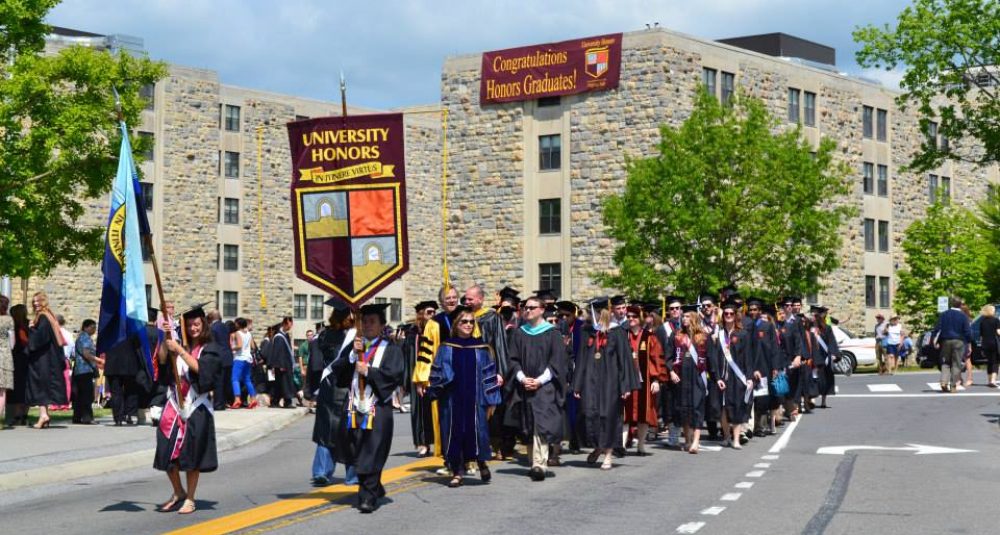
We have written previously about the Southeast, referring to it as the “land of great honors programs.” Like some other programs in the region, the one at the University of Tennessee actually has two honors programs that are interrelated: the Chancellor’s Honors Program (CHP) admits about 420 extremely talented students each year, and another 15 extraordinarily fortunate students become Haslam Scholars, who receive the most generous support of any undergraduate scholars on campus.
While the CHP does not list a definite minimum set of requirements, the average freshman entrants score 32 on the ACT and have a 4.0 GPA. This equates to about the top 10 percent of freshmen who enroll at UT.
The required curriculum for the CHP is 25 semester hours, including two courses in the freshmen year (total of 1 credit hour) and another seven courses in the remaining years (21 additional hours). The final requirement is a 3-hour thesis or “approved substitute,” which can be within the department or related to an honors topic. Continuation and completion in the CHP require a cumulative GPA of 3.25.
About 75 percent of freshmen honors students live in Morrill Hall, which, though not centrally located, features appealing double suites with one adjoining bath for only four students to share. It does not appear to be the case, however, that only honors students can live in Morrill, so choosing the right roommate could be extremely important.
Haslam Scholars at UT (similar to other elite undergraduate scholars at Alabama and Georgia, for example) receive scholarship packages worth more than $17,000 a year–and out-of-state students receive a waiver that allows them to enroll at the in-state level. Haslam Scholars also receive a free laptop, a grant ofg $4,500 for studying abroad, and special mentoring for research and thesis work.
The Haslam Scholarships are funded through a $5 million grant from the Haslam family. While the university does not list specific requirements, the likelihood is that Haslam Scholars would need to have credentials approximating National Merit Finalists (in regard to test scores), extremely high GPAs, AP/IB results at the highest levels, and other evidence of superior accomplishment in leadership, service, and cultural activities.
Haslam Scholars must complete at least 28 semester hours of honors work, including 6 hours of research coupled with a presentation, and 3 hours of service or executive internships.
Haslam Scholars are essentially a part of the CHP as well, and are eligible to live in Morrill Hall and participate in CHP programs and activities.
While all honors colleges and programs offer interdisciplinary courses and emphasize student interactions in small classes, the University Honors Program at the University of New Mexico does an excellent job of describing exactly how these best practices come together to develop students who are confident, engaged, and increasingly aware of their place in a complex world.
“Rather than simply piling on extra work, Honors courses are specially designed and crafted to be interdisciplinary,” the program site says. “Topics are examined a little more in depth than in normal undergraduate courses at the University. Extensive student participation and creativity form the foundations of every course. Enrollment is capped at 16 students. Interaction takes place in group activities and round-table discussions or presentations.”
The curriculum requires a minimum of 24 hours of honors credit, and it is, in fact, carefully designed. First-year students take at least one 100-level honors “Legacy” course.
“Legacies incorporate history, literary works, philosophy and/or political theory, drama and/or poetry, art, music, dance and/or architecture, science, math and/or technology. Legacies deal with the development of ideas rather than definitive historical time.”
Next come 200-level courses. These are cross-cultural topics, including Women, Africa, the Far East, the Americas, Medieval Europe, and the origins of mathematics and science. “These courses incorporate interdisciplinary explorations of specific topics with an emphasis on developing and strengthening skills important to success in Honors and undergraduate education, including oral and written communication skills, reading skills, critical and creative thinking, etc.”
The next series, 300-level courses, are an interdisciplinary exploration of specific topics designed to demonstrate the interconnectedness of academic disciplines. “Recent courses have focused on the significance of gender in myth and literature, bio-medical ethics, the nature and politics of nuclear energy, the origins of prejudice, arts across cultures, the existential imagination, and cross-cultural communication.”
At the 400 level,topics are more in- depth than those in lower-level courses, and students will have increasingly greater roles and responsibilities, the ultimate goal of the curriculum. “These courses afford enthusiastic and enterprising students the opportunity to craft a publishable paper or coordinate a collaborative mini-conference.”
Finally, senior options, earning six credit hours, can take the form of a thesis that can be interdisciplinary or within a discipline; or a senior teaching assistantship; or a senior colloquium involving a service learning project.
Another especially interesting option for honors students is to work on the honors publication, called Scribendi, Latin for “those which must be written.” Ten to twelve honor students work on the magazine, which publishes creative and non-fiction work not only by students at UNM but also by students at any of the 127 members schools of the Western Regional Honors Council. UNM honors students can receive credit for their work on the magazine.
Through the Conexiones Program, honors students can participate in more than a month of intensive Spanish-language study in Spain, in the cities of Trujillo and Salamanca. Students live with host families in Trujillo, “a city whose history and architecture represents in itself the history of Spain (from Iberians and Romans, Moors and Christians, to the famous Spanish nightlife, modern architecture and cyber cafés).”
“Students will attend classes in a 15th century restored convent, the site of the Fundación Xavier de Salas, an institution created with the purpose of studying and disseminating the theme of connections between Extremadura and the Americas.
“Weekly excursions are part of the program, including the visit to the medieval city of Cáceres and the Roman city of Mérida. Some highlights of the program are: a behind scenes tour of the ancient library at the University of Salamanca (one of the oldest in Europe), a day at a bull ranch in Salamanca, attendance at a performance of Classic Theater at the Roman Amphitheater of Mérida, a visit to the medieval town and monastery of Guadalupe and a day in the sister city of Alburquerque, with a tour through its medieval castle.”
The UHP at New Mexico began in 1957 with an enrollment of only 30 students; now the program has 1,300 students. Admission requires a minimum ACT of 29 (SAT 1860) and a minimum GPA of 3.50. Students must maintain a 3.20 GPA to remain in good standing.
UHP students enjoy priority registration, and many live in the Scholars Wing of the Hokona/Zia Residence Hall, home to Regents’ Scholars, Presidential Scholars, as well as UHP residents. Hokona is a traditional, co-ed dorm, with mostly double rooms and corridor-style baths. It is air conditioned and centrally located, very close to La Posada (LaPo) Dining Hall, the library, and buildings for economics and social sciences.
The University Honors Program at Kansas State is very new by honors standards, having begun only six years ago, in 2006. During the 2011-2012 academic year, a total of 33 students graduated from the KSU program, indicating that it is one of the smallest public honors programs–at this point in its development.
There are signs of expansion, including the designation of Marlatt Hall as the location of the honors cluster floor, beginning in 2009.
“One of the goals I have for the honors program is to really develop a community,” Stephen Kiefer, director of the K-State Honors Program, said at the time. “Having them all living in proximity to one another is going to facilitate that goal enormously.”
Recently renovated at the time of its designation as the honors residence hall, Marlatt was chosen for the honors cluster floor because it is spacious, has both suite-style and traditional-style rooms, and is affordable, Kiefer said.
Admission to the honors program requires a minimum ACT of 28 and a high school GPA of 3.75 (weighted or unweighted). Applicants must also submit an essay or project along with one letter of recommendation. Students must maintain a 3.50 GPA to remain in good standing.
The honors curriculum is not yet as extensive as it is in many programs, requiring 15-16 honors credits for completion, including a thesis or a project. Honors students are, however, true partners in defining their college careers.
“As an Honors student,” the program site says, “you will have the opportunity to develop your personal program of study by working closely with the University Honors Program and your academic advisor. From the very outset of your involvement in the Honors Program, you will be an active partner in identifying important learning outcomes and how those will be best achieved.
“The goals of this process are twofold: they allow you to identify and fulfill your academic plans and they will provide you with the documentation of such accomplishments. This documentation will provide you with many of the tools necessary to succeed in your post-baccalaureate plans, whether they involve a job, professional school, or a graduate program.”
KSU has already established itself as a public university powerhouse when it comes to achieving prestigious awards. The university site states that “K-State ranks first nationally among state universities in its total of Rhodes, Marshall, Truman, Goldwater and Udall scholars in the last 25 years, earning K-State a place among the nation’s elite universities.”
Our own research shows that KSU would rank behind only Illinois, Penn State, and Virginia in the number of undergraduate Goldwater scholars in the STEM subjects, and would be tied with the University of North Carolina for the number of Truman scholars. We do not know how many of those awards have been earned by honors students since 2006.
The strongest academic departments at K-State are biological/agricultural engineering, atomic and molecular physics, industrial engineering, and veterinary medicine. The undergraduate engineering program as a whole is ranked number 66 in the nation.
Update April 2013: OSU students have won five Goldwater awards valued at $7,500 for undergrad research, in the last two years, making the school one of the leaders in this important category. In 2013, all three of the Goldwater winners were students in the honors college, along with a fourth student who earned an honorable mention.
The Oregon State Honors College in Corvallis will enroll about 850 total students this Fall, including 300 new arrivals, but it won’t be long until enrollment will increase to about 1,000, a number that seems close to ideal for many universities based on our work thus far.
The Honors College is one of several programs that we may include in an expanded edition of our book, A Review of Fifty Public University Honors Programs.
The minimum admission requirements for freshmen entrants are SAT 1820/ACT 27/unweighted GPA 3.75, but only about 54 percent of applicants are accepted; the actual averages for accepted students are SAT 2027/ACT 31/unweighted GPA 3.95. The average GPA for transfer students is 3.83 for previous college work.
OSU is on the quarter system, and about 20 percent of the total credit hours applied toward graduation must be in honors courses or research/thesis. The minimum requirement for freshmen entrants who will become honors scholars is 30 credits, including thesis. The minimum requirement for transfers and upperclass students is 15 credits, qualifying them as honors associates.
Students on both tracks write a thesis and then can be eligible for the Honors Baccalaureate Degree, awarded jointly by the Honors College and the college of the student’s major. All honors students must maintain a 3.25 cumulative GPA at OSU to remain in good standing.
A key element of the honors curriculum is that it changes each year, not regarding total credit requirements but with respect to the courses and emphases determined by the honors faculty.
“The University Honors College creates an entirely new curriculum each academic year featuring some of OSU’s most inspiring teachers and serving many of OSU’s most talented and motivated undergraduates,” the web site says.
Class sizes are limited to 24 students for lower-division classes, and 12 students for upper-division courses. All courses are taught by professors and not by teaching assistants. Graduates of the OSU Honors College enjoy a 90 percent acceptance rate into graduate and professional schools.
Honors students are eligible for a limited type of priority registration: they register first among their peers in the same class group (as sophomores, they would register before other sophomores).
In the Fall of 2012, honors students may live in West Hall, a change from previous years, when they were assigned to McNary Hall on the east side of campus. West Hall is located near a large residential community including five other major residence halls. It is not far from business, engineering, and forestry buildings.
West Hall features suite style rooms, a shared kitchen, and a computer lab. For each pair of rooms, there is a shared bathroom. West Hall is also connected to the Marketplace West dining area, which includes at least seven theme-style cafes. About two-thirds of incoming honors students will live in West Hall.
OSU is noted for having one of the best forestry schools in the nation, and other high-ranking disciplines are ecology, oceanography, microbiology, nuclear engineering, zoology, public health, food science, and pharmacy.
Along with the University of Oregon, OSU is considered a flagship university, and the schools receives more research funding than all other Oregon colleges combined.
In our continuing series of profiles on honors programs that we would have liked to include in our book, A Review of Fifty Public University Honors Programs, we will discuss in this post the well-known honors program at Miami University in Oxford, Ohio.
An early post complimented Miami Honors for their up-front stats showing the achievements (in the form of placement percentages) of their most recent class of graduating honors students. So before describing the details of the program, we are listing the Miami web site stats for placement rates for the 2011 class below:
Law School: 100% placement (national average 69%)
Medical School: 85% placement (national average 45%)
Acceptance to Grad School: 94% (national avg not listed)
Job Prior to Graduation: 86% (national avg <56%)
Four-year Grad Rate: 98% (national average <56%)
The Miami program does not list a rigid set of admission requirements, but the average test scores are SAT 1340/ACT 30/GPA 4.0. A few students, however, are admitted with significantly lower test scores, if they have outstanding qualities in other areas, such as leadership, academic awards, and volunteer activities.
Like some other honors curricula we have reviewed, the Miami requirements are extremely flexible, with credit assigned for “honors experiences” rather than honors courses alone, although honors courses are the basic elements of honors experiences. And, following a trend in honors education, students have to prepare and submit for review annual online portfolios that organize and summarize what they have learned.
Honors experiences include small, interactive seminars, research, study abroad, undergrad teaching assistantships, graduate courses, leadership projects, and internships. Honors portfolios must demonstrate progress in six areas: written communication, collaboration, critical thinking, problem solving, intercultural understanding, and reflection (self-understanding). Students must complete at least nine experiences.
Note: Readers may want to see our recent post on “College Learning Assessment (CLA): Rationale for Honors?” in which we discuss the ways that honors curricula already enhance critical thinking and writing skills that college reformers often advocate.
Honors housing is important at MU because students are required to live on campus during the first two years.
“Although members of the University Honors Program eventually move all across campus, most have one thing in common: they spent their first year living in Tappan or Emerson Hall,” one student reports.
Tappan Hall is located on South Quad and is close to Harris Dining Hall, an all you care to eat location, and Scott Hall, which houses Encore and Ovations food courts. South Quad is not the most central location on campus, but, as another student says, the “location is great…for all the ‘good stuff’ (Rec Center, Hamilton Dining Hall, Shriver Center, Western Campus…”
Most rooms are corridor style with communal baths and shared double rooms. It appears that at least some of the rooms are air-conditioned, and there are a few suite-style rooms as well.
Honors colleges and programs allow transfers from other universities, but high GPAs in challenging courses must be a part of the transfer plan. Some programs also require at least one interview for prospective transfer students.
We will write a series of posts on the varying transfer requirements, and the next edition of A Review of Fifty Public University Honors Programs may include transfer requirements as a part of each profile.
In this post, we will look at the transfer requirements of the honors programs at Michigan, Penn State, Georgia, Arizona State, and UC Irvine.
Michigan: The LSA Honors Program does not list a required GPA, but based on GPA requirements for transfers at similar programs, we estimate that the GPA would need to be in the 3.75 range in challenging courses. An interview, by appointment, with a representative in the major department is required.
“Students who transfer to University of Michigan and the College of Literature, Science, and the Arts (LSA) with junior standing (55 credits or more) may be considered for the Honors Program by their concentration (major) departments. You should contact the department early in your first semester in LSA and ask about making an appointment with a concentration advisor. Make sure you mention that you are interested in doing an Honors concentration.”
“During your appointment with the concentration advisor, you and the advisor will consider your background, academic preparation, and your interests and decide whether an Honors concentration is right for you. If you do declare an Honors concentration, you will be a member of the Honors Program, and we urge you toschedule an appointment with an Honors general advisor to discuss your academic plans and your opportunities as a member of the Honors community.”
Penn State Schreyer Honors College: Transfers who have at least one full semester at Penn State may be eligible to apply to Schreyer through the college’s Gateway Program.
“The SHC requires Gateway applicants to have:
at least one full-time semester of study completed at Penn State
a minimum of four full-time semesters of study remaining before graduation
a cumulative GPA of 3.70 or higher at the time of application
an application-semester GPA of 3.50 or higher for rising juniors and 3.70 for rising sophomores
“The criteria stated here are minimums set by the SHC. In some cases, additional criteria for Gateway entry have also been established by the academic unit (e.g., higher cumulative GPA, specific courses, declaration of major, etc). The online application form includes additional criteria for your academic unit. In all cases, the department or academic college reviews applications and makes decisions which are communicated to applicants by the SHC.”
Georgia: “To be eligible for Honors, transfer students must have completed at least 30 transferable hours of graded academic credit and must have at least a 3.75 transfer GPA. Transfer acceptances will be determined on a space-available basis.
“Transfer students must apply to the Honors Program prior to their first term at the University of Georgia. Transfer students must submit a complete application by the postmark deadline specified on the application to be eligible for acceptance.”
Arizona State, Barrett Honors College: Transfers from other colleges should have at least a 3.60 GPA. The average SAT for freshmen admits is 1310, and the ACT average is 29.
“Lower Division Entry is generally reserved for students who apply to Barrett during the fall of their senior year of high school seeking enrollment as incoming freshmen. Those individuals already in their first semester at ASU and students in their first semester at another university or college looking to transfer to ASU may also seek Lower Division Entry for the second semester of their first year. The Lower Division honors curriculum is designed for students spending four years at ASU and Barrett.
“Upper Division Entry is specifically designed for those individuals who have completed approximately half of their undergraduate degree program and is geared at enrollment during the start of what is traditionally considered the junior year. The Barrett Upper Division academic requirements are designed for completion over the course of a student’s final four ASU semesters, not including winter and summer intersessions.”
UC Irvine: The Campuswide Honors Program (CHP) at Irvine makes specific provision for the possible transfer of some community college students into the program.
“Students eligible for Honors to Honors must attend a participating community college, have a GPA of 3.7 or better, and have successfully completed their community college Honors Program. Participating community colleges in this pilot program are: Cerritos College, Citrus College, Cypress College, Fullerton College, Golden West College, Irvine Valley College, Long Beach City College, Mt. San Antonio College, Orange Coast College, Pasadena City College, Rio Hondo College, Saddleback College, Santa Ana College, Santa Barbara College, Santa Monica College, and Santiago College.
“All other transfer students are invited to apply to the CHP prior to matriculation at UCI, or after they have completed at least one quarter at UCI. To apply you must have a minimum overall GPA of 3.5. (Please note that students who are admitted to the CHP often have GPAs higher than the minimum required for consideration.)”
Talented students in a hurry to obtain medical degrees or master’s degrees might want to consider the Florida State University Honors Program, which has special options available for honors students who qualify.
The program also has a pre-law option that enables honors students to shadow law school classes and attend functions related to the law school while they are undergrads; the students are then guaranteed admission to the FSU College of Law if they meet the admission requirements.
The honors program itself is selective: the average SAT/ACT is 2070/31. The GPA requirement is difficult to report because FSU adjusts high school GPAs according to a somewhat complicated formula:
“The Office of Admissions recalculates all grade point averages — we do not use the GPAs listed on your high school transcript or report card. Only academic subjects will be used in the recalculation. Grades of C- or better in dual enrollment, AICE, AP, and IB coursework will receive 1 full bonus point in the recalculation; grades of C- or better in honors, pre-AICE, pre-AP, and pre-IB will receive 1/2 bonus point. For repeated courses, we will only forgive a low grade if the exact course has been repeated (i.e., Algebra I will not replace an Algebra I honors grade — both courses will be used in the recalculation).”
Outstanding students can also apply to one of FSU’s “2+3” programs that offer both a bachelor’s and master’s degree in five years. (Many master’s degrees normally require two years for completion, so five years is an abbreviated length for both degrees.)
“The combined bachelors/masters degree programs provide academically talented students an opportunity to complete a bachelor’s and a master’s degree in a shorter time span. These programs allow students to double-count graduate courses for both degrees, thus reducing the time it would normally take.”
There are 16 departments that allow the master’s fast track: computer science, history, math, philosophy, science-teaching, statistics, marketing, communication, criminology, recreation management, students with exceptionalities, mechanical engineering, electrical engineering, nursing, public health, and public administration.
The honors pre-med tract in some cases allows students to obtain bachelor’s and medical degrees in seven years instead of eight. The pre-law does not appear to speed up the process of obtaining a law degree, but does, as noted above, lead to admission and provide realistic previews of the law school experience.
The honors program includes many of the best features of honors education, including an interesting curriculum, smaller classes, priority registration (honors students register with grad students), and honors residence halls.
The FSU program is one of the fifteen additional public university honors programs that we hope to include in the 2014 edition of our Review . The programs are offered at the following universities: Colorado State, Florida State, George Mason, Kansas State, Kentucky, LSU, Miami of Ohio, Ohio University, Oklahoma, Oklahoma State, Oregon State, Temple, Tennessee, UC Riverside, and Utah.
The name captures the uniqueness of honors education at Ohio University: Honors Tutorial College. The college has 203 professors, called “tutors,” who work with about 240 honors tutorial students either in very small groups or one-on-one.
The college is one of the fifteen additional public university honors programs that we hope to include in the 2014 edition of our Review . The programs are offered at the following universities: Colorado State, Florida State, George Mason, Kansas State, Kentucky, LSU, Miami of Ohio, Ohio University, Oklahoma, Oklahoma State, Oregon State, Temple,Tennessee, UC Riverside, and Utah.
For anyone who may associate the word “tutor” with those persons who assist struggling students, it is time to banish that conception from your mind. The students at the HTC are not there to catch up but to leap farther ahead.
Students at the honors college–officially called “tutees”– can choose from among 32 courses of study, and each discipline has a director of studies, a full-time professor in the chosen department who coordinates honors tutorials.
The college web site has an essay called “Something Completely Different,” and prospective students are urged to read it. “The purpose of this document,” the essay begins, “is to give some guidance about how HTC is different and why those differences matter. If you get one thing out of this piece of paper it should be the following: for 99% of the individuals who end up matriculating in the Honors Tutorial College learning by tutorial is vastly different from any other form of educational methodology they have encountered.”
[Emphasis in original.]
Although located in the town of Athens, about an hour and a half southeast of Columbus, Ohio University is less influenced by its Athenian namesake than by the two most famous universities in England:
“The Honors Tutorial College (HTC) is based on the centuries old tutorial system of undergraduate education developed at Oxford and Cambridge universities in Great Britain. Ohio University is the only institution in the United States with a degree-granting college incorporating all the essential features of the traditional tutorial system.
“Tutees gain important fundamental knowledge, hone essential skills, and begin to develop an understanding of what inspires them.
“Tutors often have their own intellectual horizons expanded by the observations and questions of students who bring fresh perspectives to familiar subjects.”
The tutorial process puts the student at center stage, with a great responsibility for showing creativity, initiative, persistence, and precision. They must learn not only the material at hand but also the minds and habits of their tutors, a process which requires the sort of creative anticipation and planning that is the frequent task of accomplished people in their careers.
Students must meet with tutors at least once a week for a minimum of 50 minutes. But do not think that this makes the tutorial classes easier. The preparation and planning necessary for each meeting can be daunting.
Discussing research papers with tutors is a major part of the work, placing a high premium on the ability to organize and articulate reasoned positions. In the lab context, students work directly with research scientists and lab supervisors, often on projects that have immediate impact.
One such student was Nyssa Adams, a recent graduate of the HTC, and now a student in the combined MD/Ph.D program at the Baylor University School of Medicine, one of the nation’s top medical schools. While at the HTC, Nyssa began working on research to improve cancer drugs used to fight ovarian cancer.
In writing papers and discussing them in tutorials, Nyssa developed an increased “respect for research,” not only the difficulties involved, but the exciting challenges it offered to her. Having begun college with an interest in a different field, she made the change to research, giving credit to Jan Hodson of the honors staff who helped Nyssa to realize that “there’s no reason for me not to succeed.”
Working so closely with professors gives students interested in science multiple opportunities “to find your lab” and “dig into research,” Nyssa says. Her own digging made her one of the outstanding undergrad researchers at HTC, and a student/scholar with the confidence and ability to earn the two doctorates she is seeking.
The HTC offers its own degrees, including degrees in business, fine arts, and journalism. The curriculum, while flexible and reliant on individual choices, typically turns out to be extensive and demanding: most students finish with approximately 200 quarter hours, of which about 48 are in tutorials or seminars.
The minimum admission requirements for the HTC are ACT/30, SAT/1300/GPA top 10%. The actual averages for HTC admits is SAT verbal 683, quantitative 664, for a total of 1347.
Unlike many honors programs, the HTC makes most of the information about the college readily available on the web site.
HTC students have the option to live in the Read-Johnson Scholars Complex on the East Green of the campus, an air-conditioned central location with dining and laundry facilities nearby. One excellent feature is a sink in each room.
Students may also live in Hoover Hall on the South Green, perhaps not as centrally located but still a great option if students prefer “mod” room arrangements–a combination of single and double rooms with a central living area, all shared by six students.
The Honors College at Oklahoma State University has many strong features, including an honors curriculum that makes the college competitive with the leading programs we have already identified in our research.
The college is one of the fifteen additional public university honors programs that we hope to include in the next edition of our Review . The programs are offered at the following universities: Colorado State, Florida State, George Mason, Kansas State, Kentucky, LSU, Miami of Ohio, Ohio University, Oklahoma, Oklahoma State, Oregon State, Temple, Tennessee, and Utah.
We have noticed that even though the average size of the honors programs we survey is about 1,800 students, some of the best, in terms of curriculum and honors features, are smaller, with approximately 1,000 students enrolled. The honors college enrolls 1,299 students, which may be close to the optimum size for coordinating honors curricula, housing, and advising.
The curriculum at the honors college requires completion of 39 honors credit hours for the Honors College Degree, “the highest academic distinction that may be earned by undergraduates at Oklahoma State University.”
The Honors College Degree includes the 21-hour requirement for the General Honors Award (one honors track) and the 12-hour Departmental or College Honors Award (the departmental honors track, which includes a thesis and oral defense). Additional hours for students earning the Honors College Degree may come from more undergraduate research, study abroad, internships, community service, or AP credits, on a 1:3 ratio. Recipients of this highest degree also give a public presentation related to their thesis.
Another strength of the Honors College is the experience of its director and staff. The director is Dr. Robert Spurrier, who is a past president of the National College Honors Council (NCHC). Assistant Director Jessica Roark is chair of the NCHC Honors Advising Committee. In fact, all six members of the honors staff are graduates of an honors college or honors program. As far as we know, no other college or program can make this claim.
Oklahoma State grads also perform well in the attainment of prestigious undergraduate and postgraduate scholarships, especially the undergrad Goldwater awards in the STEM subjects, the postgrad Truman awards in a variety of disciplines, and Udall awards, which are mostly related to environmental studies.
If Oklahoma State had been included in the current edition of our book that evaluated 50 leading university honors programs, it would have tied for seventh in Udall awards and eleventh in Truman awards.
Regarding entrance requirements, the minimum score and GPA for entering freshmen is an ACT composite score of 27 (SAT 1220 on critical reading and mathematics only) with a 3.75 high school grade point average (weighted grade point averages certified by the high school may be used) if the application is submitted by February 1. Students who fall just short of these criteria may submit an essay in response to one of several prompts provided by The Honors College.
“Transfer students and continuing OSU students) are admitted on the basis of their college grade point averages (fewer than 60 credit hours, 3.30; 60-93 credit hours, 3.40; 94 or more credit hours, 3.50).
“Honors articulation agreements are in place with a number of two-year colleges in Oklahoma, and transfer honors credit from other institutions is accepted as well.”
The college offers approximately 80 honors sections each semester, “including both honors sections of regular departmental course offerings (Calculus, Chemistry, English Literature, History, Philosophy, etc.) and special HONR-prefix honors seminars (most of which are interdisciplinary and team-taught)…”
Up to 300 honors students may choose to live in the honors dorm, Stout Hall, which features in-room sinks in combination with traditional hall baths, except for the fourth floor, which has single rooms. Stout Hall is a smoke and alcohol-free facility. Stout Coffee and Cafe is located in the basement and serves coffee, sandwiches, soups, and salads. There are also honors classrooms in Stout Hall. Stout Hall would have easily scored above the median in our metric for honors housing if the honors college had been included in our current survey.
Aspiring honors students typically can list an impressive array of accomplishments to go along with their high test scores and GPAs. These are often sufficient to merit their admission to honors programs throughout the nation.
From all the evidence we have seen in the process of reviewing 50 leading public university honors programs, the great majority of honors students do not rest on their high school laurels but continue to contribute and excel through their college careers, and beyond.
Probably the majority of honors students display their virtuosity through a mastery of the full range of subject areas–science, math, foreign languages, and writing–along with a background of community involvement and artistic accomplishment, say, in music.
Not so many come to their honors colleges and programs with a commitment that is strong enough to encompass subject mastery and community involvement and participation in varsity athletics. With full course loads and multiple majors (in many cases), the time and energy required to compete at the varsity level at a major I-A university is a challenge for even the most gifted honors student.
Meet Aubri Carman, who just graduated from the University of Arizona Honors College summa cum laude, after arriving at UA as a varsity soccer player. Following her graduation as salutatorian at Mountain Pointe High School in Tempe, Aubri won a prestigious Flinn Scholarship that gave her a “full ride” at the Arizona public university of her choice. Only 20 Flinn scholarships were awarded in 2008, out of more than 550 highly-qualified applicants.
Aubri chose the University of Arizona and competed on the varsity level in soccer. But a passion for biochemistry and biophysics took over around her second year at the university. “I came in as an NCAA Division 1 women’s soccer player, focused solely on athletics,” she says, “but then decided to go on another path and focus more on academic pursuits. I got involved, made key contacts through The Honors College and was able to pursue all the things I was passionate about.”
The following excerpt from a University of Arizona piece completes Aubri’s story–up to now–though it does not mention that she was named the outstanding senior in the UA Honors College in 2012. The piece was in recognition of her selection as one of two winners of the prestigious Merril P. Freeman award.
“Aubri Carman is a Flinn Scholar graduating Summa Cum Laude with honors with degrees in both biochemistry and molecular biophysics and molecular and cellular biology. She has minors in Spanish, political science and chemistry. She is the Outstanding Senior for the chemistry and biochemistry program and was honored with the Pillars of Excellence Award.
“She served as a student ambassador for the department of chemistry and biochemistry and as a member of the department’s peer mentoring program. She works at C.A.T.S Academics where she is a tutor for UA student-athletes and at the Honors College she plans activities for Flinn Scholars and recruits new students. She is also an active in the Mortar Board, a senior honor society.
“Carman has conducted research in three different laboratories on campus. She studies molecular and proteomic approaches to characterizing pediatric staphylococcus aureus bloodstream infections. She is also a Galileo Circle Scholar and a Michael A. Wells Research Scholar and her work has been submitted for publication in the journal, Clinical Infectious Diseases.
“She has taken graduate level courses at the Mel and Enid Zuckerman College of Public Health and helped with the planning of the inaugural New Frontiers in Global Health Leadership Forum.
Thanks to support from the Flinn Foundation, Carman has traveled extensively gaining valuable experiences in the health-care field. In South Africa, she worked with Child Family Health International as a clinical volunteer. In Costa Rica, she served as a global health ambassador for the Foundation for International Medical Relief of Children performing routine tasks at a small primary care clinic and organized a six-week nutrition and exercise outreach initiative for women.
“An avid athlete, she organized a 3 vs. 3 soccer tournament fundraiser to benefit Grassroot Soccer, an organization that uses the power of soccer to educate youth in Sub-Saharan Africa about HIV. She also volunteers at The University of Arizona Medical Center in the pediatric ward.
She [has been awarded] a Fulbright Scholarship, where she would conduct public health research with Grassroot Soccer in Zambia. Having gained admission to several medical schools, she looks to become a doctor and gain a master’s degree in public health.”
Aubri will probably always be an athlete, but her commitment has grown and flourished as an honors student, and it is a commitment that will continue to serve humanity.