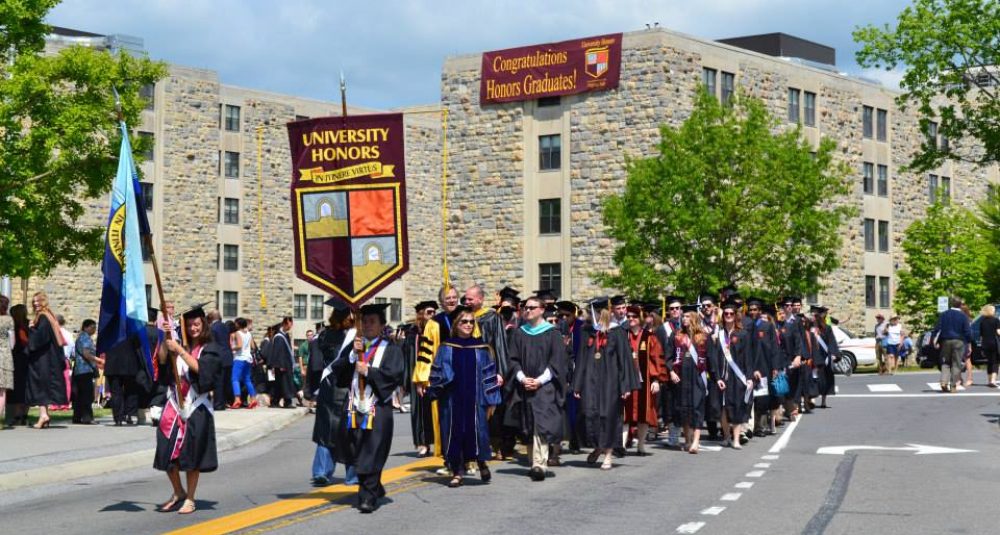
As we review honors curricula we sometimes encounter so many options that we find it difficult to emerge with a clear impression of the requirements. The curriculum for the University of New Hampshire Honors College is that rare combination of clarity and flexibility that can be readily understood.
Moreover, the curriculum is extensive, requiring 32 hours of honors credits for graduation if students pursue the University Honors Designation. This option includes 16 hours of honors seminars, usually limited to 20 students, which also count toward general education requirements. Then students go on to complete another 16 hours in Honors in Major courses, including at least 4 hours of which are the honors thesis.
This kind of clear integration between honors general education requirements and departmental specialization, including a thesis, strikes us as one of the most sensible ways to structure the honors curriculum. Students who do not choose to receive the University Honors Designation simply go straight to the Honors in Major track when they reach upper-division status.
A typical first-semester freshman entrant should have an ACT/SAT of at least 29/1970, and rank in the top 10 percent (or equivalent) of her high school class. Second-semester freshmen may also apply if they rank in top 10 percent of their college; if students have a 3.4 college GPA but do not rank in the top 10 percent of their college, they may submit a personal essay and teacher recommendations to the honors advisor.
Honors students may apply to live in Hubbard Hall, a co-ed hall that houses about 250 students in traditional rooms with corridor baths. Hubbard is not as close to some classes as other dorms, but it is still in a good location near Williamson and Christensen residence halls. All three are very convenient to Philbrook Dining Hall, one of the major dining locations on campus.
Hubbard Hall is definitely the place for the most serious students on the UNH campus. Here is what some of them say:
“The Hubbard Hall community is perfect for incoming freshmen; it allows them to be around other freshmen and some upperclassmen. Also, it provides a good balance where one can explore social things in a safe way, and still have a quiet place to live and study to come home to.”
“Hubbard is a nice dorm which has an environment that provides many social and academic opportunities for students who wish to make a bunch of new friends as well as maintain their grade point average.”
Among the best academic programs at UNH are earth sciences, history, sociology, and English. The intellectual law program at the law school is one of the leading programs of its type in the nation.
In the last decade, the LSU Honors College has grown and improved, and with a recent emphasis on prestigious scholarships and an expanded honors residence hall, the college is a strong option in the South.
Now with about 1,200 students, the College is in our category of “smaller” programs–those with fewer than 1,800 honors students. It appears that the recent trend in honors colleges is to establish residential scholars’ communities of 1,000–1,200 students.
Admission to the College is selective, with a “recommended” SAT of 1330 (ACT 30), plus an essay. A minimum score of 660 on the SAT critical reading portion is also recommended. An ACT composite score of 29 is acceptable if the English score is 31. The deadline to apply is November 15.
The Honors House Residence is located in West Laville Hall (renovated in 2010) and now in East Laville Hall, newly renovated and open to students in the Fall of 2012. Both are located adjacent to the 459 Dining Commons and the French House, home of the College. About 600 students can be accommodated in the halls, both of which have central air conditioning with individual room controls. One important feature is that the halls are available to students for all four years of residence. Although the baths are corridor style, each room has its own sink.
Next to the Honors House is the academic center of the Honors College, the French House, an historic building resembling a French chateau, where small seminar classes are held, students meet with specialized advisors, and all Honors College events take place, ranging from classical concerts to Quiz Bowl tournaments.
The honors curriculum is substantial, requiring 32 hours of honors credit, including a thesis; an overall GPA of 3.5 is required for graduation. (This overall requirement compares very favorably with those of the fifty honors programs we have formally evaluated.) At least 6 honors hours must be in seminars, and at least 12 hours must be upper-division courses, including the thesis.
Students can earn “sophomore honors distinction” if they complete 20 hours of honors work in the first two years, including 6 hours of honors seminars. Upper division honors distinction requires exemplary work in junior and senior courses along with an excellent honors thesis.
Honors credit may be earned in honors-only seminars; in small versions of regular classes, with an honors component; and in honors “option” courses, requiring the student to arrange individual instruction with a professor. Honors students have priority registration for honors courses.
Since 2005, when LSU established the Office of Fellowship Advising within the Honors College, LSU students have won 13 Goldwater awards for undergraduate research in STEM fields, and have had 15 finalists for the Truman Scholarship for postgraduate studies. LSU students also earned seven National Science Graduate Research Foundation grants in 2012. The establishment of a fellowship office within the honors college or program is an important consideration for prospective students who have an interest in prestigious awards.
Honors students are also encouraged to travel and study abroad “to enrich their education and to gain a wider perspective on the future of this country. The Honors College sponsors summer study trips to China and to South Africa, where students learn foreign languages, engage with students from those countries and learn about their cultures.”
When the President and educators across the country emphasize the importance of community colleges, the message is usually that the two-year institutions are mainly important as a means of providing the advanced technical and vocational instruction that is so important in today’s economy. Less is said about the critical role these institutions play in preparing students for high academic achievement at some of the best public and private universities.
Michigan. Cornell. Georgia Tech. NYU. Wisconsin. Mt.Holyoke, Smith, UCLA, Northwestern, UNC Chapel Hill. Columbia and Yale. These and many other institutions are among those who have accepted the outstanding honors students of the Hillsborough Community College Honors Institute, which offers honors courses at five campuses in the Tampa area.
Under the longtime directorship of Dr. Lydia Lyons, a past president of the National Collegiate Honors Council (NCHC), the HCC Honors Institute has been the springboard to excellence for thousands of outstanding students who have gone on to obtain bachelor’s and graduate degrees, not only from most universities in Florida, but also from the schools listed above and many, many more.
There is a sound argument to be made that community college honors programs may even be the best way to graduate from a premier four-year honors program or a prestigious private college.
One big reason, according to Dr. Lyons, is that most community college students pay relatively little to attend school during the first two years; therefore, if they get accepted to a fairly expensive four-year school, even without a lot of financial aid, their total cost for four years is still much less than they would have paid if they had attended a four-year school from the outset.
Another reason is that there can be more support at the two-year schools. “In our Honors Institute,” writes Dr. Lyons, “we are mindful of creating Honors students, not simply providing services for students….”
This does not translate, however, to indulgence. Many of the Honors students “have come to understand that they had to apply themselves to be successful in their courses.” For some of the most talented students, the Institute may be the first place that has required them to accept and, ultimately, to embrace this challenge.
This process of creation requires a faculty that is committed to traveling from one campus to another when it is necessary to do so, and a staff that is ready to nurture and support students through advising and mentoring, especially, perhaps, when the time comes to apply to the four-year institution.
Dr. Lyons has established informal but effective relationships with scores of colleges around the country. When a student wants to attend one of these schools, she is their advocate. Examples of her success with this sort of outreach are the presentations that Institute students receive from outside representatives, including those from Columbia and Mt. Holyoke.
Dr. Lyons and her staff also provide counseling that helps students match their school choice with their majors, rather than just the “brand” of the four-year school.
But just as important in preparing Institute students is the extensive honors curriculum. Completion of the honors curriculum requires 24 semester hours of honors credits–as many or more honors credits as are required by a lot of four-year honors colleges and programs.
Applicants must meet at least one of the following criteria to qualify for the Honors Institute:
High school GPA of 3.4 (unweighted) or higher -or-
SAT combined score of 1160 or higher -or-
ACT combined score of 26 or higher -or-
Top 10% of graduating class with SAT combined score of a minimum 1050, or a minimum ACT composite score of 25, or CPT score of a minimum of 90 in writing and a minimum of 92 in reading -or-
12 hours dual enrollment with 3.8 GPA
As for the honors community, students from all campuses meet at the Dale Mabry Campus in Tampa for student association and board meetings and also use frequent service projects and film study groups to form closer associations.
The mission statement of the Institute says that “Honors students will be challenged to accept their moral responsibilities which include leadership, thoughtful self-governance, and service to others.”
The New College of Florida, located in Sarasota, is the official public liberal arts college for the state, and with only about 800 undergraduates enrolled, the entire campus functions in much the same way as a relatively small honors program at a larger university.
New College is not, strictly speaking, an honors college. But with an estimated average SAT in the 2000 range and average GPA of about 3.75, it is as selective as many major research university honors colleges and programs, and the curriculum and extremely flexible options appear to have some of the same elements as Echols Scholars enjoy at the University of Virgina along with tutorial choices that are similar to Ohio University’s Honors Tutorial College.
Like Echols scholars, all students at New College can create their own, individual curriculum, with a choice of forty majors and additional choices for double concentrations. Classes are with very small–about 12 students–or one on one, in the tutorial format that is associated with Ohio U.
And there’s one other thing you should know about New College: there are no grades.
Students receive lengthy and detailed narrative evaluations of their performance in course work and tutorials. Does this hurt New College students when they apply to graduate and professional schools?
The answer appears to be no. “About 80 percent of New College alumni go on to graduate school within six years of graduating,” the college reports. “For the 2010 graduating class, 86 percent of graduates who applied to a Ph.D. program were accepted, and 100 percent who applied to law school got in! It’s no wonder that The Wall Street Journal ranked New College the nation’s no. 2 public feeder school for elite law, medical and business schools.”
Another key feature of New College is that Kiplinger’s Best Values in Public Colleges ranks New College at number 5 as an in-state public college value, and at number 19 as an out-of-state value.
One thing that students should consider is very small size of the college. On the plus side, there is the flexibility, the individual instruction, the research opportunities, and excellent options for studying abroad, especially in language-related study. New College students have an extraordinarily high rate of success in attaining Fulbright Student Fellowships, to go with the excellent prospects for placement in graduate and professional schools.
But on the other side of the ledger, the small campus is also like a very small town, and some small towns can seem confining. One factor that may offset the small size is that about 80 percent of students live on campus.
“New College’s Pei Campus is the center of residential life, the college says, “with eight out of a total of nine residence halls located there. Along with the dorms, Hamilton ‘Ham’ Center, Palm Court, the Fitness Center and other recreational facilities form a student village where academics and campus life seamlessly intertwine and ‘learning occurs around the clock.'”
“Designed by internationally-renowned architect I.M. Pei, New College’s Pei Residence Halls opened in 1965 and accommodate more than 250 students in double and triple-occupancy rooms, each with its own private bathroom. Community spaces and laundry rooms in the Pei buildings are located in each of the three quads, and the outdoor Palm Court around which the rooms are grouped is a focus of New College student life. Pei rooms are spacious, measuring approximately 15′ x 15.’
“All of the rooms have recently, and some feature covered porches or large balconies, providing additional living space. The clustered construction, communal spaces and orientation around Palm Court affords Pei residents a strong sense of community.”
Dining options include the student-run Four Winds Cafe, located on the Bayfront section of campus, a market cafe with sandwiches and traditional entrees, and a deli.
And we shouldn’t neglect to mention the nearby beaches.
“Lido Key offers quiet North Lido Beach, the popular Lido Beach with parking and restrooms, and South Lido Beach, which has BBQ grills and picnic tables under Australian Pines. Boutique stores and restaurants can be found on St. Armands Circle.
“Siesta Key Beach, named America’s #1 beach and known for its powdery white sand, has volleyball nets, tennis courts and picnic area. Every Sunday at sunset there’s a drum circle. Siesta Village offers restaurants and nightlife. Turtle Beach, on the southern end of the island, is quieter with coarser sand and beach dunes.
“Or head up north to Anna Maria Island for a change of scenery. There are many restaurants and funky shops along the beautiful beaches. Check out the island’s annual Bayfest, too.”
Some honors programs and colleges make liberal use of honors contract courses, which allow a student to receive honors credit for taking a non-honors class if the student and professor agree on additional requirements–often a paper or research project–and honors staff confer formal approval on the contract arrangement.
Whether the contract courses are worthy additions to honors education depends on the following factors:
the reasons that the courses are offered;
the substance of the additional requirement for honors credit; and
the frequency of the contract courses.
If faculty productivity requirements reward departments and individual faculty for teaching large numbers of students, then honors contracts may allow faculty to receive credit for teaching a large section and also allow the honors credit for the section. This approach may be defensible if budget cuts or productivity requirements leave no other alternative, or if the university as a whole offers smaller, high-quality classes to most of its students, whether or not the students are in the honors program.
Using contract courses primarily as a means of circumventing faculty involvement in honors-only courses, however, could well be a sign that the program lacks strong support from the departments, the administration, or both.
But if a culture of excellence is pervasive at a university, then the honors contracts may be more defensible. Honors students at the University of North Carolina at Chapel Hill, for example, might be able to contract for a large number of classes that are relatively small and of high quality, but that are not formally designated as honors-only classes. While this arrangement may lead to claims that the honors program is not sufficiently distinct from the university as a whole, the result is nevertheless likely to be a substantive experience.
In any case, honors contract courses should in fact be substantive. If an additional paper is required for honors credit, then the paper should be of considerable length and reflect serious scholarship. The stronger the requirement, the higher the likelihood that the professor and student have a higher degree of collaboration. In such cases, the contract courses mix tutorial and class instruction, perhaps even to a greater extent than would a regular honors course.
On the other hand, if honors contract courses are the dominant element in the honors curriculum, it is difficult to see how the faculty involvement could reach the high level discussed above. For if that level of involvement could be attained, why would it not result in more actual honors courses instead of an excess of contract courses?
Editor’s Note: There is a full, updated profile and detailed rating of Macaulay Honors College in our book, INSIDE HONORS. You can see a list of the highest rated honors programs here.
Students who are residents of New York State have the unique opportunity of qualifying for free tuition and other benefits at the Macaulay Honors College, which is affiliated with eight senior colleges of the City University of New York. Admission to Macaulay for state residents not only makes them Macaulay Scholars with free tuition but also presents to them the Big Apple in all its fascinating dimensions.
Out-of-state students who meet CUNY New York State residency requirements can also receive the full tuition scholarship. And for those who do not qualify for the free tuition support, CUNY provides one of the best values in higher education. In addition, the student will receive all of the enhanced benefits of a Macaulay education.
Macaulay students study at the following CUNY campuses: Baruch College, Brooklyn College, City College, Hunter College, John Jay College, Lehman College, Queens College, and the College of Staten Island (CSI). There are special honors housing packages at City College and Hunter College. All the other colleges have residence options. Macaulay Honors College is housed in an elegant, renovated brownstone located in the Upper West Side, near Central Park and the Lincoln Center for the Performing Arts.
In addition to free tuition, Macaulay students receive a $7,500 Opportunities Fund “to pursue global learning, internships, and other service and learning opportunities”; a MacBook Pro laptop; a “Cultural Passport” that permits free or discounted admission to arts, cultural, and educational institutions across the city; and specialized advising through the Macaulay Advising Program (MAP).
The laptops are an integral part of Macaulay’s plan to enable students to participate in social and academic programs at campuses other than their home campuses and to prepare and present e-portfolios of their college work, with the help of Instruction Technology Fellows (ITF’s) assigned to each of the honors seminars. “ITFs are CUNY doctoral students in a wide range of academic disciplines, carefully selected for their familiarity and experience using technology both in the classroom and in research,” according to the Macaulay site.
Admission to Macaulay is selective, with an average SAT score of 1410 and grade average of 93.9. In addition, co-curricular activities, essays, and letters of recommendation are required. The acceptance rate was 29% for the Class of 2016; approximately 540 freshmen will be entering Fall 2013.
The honors curriculum for the first two years is focused on the city of New York itself:
“Seminar 1 introduces Macaulay Scholars to the arts in New York City and the Cultural Passport. During the semester, students attend theatrical, operatic, and musical performances, exhibitions of visual art, and other highlights of the current cultural season, and help to create the annual “Snapshot of New York City” exhibition.”
“During Seminar 2, Macaulay Scholars investigate the role of immigration and migration in shaping New York City’s identity–past, present, and future. Visits to archives, interviews, mapping and walking tours allow students to create the collaborative Neighborhood Websites, presenting their research through audio, video, photography, and other media.”
“In Seminar 3, Macaulay Scholars analyze issues in science and technology that have an impact on contemporary New York. Students work together to create scientific posters and presentations for a Macaulay-wide conference of their peers and others in the Macaulay community.”
“The purpose of Seminar 4 is to analyze the ongoing interplay of social, economic, and political forces that shape the physical form and social dynamics of New York City. Throughout the semester, students engage in a team research project, sometimes including Public Service Announcement Videos, to be presented at a model academic conference.”
Macaulay’s upper-level seminars encourage students to integrate course work and their own primary research, in a richly collaborative and supportive interdisciplinary setting. Recent topics include Sexuality and American Culture, Imagining the End of the World, The Future of Education, Religion and Public Policy, and Women and Global Public Policy Since the 1960s.
As for off-campus opportunities in New York City, Macaulay students benefit from special access to network with New York’s most dynamic firms.
“Macaulay students often use some of their $7,500 Opportunities Fund to develop customized programs that enable them to explore different professional paths, or to gain additional hands-on experience in fields they wish to pursue in graduate school or professionally after college.”
Examples of recent internships are New York Life, HBO, The New York Historical Society, The Earth Institute Center for Environmental Sustainability (EICES), NYU Langone Medical Center, BBC Worldwide Americas, The New York State Office of the Attorney General, US Trust, Free Arts NYC, The Department of Consumer Affairs (DCA), and Northwestern Mutual.
Over 90% of Macaulay students intend to study abroad. Again, they can use their Opportunities Fund, outside fellowships, and additional resources CUNY makes available to them to pursue a wide range of semester and year-long study abroad programs, at universities around the globe.
Students might analyze marine life in the Galapagos, study drama at Trinity College of Dublin, learn Arabic at Bosphorus University in Istanbul, or study mathematics at the City University of Hong Kong.
Other examples of recent study-abroad locations are the following: Argentina, Australia, Austria, Barbados, Brazil, China, Chile, Costa Rica, Cuba, Czech Republic, Denmark, Ecuador, Egypt, England, France, Germany, Greece, Guatemala, Ireland, Israel, Italy, Japan, Korea, Lithuania, Morocco, Netherlands, Puerto Rico, Russia, Singapore, South Africa, Spain, and Turkey. Macaulay students have studied on every continent with the exception of Antarctica.
Macaulay graduate, David L.B. Bauer of City College, became something of an undergraduate “brainiac” celebrity, who chose Macaulay over the Ivies after he won the Intel Science Talent Search as a high school student in 2005. A winner of Goldwater, Rhodes and Truman Scholarships while at Macaulay, Bauer focused on research in clinical medicine at the Wellcome Trust Centre for Human Genetics (WTCHG) at the University of Oxford, where he worked during his junior year at CCNY. Bauer is currently a DPhil candidate in clinical medicine at Oxford.
A second Rhodes scholarship was awarded to a Macaulay student in October, 2011 to Zujaja Tauqeer (Macaulay and Brooklyn College ’11). Zujaja, who graduated with a BA/MD, is studying the history of medicine in a two-year program at Oxford.
Public universities are increasingly subject to productivity measures as a means of justifying continuing revenue support, such as it is, from the states. One such measure is “credit hour productivity,” which represents the ratio of total student credit hours taught per faculty member.
For example, a faculty member who teaches large lecture classes will receive “credit” for teaching hundreds of student hours, while some faculty who teach small honors seminars may receive credit for hours earned by, say, 15 students. In many public universities, funding for departments and even larger divisions is based in part on the total number of credit hours that are taught.
Sometimes, credit hour productivity is also a factor in tenure and promotion evaluations, providing yet another source of pressure to apply the productivity model to instruction.
Unfortunately, this model is inimical to what is probably the strongest feature of honors education: small, interactive classes, similar to those at the best liberal arts colleges and elite private institutions.
Therefore, a big challenge for many honors directors is to find a way to persuade deans and department chairs to utilize weighted systems as a way of giving approximate productivity credit to faculty for teaching honors classes.
Many research institutions already weight their systems so that faculty who teach graduate courses, which typically feature small, seminar-sized classes, receive augmented credit for teaching the courses, based in part on the time and supervision required when working with advanced students who are engaged in research and in-depth writing or laboratory assignments.
Alternatively, some universities give the same productivity credit for teaching lower-division honors courses as they do for teaching upper-division courses, and also give the same credit for teaching upper-division honors as they do for teaching graduate courses.
In the end, the decision to use productivity weighting comes down to the willingness of the institution to acknowledge the value-added impact of honors programs to the university as a whole–and then reward that value by implementing sufficient productivity credits to induce faculty and departments to participate fully in honors education.
The absence of such support is, sadly, evidence that the students who choose a university because of the honors program are far more subject to the mass production model in higher education than they would ever expect to be.
In a broader sense, the inadequate support gives many critics of public universities, who often disparage research and excellence in the interest of this very same productivity, yet another victory on their way to reducing the quality and influence of public universities.
We have written previously about the Southeast, referring to it as the “land of great honors programs.” Like some other programs in the region, the one at the University of Tennessee actually has two honors programs that are interrelated: the Chancellor’s Honors Program (CHP) admits about 420 extremely talented students each year, and another 15 extraordinarily fortunate students become Haslam Scholars, who receive the most generous support of any undergraduate scholars on campus.
While the CHP does not list a definite minimum set of requirements, the average freshman entrants score 32 on the ACT and have a 4.0 GPA. This equates to about the top 10 percent of freshmen who enroll at UT.
The required curriculum for the CHP is 25 semester hours, including two courses in the freshmen year (total of 1 credit hour) and another seven courses in the remaining years (21 additional hours). The final requirement is a 3-hour thesis or “approved substitute,” which can be within the department or related to an honors topic. Continuation and completion in the CHP require a cumulative GPA of 3.25.
About 75 percent of freshmen honors students live in Morrill Hall, which, though not centrally located, features appealing double suites with one adjoining bath for only four students to share. It does not appear to be the case, however, that only honors students can live in Morrill, so choosing the right roommate could be extremely important.
Haslam Scholars at UT (similar to other elite undergraduate scholars at Alabama and Georgia, for example) receive scholarship packages worth more than $17,000 a year–and out-of-state students receive a waiver that allows them to enroll at the in-state level. Haslam Scholars also receive a free laptop, a grant ofg $4,500 for studying abroad, and special mentoring for research and thesis work.
The Haslam Scholarships are funded through a $5 million grant from the Haslam family. While the university does not list specific requirements, the likelihood is that Haslam Scholars would need to have credentials approximating National Merit Finalists (in regard to test scores), extremely high GPAs, AP/IB results at the highest levels, and other evidence of superior accomplishment in leadership, service, and cultural activities.
Haslam Scholars must complete at least 28 semester hours of honors work, including 6 hours of research coupled with a presentation, and 3 hours of service or executive internships.
Haslam Scholars are essentially a part of the CHP as well, and are eligible to live in Morrill Hall and participate in CHP programs and activities.
While all honors colleges and programs offer interdisciplinary courses and emphasize student interactions in small classes, the University Honors Program at the University of New Mexico does an excellent job of describing exactly how these best practices come together to develop students who are confident, engaged, and increasingly aware of their place in a complex world.
“Rather than simply piling on extra work, Honors courses are specially designed and crafted to be interdisciplinary,” the program site says. “Topics are examined a little more in depth than in normal undergraduate courses at the University. Extensive student participation and creativity form the foundations of every course. Enrollment is capped at 16 students. Interaction takes place in group activities and round-table discussions or presentations.”
The curriculum requires a minimum of 24 hours of honors credit, and it is, in fact, carefully designed. First-year students take at least one 100-level honors “Legacy” course.
“Legacies incorporate history, literary works, philosophy and/or political theory, drama and/or poetry, art, music, dance and/or architecture, science, math and/or technology. Legacies deal with the development of ideas rather than definitive historical time.”
Next come 200-level courses. These are cross-cultural topics, including Women, Africa, the Far East, the Americas, Medieval Europe, and the origins of mathematics and science. “These courses incorporate interdisciplinary explorations of specific topics with an emphasis on developing and strengthening skills important to success in Honors and undergraduate education, including oral and written communication skills, reading skills, critical and creative thinking, etc.”
The next series, 300-level courses, are an interdisciplinary exploration of specific topics designed to demonstrate the interconnectedness of academic disciplines. “Recent courses have focused on the significance of gender in myth and literature, bio-medical ethics, the nature and politics of nuclear energy, the origins of prejudice, arts across cultures, the existential imagination, and cross-cultural communication.”
At the 400 level,topics are more in- depth than those in lower-level courses, and students will have increasingly greater roles and responsibilities, the ultimate goal of the curriculum. “These courses afford enthusiastic and enterprising students the opportunity to craft a publishable paper or coordinate a collaborative mini-conference.”
Finally, senior options, earning six credit hours, can take the form of a thesis that can be interdisciplinary or within a discipline; or a senior teaching assistantship; or a senior colloquium involving a service learning project.
Another especially interesting option for honors students is to work on the honors publication, called Scribendi, Latin for “those which must be written.” Ten to twelve honor students work on the magazine, which publishes creative and non-fiction work not only by students at UNM but also by students at any of the 127 members schools of the Western Regional Honors Council. UNM honors students can receive credit for their work on the magazine.
Through the Conexiones Program, honors students can participate in more than a month of intensive Spanish-language study in Spain, in the cities of Trujillo and Salamanca. Students live with host families in Trujillo, “a city whose history and architecture represents in itself the history of Spain (from Iberians and Romans, Moors and Christians, to the famous Spanish nightlife, modern architecture and cyber cafés).”
“Students will attend classes in a 15th century restored convent, the site of the Fundación Xavier de Salas, an institution created with the purpose of studying and disseminating the theme of connections between Extremadura and the Americas.
“Weekly excursions are part of the program, including the visit to the medieval city of Cáceres and the Roman city of Mérida. Some highlights of the program are: a behind scenes tour of the ancient library at the University of Salamanca (one of the oldest in Europe), a day at a bull ranch in Salamanca, attendance at a performance of Classic Theater at the Roman Amphitheater of Mérida, a visit to the medieval town and monastery of Guadalupe and a day in the sister city of Alburquerque, with a tour through its medieval castle.”
The UHP at New Mexico began in 1957 with an enrollment of only 30 students; now the program has 1,300 students. Admission requires a minimum ACT of 29 (SAT 1860) and a minimum GPA of 3.50. Students must maintain a 3.20 GPA to remain in good standing.
UHP students enjoy priority registration, and many live in the Scholars Wing of the Hokona/Zia Residence Hall, home to Regents’ Scholars, Presidential Scholars, as well as UHP residents. Hokona is a traditional, co-ed dorm, with mostly double rooms and corridor-style baths. It is air conditioned and centrally located, very close to La Posada (LaPo) Dining Hall, the library, and buildings for economics and social sciences.
The University of Oklahoma at Norman is well-known for the generosity it shows to National Merit Finalists and other applicants of exceptional ability, and the McClendon Honors College at the university appears to be as generous while offering enhanced living and learning opportunities as well.
Although the honors program at OU goes back to 1962, a series of reorganizations that resulted in the Honors College did not occur until 1997. We estimate that the college now enrolls approximately 2,000 students, placing it in the category of “large” programs with enrollments greater than 1,800.
The college requires a minimum SAT of 1330 or a score of 30 on the ACT, along with a GPA of at least 3.75 or a high school class rank in the top 10 percent. Freshman applicants must also submit a 400-500 word essay. Transfer students and those with more than 15 hours of credits at OU may apply if they have a college GPA of at least 3.40.
The honors college is unusual because of the extent of financial grants that it can bestow on especially talented students. Among the scholarships available (even to out-of-state students) through the OU Scholars office are the Award of Excellence Scholarship and the Regents Scholarship, each of which provides a tuition waiver of $2,500 per semester, up to eight semesters, for a total value of $20,000. The awards also provide up to $1,250 for summmer school tuition.
The Honor Scholars awards provide tuition waivers of $1,750 per semester for eight semesters, for a total value of $14,000. University Scholars can receive a $2,500 tuition waiver for one year.
As for non-resident National Merit Finalists, the term “free ride” comes to mind. Here is what OU offers:
“The following scholarship package is guaranteed to every non-resident National Merit Finalist who names OU as his/her college of first choice with the National Merit Scholarship Corporation:
“Oklahoma Academic Scholars Programs $22,000
$2,750 per semester/$5,500 per year for four years to help offset the costs of fees, books, room & board
Funded by the Oklahoma State Regents for Higher Education
Funds will be deposited into billing account
Can be used toward any graduate/professional program at OU if funds remain after completion of undergraduate degree
Must maintain a 3.25 cumulative GPA and be enrolled full-time
“Non-Resident Tuition Waiver (estimated) $55,000
Waives 100% of non-resident tuition
May be used for five years (fall, spring and summer)
Can be used toward any graduate/professional program at OU if funds remain after completion of undergraduate degree
Must maintain a 2.8 cumulative GPA and be enrolled full-time
“Resident Tuition Waiver $10,000
$1,000 each fall and spring semester/$2,000 per year for five years
Can be used toward any graduate/professional program at OU if funds remain after completion of undergraduate degree
Must maintain a 2.8 cumulative GPA and be enrolled full-time
National Merit Cash Stipend $5,000
But once the dollars stop swirling about our heads, the honors college itself has many advantages. The curriculum requires about 25 hours of honors credit, including a thesis. Honors students can choose to live in Boren Hall, where many honors classes are also held and where the honors college offices are housed. Honors classes are generally limited to 22 students or less.
Boren Hall is a traditional double-room, corridor bath dorm, a part of Cate Center, which also has dining facilities. Honors students may also choose to live in the Global Community, in Couch Center; in the National Merit residence in Walker Center; or in the Scholastic, Quiet Lifestyle, Co-ed Upperclass halls. All but Boren appear to be suite-style.