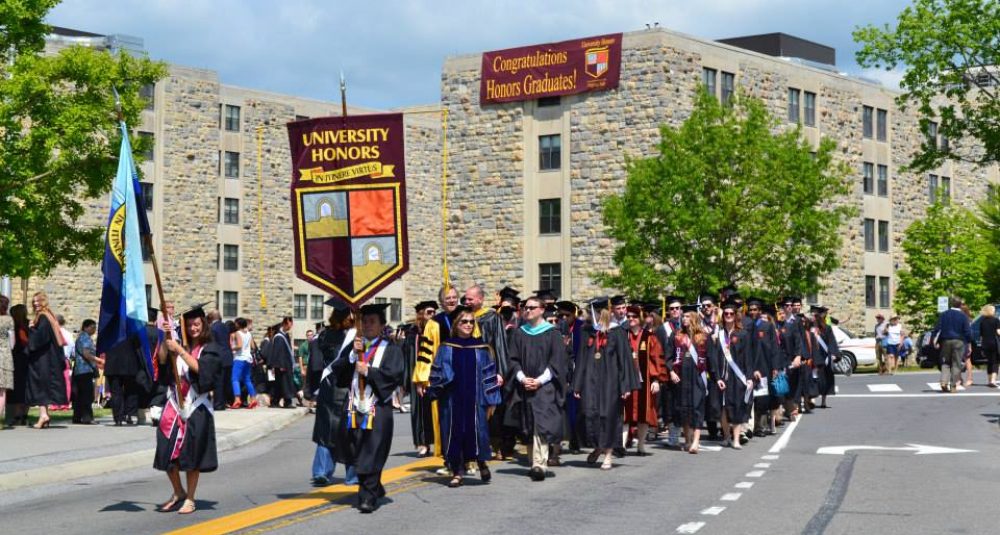
Univ of Arkansas Honors College: Mentoring Leads to Publication

Editor’s Note: Our thanks to Kendall Curlee, Director of Communications for the University of Arkansas Honors College, for assistance with this post.

One of the major strengths of honors colleges and programs is that they make undergraduate research opportunities a priority. Increasingly, early contact with distinguished professors is yielding not only better chances for entry to graduate and professional schools but also success with publication in prestigious academic journals.

At the University of Arkansas Honors College, Dr. Roger E. Koeppe II, a distinguished professor of chemistry, has now collaborated with several present and former honors college students on research projects that have led to publication.

His mentoring has been so successful that some of the students have themselves collaborated on more than one published paper.

Research That Could Lead Help the Fight with Alzheimer’s, Parkinson’s Disease

“A University of Arkansas research team shed new light on the molecular properties that drive the nervous system. Their work was recently published in Biochemistry, one of the top journals in the field. Kelsey Sparks, an alumna of the J. William Fulbright College of Arts and Sciences and the Honors College, who is currently pursuing a medical degree at the University of Arkansas for Medical Sciences, led the research effort as an undergraduate, working for three years on what became her capstone honors thesis.

“Sparks is the first author on the article, giving her primary credit for the discoveries. Other undergraduate coauthors were Fulbright and Honors College alumna and Sturgis Fellow Rebekah Langston, who currently holds a research position at the National Institutes of Health, and Renatra Gist, an alumna of Tennessee State University who completed a summer National Science Foundation-sponsored Research Experience for Undergraduates at the U of A.

“Several of their findings were surprising: for example, some of the amino acids that could form hydrogen bonds with membrane lipids caused their host helices to move faster than their non-hydrogen bonding counterparts.

“You would think that hydrogen bonds would slow things down, since water is slower than gas,” Koeppe said. The team also discovered that peptide rotations are sensitive to changes in the thickness of membranes. The paper contributes to knowledge of the molecular properties that allow the nervous system to work, and ultimately could contribute to the understanding and treatment of neurological diseases such as Alzheimer’s or Parkinson’s.

“We’re working at the first level – the physics of it,” Koeppe cautioned. “We’re not developing medical products, but we’re trying to improve the basic understanding. The remarkable thing is that these undergraduate students were making discoveries in such a complex area. They’re at the forefront in this field.”

And More Work in a Related Area…

“A University of Arkansas research team has published a paper in ChemBioChem, a top European journal of chemical biology, based on groundbreaking experiments led by undergraduate honors student Armin Mortazavi. The paper contributes to the understanding of the molecular properties of membrane proteins, which play critical roles in cell signaling, both for diseased states and basic biological functions.

“It could be useful in understanding how proteins aggregate, which is characteristic of some neurodegenerative diseases like Alzheimer’s or Parkinson’s – but that’s long down the line at this point,” Mortazavi said. “Our main purpose is to understand how they interact in the body.”

“Mortazavi, from Hot Springs, is an honors chemistry and physics double major, a Bodenhamer Fellow, and the recipient of the Goldwater Scholarship. He is listed as first author on the article, giving him primary credit for performing the experiments that led to the discoveries.

“Mortazavi’s research builds on earlier work by honors student Kelsey Sparks, who studied the role aromatic rings play in the movement of the same family of peptides. Sparks was the first author on a paper published in 2014 in Biochemistry and is a coauthor on this paper.”

The Work to Understand Neurodegenerative Diseases Continues….

Jordana Thibado‘s honors research in Roger Koeppe’s lab began in her freshman year, and has paid off with her publication as first author in Biochemistry, one of the leading journals in its field.

Thibado’s paper, “Influence of High pH and Cholesterol on Single Arginine-Containing Transmembrane Peptide Helices,” shares two findings that contribute to the understanding of cell membrane properties, and in the long term, could inform treatment of neurodegenerative diseases.

Thibado is now pursuing a doctoral degree in physiology, biophysics and systems biology at Weill Medical College, Cornell University’s medical campus in New York City. In addition to Koeppe, a Distinguished Professor of chemistry and biochemistry in the J. William Fulbright College of Arts and Sciences, coauthors include U of A doctoral student Ashley Martfeld and research associate professor Denise Greathouse.

“Upon completion of her doctorate, Thibado hopes to find a faculty position in biophysics or biochemistry and launch her own lab. Publishing research in Biochemistry will help her advance that goal: “It definitely felt great, especially after putting in four years of work, to see the research culminate in publication,” she said.

Mitchell Scholars 2018: Prestige, Support for Recipients…and Applicants

Editor’s Note: The following information comes from the U.S.-Ireland Alliance, sponsors of the prestigious Mitchell Scholarship.We applaud the program’s support for both applicants and winners of the award.

November 19, 2016–The US-Ireland Alliance selected the 12 members of the 2018 Class of George J. Mitchell Scholars following interviews held Washington, D.C.

Members of the class include a military veteran; a young man working for the City of Flint; a young woman working to combat food insecurity in Kansas; a quarterback for an NCAA Division 1 football team; a future doctor who seeks to provide quality healthcare services to transgender people; and a future economist who serves as a research assistant in the White House Office the National Drug Control Policy.

The selection committee includes Frank Bruni, New York Times Op-Ed Columnist and the author of three bestselling books, including Where You Go Is Not Who You’ll Be: An Antidote to the College Admissions Mania. One of his columns, “A Prudent College Path,” presented a very positive view of public university honors programs. The Mitchell program is very interested in applicants from honors students.

The scholarship program was created nearly 20 years ago by Trina Vargo, founder of the US-Ireland Alliance. This year, the nationwide competition attracted 323 applicants (up 14% from the previous year) for the 12 scholarships named in honor of the former Maine Senator’s contributions to the Northern Ireland peace process. Recipients are chosen on the basis of academic distinction, leadership and service and spend a year of post-graduate study at institutions of higher learning in Ireland.

Carolina Chavez, the new Director of the Mitchell Scholarship Program, worked previously for ten years on the Fulbright program at the Department of State. Chavez noted that in all of her experience, “I can tell you that the Mitchell Scholar network is exceptionally strong. Our alumni are involved and important to each other, to the Program, and to Ireland.”

Current sponsor of the Mitchell Scholarship program include Ireland’s Department of Education and Skills, Morgan Stanley, CRH and the American Ireland Fund.

“There are numerous applicants who are incredibly talented,” Ms. Vargo said. “While we can’t offer them all a scholarship, we recognize the major effort entailed in simply applying, and we wanted to find ways to help increase their opportunities….This year, we have initiated a process whereby the resumes of applicants may be shared with our major sponsors. This is a win-win given that recruitment of top talent is a priority for many companies.”

Those selected today will begin their studies in Ireland in September 2017.

George J. Mitchell Scholarship, Class of 2018

Joel Arnold graduated from Michigan State University with a double major in Social Relations/Policy and Urban and Regional Planning. A native of Flint, Michigan, Joel is currently a Blight Management Analyst for the City of Flint and administers the Love Your Block Program, which provides residents and local organizations with no-cost resources to perform major beautification efforts….He will study Urban Policy Stream at University College Dublin.

Margaret Born is a senior at Michigan State University, double majoring in Arabic and Comparative Cultures and Politics. Born to American aid workers in South Africa, Margaret grew up in Mozambique and moved to Wyoming for high school. Interested in issues of diversity and inclusion, she founded Project Nur at MSU in 2013, a student-led organization focused on combating Islamophobia on campus….Margaret aspires to work on international refugee policy and she will study International Development, Environment, and Conflict at Dublin City University.

Theodore L. Caputi is a senior majoring in Mathematics and Economics at the University of Pennsylvania. Interested in the factors that contribute to drug and alcohol addiction since high school, Theodore is currently a White House research assistant in the Office of National Drug Control Policy where he conducts analysis of the nation’s drug prevention and treatment strategies. Theodore has published several papers in peer-reviewed journals…. He will study Public Health Promotion at University College Cork.

Donovan Hicks is a recent graduate of Wofford College where he double majored in Government and Finance. A native of South Carolina, Donovan became attuned to the inequities in his community at an early age. As a college freshman, he began a long-term internship with South Carolina Legal Services, providing legal assistance to persons well below the poverty line…. He will study Race, Ethnicity, and Conflict at Trinity College Dublin.

Meghan Hind is a senior at Harvard majoring in Neurobiology. Her interests lie in the brain circuitry behind decision-making and how beliefs and behaviors affect the decision-making process. She has organized and executed several wellness programs for her Harvard classmates, most recently serving as the Director of Workshops for LifeHack Improvitas, which brought prominent figures to campus to discuss self-improvement… She will study Values and Knowledge at the National University of Ireland, Galway.

Peter Kiernan is a senior majoring in Political Science at Columbia University. Raised on Long Island, Pete joined the U.S. Marine Corps shortly after high school and became the youngest Marine to serve in the elite Special Operations Command in Afghanistan. After six years of service, Pete enrolled at Columbia where he founded the Ivy League Veterans Council, a not-for-profit dedicated to provide veterans equal access to top colleges and universities….He will study Conflict Resolution and Reconciliation at Trinity College Dublin.

Miranda Klugesherz obtained her Bachelor’s degree in Sociology/Communication Studies from Hastings College and is currently a Master’s degree student in Communications Studies at Kansas State University. Concerned with food insecurity for much of her life, she currently serves as the Chair of the Junction City Food Policy Council, which advises the City Commission on matters related to the local food system…. She will study Social Policy at University College Cork.

Elizabeth (Ellie) Sell is a senior Chemistry student at Princeton University and an Emergency Medical Technician with the Princeton First Aid and Rescue Squad. As a research assistant at Children’s National Medical Center, Ellie used data from a trauma registry and GIS mapping to identify neighborhoods where certain types of injuries were more prevalent, giving her fellow health educators information to better hone their outreach efforts….An aspiring physician, she will study Gender, Sexuality and Culture at University College Dublin.

Lacey Smith is a recent graduate of Loyola Marymount University where she majored Health and Human Sciences.  A native of the Los Angeles area, Lacey is currently working in Haiti as a Global Health Fellow with Medical Missionaries, a US-based volunteer organization….She will study Immunology and Global Health at Maynooth University.

Tyler Swafford is a senior at Eastern Kentucky University majoring in Globalization and International Affairs. He is the starting quarterback of the Division I EKU football team and serves on the EKU Student-Athlete Advisory Committee as the liaison between the team and the EKU administration. He has twice received the Ohio Valley Conference Academic Medal of Honor for having the highest GPA (4.0) on the football team…. An aspiring human rights attorney, he will study Geopolitics and Global Economy at University College Dublin.

May Treuhaft-Ali is a senior at Wesleyan University majoring in Theater Studies. With a belief that theater has the power to question and deconstruct systems of power, May has written and directed plays for Wesleyan’s Theater Department and Second Stage. Her plays were selected twice by the LA-based Blank Theatre Company’s Young Playwrights Festival, a national competition for young writers…. She will study Theatre and Performance at Trinity College Dublin.

Kathleen White is a graduate of Manhattan College and holds a degree in History and Peace Studies. A social justice advocate, Kathleen joined the Jesuit Volunteer Corps after college and served as Outreach Coordinator for the Campaign for the Fair Sentencing of Youth where she worked on abolishing juvenile life without parole….Kathleen will study Sociology at University College College Cork.

Rhodes Scholars 2017: Ivies Down a Bit, UVA Has Two

The Rhodes Scholarships continue to be awarded mainly to students from private colleges and universities, but the latest group of 32 students does include “only” 10 from Ivy League universities. Public universities with 2017 scholars are Virginia (2), Georgia, Indiana, Kansas, South Carolina, and UT Austin, for a total of seven.

The new list of Rhodes Scholars (awarded in November 2016 for the year 2017) includes four from Harvard, far and away the cumulative leader among all schools; one from Princeton, two from Yale, and one each from Dartmouth and Cornell. In the previous two years, the Ivy League had 14 of the 32 awards won by American students. In 2013 there were 16.

The University of  Virginia has now had six Rhodes Scholars since 2013.  UVA and North Carolina at Chapel Hill are the leaders among all state universities in the number of Rhodes Scholars earned by their graduates. UVA has 53 Rhodes Scholars, and UNC Chapel Hill has 49.

The University of Georgia, with another Rhodes winner this year for a total of 24, is notable for having almost all of its many prestigious award winners being members or graduates of the honors program.

Montana State University, despite its relatively small size, now has 11 Rhodes Scholars this year to go with an extremely high number of Goldwater Scholars.

The University of Texas at Austin now has 31 Rhodes Scholars.

Once again, the service academies are well-represented: both the U.S. Naval Academy at Annapolis and the U.S. Military Academy at West Point had Rhodes winners.

Black Hills State University: An Honors Program with International Opportunities

Editor’s Note: The following post is one in a series written by honors professionals across the country.

By Dr. Courtney Huse Wika, assistant professor of English and director of the Black Hills State University Honors Program

The gold rush and the old west aren’t the only gems of the historic Black Hills of South Dakota. Students looking for an Honors Program with unique academic engagement, opportunities for international travel, and a powerful social support network, should take a look at Black Hills State University.

The University Honors Program at Black Hills State University is designed to provide the University’s top students with the support and individualized instruction they need to pursue their highest academic and professional goals. Located in the scenic Black Hills of Spearfish and Rapid City, S.D., the University Honors Program at BHSU adds to the already tremendous value of a Black Hills State University education.

Here are seven significant advantages of the University Honors Program:

1. Unique Coursework: The goal of the Honors curriculum is to provide students with a well-rounded education and, at the same time, to give them a chance to follow their own academic, professional or creative interests. Depending on the degree program, there are two tracks for the University Honors Program: Bachelor’s and Associate. Faculty create one-of-a-kind courses that promote academic excellence and the free exchange of ideas, academic scholarship and research, and experiential learning.

2. Faculty Mentors: From their first semester on campus, students work closely with professors across campus and specifically in their chosen field(s) of study. Traditionally, Honors classes remain small to promote individualized instruction and foster the student-faculty mentor relationship.

3. Undergraduate Research and Creative Scholarship: Each Honors course promotes academic engagement and research, and Honors students are a majority presence at The Black Hills Research Symposium and presenters for BHSU at the National Conference on Undergraduate Research (NCUR), the annual national research conference. As a final opportunity to direct their own research, creative activity, service project, or study abroad experience, students complete and publicly defend a capstone project under the mentorship of their capstone committee composed of esteemed BHSU faculty. The capstone project often serves as material for application to graduate schools, school districts, and in the professional world.

4. Opportunities for International Travel: The University Honors Program partners with the Office of International Studies and Global Engagement to offer tailored international experiences for interested students, such as study abroad, faculty-led colloquia, teaching abroad, and international service-learning trips. Students who complete the University Honors program with a meaningful international experience have the the distinction of graduating as an International University Scholar.

5. Honors Colloquia: Designed as intensive seminars, these courses are unique to the University Honors Program. They are mid-level courses that assume no prior background in the area but that emphasize scholarly reading, writing, and research. Colloquia topics have included “Molecules that Changed History,” “Harry Potter and the Politics of Power,” “Ethics and Leadership in Popular Science Fiction,” and a service-learning course with a 10-day stay in the Philippines.

6. Home Away from Home: University Honors students enjoy a built-in social and academic community through frequent social events, “stocials” (study socials), community service projects, and Thursday afternoon Geek Speak lectures from esteemed faculty. The program also hosts its own student group, the Honors Club, which organizes campus and community events and activities like blood drives, volunteer afternoons at the no-kill animal shelter, and the BHSU Pantry for students and student families in need. University Honors students also enjoy a private Honors Center in historic Woodburn Hall.

7. University Scholar Transcript Designations: Students who successfully complete the University Honors Program requirements will receive the academic distinction of “University Scholar” on their official academic transcript. This designation indicates to employers and graduate program committees that the applicant’s academic achievement is higher than most graduates.

Students at BHSU are surrounded by picturesque vistas on campus with nearby hiking and biking trails for the perfect study break. Challenging and engaging academics inspire profound research and international experiences which are at the core of the BHSU University Honors Program.


How Many of Those Honors Classes are Restricted to Honors Students Only?

Editor’s Note: Thanks to honors Deans and Directors from across the country, we received more data than ever before in 2016. Most of the data appear in our new book, but periodically we will report on other discoveries that we did not have time to include.

We have written about honors classes several times, having reported on average class sizes and the various types of honors class sections–honors seminars, honors-only classes in the disciplines, mixed honors classes (honors and non-honors students), and contract sections, in which honors students do extra work in a regular class for honors credit.

Before presenting data that show the percentage of class work honors students do in the various class types, here is a brief recap on the average class sizes of honors sections, based on actual, detailed data from 50 major honors programs:

  • Honors-only class section size= 19.0 students
  • Mixed sections for honors credit= 51.1 students
  • Contract sections for honors credit= 60.1 students
  • OVERALL average size of class sections for honors credit= 26.3 students

But now for the additional, unpublished data.

Since class sizes vary significantly according to the type of class section, here is a summary of the percentage of classroom time that honors students spend in the different section types:

  • In 22 of the 50 programs we rated, all honors credit sections were “honors-only” sections (no mixed or contract sections).
  • Across all 50 programs, 83.1% of enrollment time was in honors-only sections.
  • 13.6% of enrollment time was in mixed sections that included both honors and non-honors students. Many of these sections had separate honors-only breakout or lab components.
  • The remaining 5.1% of enrollment time was in contract sections, in which students in regular classes had to complete extra work for honors credit.

Honors-only classes may be seminars that are generally interdisciplinary, or more discipline-specific classes.

  • Our findings show that 45.8% of honors-only classes are seminars are interdisciplinary sections, which are typically offered through the honors college or program itself.
  • The remaining 54.2% of honors-only classes are centered on the academic disciplines, many offered directly by the academic departments.


New U.S. College Rankings: Wall St Journal Partners with Times Highered

Whether we need it or not, there is a new ranking on the scene, the Wall Street Journal/Times Higher Education College Rankings 2017.

There are some interesting features, and the rankings are certainly worth a look.

The rankings combine national universities and liberal arts colleges into one group, and in this way resemble the Forbes rankings. And, also like the Forbes rankings, the salaries earned by graduates also count as a metric, 12% of the total in the WSJ/THE rankings.

Farther down, we will list the top 100 colleges in the rankings. Only 20 of the top 100 schools are public; 31 are liberal arts colleges; and the remaining 49 are elite private universities. This is not much of a surprise, given that financial resources are a major ranking category.

Before listing the top 100, we will list another group of schools that have the best combined scores in what we consider to be the two most important umbrella categories in the rankings, accounting for 60% of the total: “Engagement” and “Output.”

Engagement (20% of total, as broken out below):

A. Student engagement: 7%. This metric is generated from the average scores per College from four questions on the student survey:

  1. To what extent does the teaching at your university or college support CRITICAL THINKING?
  2. To what extent did the classes you took in your college or university so far CHALLENGE YOU?
  3. To what extent does the teaching at your university or college support REFLECTION UPON, OR MAKING CONNECTIONS AMONG, things you have learned?
  4. To what extent does the teaching at your university or college support APPLYING YOUR LEARNING to the real world?

B. Student recommendation: 6%. This metric is generated from the average score per College from the following question on the student survey:

  1. If a friend or family member were considering going to university, based on your experience, how likely or unlikely are you to RECOMMEND your college or university to them?

C. Interactions with teachers and faculty: 4%. This metric is generated from the average scores per College from two questions on the student survey:

  1. To what extent do you have the opportunity to INTERACT WITH THE FACULTY and teachers at your college or university as part of your learning experience?
  2. To what extent does your college or university provide opportunities for COLLABORATIVE LEARNING?

D. Number of accredited programs (by CIP code): 3%. This metric is IPEDS standardized number of Bachelor’s degree programs offered.

Output (40% of the total, as broken out below):

A. Graduation rate: 11%. This metric is 150% of the graduation rate status as of 31 August 2014 for the cohort of full-time, first-time degree/certificate-seeking undergraduates, Bachelor’s or equivalent sub-cohort.

B. Graduate salary: 12%. This metric estimates the outcome of median earnings of students working and not enrolled 10 years after entry.

C. Loan default/repayment rates: 7%. This metric estimates the outcome of the 3-year repayment rate from College Scorecard data. The value added component is the difference between actual and predicted (based on underlying student and College characteristics) outcomes.

D. Reputation: 10%. This metric is the number of votes obtained from the reputation survey, and is calculated as the number of US teaching votes from the reputation survey and the number of US-only teaching votes from country section of the reputation survey.

The two remaining umbrella categories measure Financial Resources, including the amount spent per student; and the Environment, including the diversity of enrolled students (or faculty) across various ethnic groups. You can find a summary of the methodology here.

Here are the 23 colleges that scored at least 17.0 (out of 20) in Engagement and at least 30.0 (out of 40.0) in Output, listed in order of their overall place in the WSJ/TimesHigherEd rankings:

Stanford–Ranking 1; Engagement 17.4; Output 39.4

Penn–Ranking 4; Engagement 17.6; Output 39.0

Duke–Ranking 7; Engagement 17.2; Output 39.3

Cornell–Ranking 9; Engagement 17.3; Output 38.2

WUSTL–Ranking 11; Engagement 17.5; Output 38.6

Northwestern–Ranking 13; Engagement 17.1; Output 37.8

Carnegie Mellon–Ranking 19; Engagement 17.2; Output 37.0

Brown–Ranking 20; Engagement 17.5; Output 35.7

Vanderbilt–Ranking 21; Engagement 17.2; Output 38.8

Michigan–Ranking 24; Engagement 17.4; Output 37.2

Notre Dame–Ranking 25; Engagement 17.4; Output 37.0

Swarthmore–Ranking 34; Engagement 17.7; Output 31.0

Smith–Ranking 35; Engagement 17.1; Output 31.3

Univ of Miami–Ranking 37; Engagement 17.5; Output 30.8

Purdue–Ranking 37; Engagement 17.2; Output 34.1

UC Davis–Ranking 43; Engagement 17.1; Output 33.8

Illinois–Ranking 48; Engagement 17.1; Output 35.6

UT Austin–Ranking 51; Engagement 17.3; Output 33.3

Florida–Ranking 56; Engagement 17.1; Output 35.6

Pitt–Ranking 59; Engagement 17.0; Output 32

Michigan State–Ranking 63; Engagement 17.7; Output 32.9

Wisconsin–Ranking 67; Engagement 17.2; Output 33.5

Texas A&M–Ranking 81; Engagement 17.6; Output 31.7

Below are the top 100 colleges in the new rankings:

1. Stanford
2. MIT
3. Columbia
4. Penn
5. Yale
6. Harvard
7. Duke
8. Princeton
9. Cornell
10. Caltech
11. Johns Hopkins
11. WUSTL
13. Northwestern
13. Chicago
15. USC
16. Dartmouth
17. Emory
18. Rice
19. Carnegie Mellon
20. Brown
21. Vanderbilt
22. Williams
23. Amherst
24. Michigan
25. Notre Dame
26. UCLA
27. Tufts
28. Pomona
29. Georgetown
30. North Carolina
30. Wellesley
32. Case Western
33. NYU
34. Swarthmore
35. Smith
36. Middlebury
37. UC Berkeley
37. Carleton
37. Haverford
37. Univ of Miami
37. Purdue
42. Boston University
43. UC Davis
44. Bowdoin
45. Wesleyan
46. Claremont McKenna
47. Bryn Mawr
48. Illinois
49. UC San Diego
50. Lehigh
51. Georgia Tech
51. UT Austin
53. Bucknell
54. Colgate
54. Wake Forest
56. Virginia
56. Florida
58. Rochester
59. Pitt
60. Hamilton
61. Washington
62. Oberlin
63. Boston College
63. Michigan State
65. Trinity College (Conn.)
66. Colby
67. George Washington
67. Macalester
67. Wisconsin
70. WPI
71. Ohio State
72. Northeastern
73. Lafayette
73. Trinity (TX)
75. Tulane
75. Vassar
77. Davidson
78. Grinnell
78. RPI
80. Barnard
80. Texas A&M
82. Drexel
83. Denison
84. Occidental
84. Richmond
86. SMU
87. Howard
88. Holy Cross
89. Brandeis
90. Denver
91. De Pauw
92. Rose-Hulman
93. William and Mary
94. Kenyon
95. Bentley
96. Connecticut College
96. Penn State
96. Scripps College
99. Stevens Inst Tech
100. Maryland


Univ of Arkansas Chancellor to Teach Honors College Course

FAYETTEVILLE, Ark. – Few undergraduate students get to sit down and discuss big issues with campus leaders. Next spring, 14 students at the University of Arkansas will get an unparalleled opportunity to do just that, thanks to a new Honors College course, Flagship U!, to be led by Chancellor Joseph Steinmetz.

Chancellor Joseph Steinmetz brings a great deal of leadership expertise to the table. Care to join him?

Photo of Chancellor Steinmetz, by Russell Cothren

“I’ve missed teaching and I look forward to working with these top students,” Steinmetz said. “I’d like to share what I’ve learned so far, and I’m interested in getting their perspective on issues that I deal with on a day-to-day basis.”

Steinmetz also will lead a public forum on “The Fate of theFlagship U,” at 5:15 p.m. Wednesday, April 5, 2017, in Gearhart Hall Auditorium (GEAR 26).

It is rare for a university chancellor or president to teach any type of course, given the demands of their position. This course is especially unique.

“I don’t know of any other chancellors who have invited undergraduate students into their home to discuss pressing, and in some cases, controversial campus issues,” said Lynda Coon, dean of the Honors College. “What a fantastic opportunity for our students – we are very grateful to Chancellor Steinmetz for sharing his valuable time and expertise.”

Flagship U! is second in the Honors College Forum series, which brings top faculty and honors students together to discuss trending issues, from the 2016 presidential election to diversity in design.

Each student in Flagship U! will research and present on topics that shape academe, such as inclusion and access, Title IX, substance abuse, and enrollment growth. Leaders in Steinmetz’ administration will partner with the students; for example, Jeff Long, vice chancellor for intercollegiate athletics, will advise the student presenting on athletics. Each student also will track developments at another flagship university, selecting from a list of schools that includes the University of Texas, the University of Michigan and Penn State.

Honors students interested in leadership – whether in academe, a Fortune 500 company, public service, or another endeavor – are encouraged to apply. For more information, visit the Forum: Flagship U! page on the Honors College website.

“We hope to draw exceptional students from every college on campus,” Dean Coon said.

About the Honors College: The University of Arkansas Honors College was established in 2002 and unites the university’s top undergraduate students and professors in a learning environment characterized by discovery, creativity and service. Each year the Honors College awards up to 90 freshman fellowships that provide $70,000 over four years, and more than $1 million in undergraduate research and study abroad grants. The Honors College is nationally recognized for the high caliber of students it admits and graduates. Honors students enjoy small, in-depth classes, and programs are offered in all disciplines, tailored to students’ academic interests, with interdisciplinary collaborations encouraged. Fifty percent of Honors College graduates have studied abroad – three times the national average – and one hundred percent of Honors College graduates have engaged in mentored research.

About the University of Arkansas: The University of Arkansas provides an internationally competitive education for undergraduate and graduate students in more than 200 academic programs. The university contributes new knowledge, economic development, basic and applied research, and creative activity while also providing service to academic and professional disciplines. The Carnegie Foundation classifies the University of Arkansas among only 2 percent of universities in America that have the highest level of research activity. U.S. News & World Report ranks the University of Arkansas among its top American public research universities. Founded in 1871, the University of Arkansas comprises 10 colleges and schools and maintains a low student-to-faculty ratio that promotes personal attention and close mentoring.

Purdue Honors College Dean to Chair National Honors Committee

Editor’s Note: The following post comes from the Purdue Honors College. Dean Rhonda Phillips will be an asset in bringing greater attention and support to honors programs and colleges within major public research universities.

WEST LAFAYETTE, Ind. — With honors colleges growing in popularity among high ability students, the National Collegiate Honors Council (NCHC) has selected Purdue Honors College Dean Rhonda Phillips to co-chair its NCHC Large Research University Committee alongside Mark Law, director of the University of Florida Honors Program.

“NCHC has an opportunity to support large universities and research to build effective honors education by convening R1 institutions,” said Hallie Savage, executive director of the NCHC.  “Through the collaborative work of these institutions, we will engage a broad range of expertise in honors programs and colleges.  This is a unique opportunity for members of large institutions in program development.”

Phillips will head to Seattle for the 51st annual NCHC Conference later this month.  She is uniquely poised to serve as committee co-chair, as she has successfully built the Purdue Honors College to a scholarly community of 2,200 students in just three years.  Under her direction, the college has burgeoning enrollment and a new academic home, tailor-made for gifted students.  The 324,000- square-foot, $90 million Honors College and Residences opened in August.  It houses learning studios, faculty and staff offices, a STEAM lab and large community gathering spaces, among other things.

“I look forward to working with colleagues from around the U.S. to examine the needs of Honors Colleges at large research institutions and determine how we can better serve our students,” Phillips said.  “Right now, honors education has a great deal of momentum.  More students and families are recognizing the added value we provide.  We want to refine honors programming, while ensuring that sustainable growth continues.”

Currently there are dozens of public universities making investments in honors colleges, hoping to compete with historically prestigious private schools to attract the best and brightest.  For example, Rutgers opened an $84.8 million, 170,000 square foot honors college facility in August of last year.  Phillips says in many cases, that focus is paying off.

“Students find we offer many of the same perks and outcomes as the Ivy League for a fraction of the cost, small and supportive classes, undergraduate research opportunities, and a distinguished faculty and student body,” Phillips said.

The National Collegiate Honors Council (NCHC) is a professional association of undergraduate honors programs, colleges, directors, deans, faculty, staff and students.  With more than 1,300 members in the U.S. and abroad, it provides support to institutions and individuals as they develop and expand honors education.

About Purdue Honors College:

The Honors College, which admitted its inaugural class in 2013, brings together students from all areas of study across campus, along with faculty, staff, alumni and organizational partners, in pursuit of academic excellence. Fostering transformative scholar and leadership development, the college is a community of scholars who learn together and explore ways to connect to Purdue and to the world beyond through engaged service. Website:  https://honors.purdue.edu/

Mizzou Honors College Offers Priority Registration, Receives Large Gift for Undergrad Research

 Editor’s Note: The following post comes from the University of Missouri.

“The University of Missouri Honors College has announced that, effective for Fall semester 2017, all Honors students will have priority registration and be able to register for classes on Day 1 of registration for every subsequent semester (inclusive of Fall 2017), by assigned hours (as determined by credit hours earned).

“Also, beginning January 1, 2017 the College will become the hosts to the Cherng Program in Honors. With the support of Andrew & Peggy Cherng and the Panda Charitable Foundation, the College will offer an innovative, fully interdisciplinary general education curriculum which will be team taught, include faculty guided research and problem-based learning, and tie into an experiential opportunity to travel to Kuala Lumpur or Hawai’i for an immersive experience.

“The gift will also allow Mizzou to support up to 20 Cherng Scholars, providing undergraduates a stipend of at least $5,000 for participating in the curricular program or undertaking research and artistry in the summer months. The generous support of the Cherng’s and the Panda Charitable Foundation will allow the College to offer nearly 400 undergraduate research and artistry positions each year.”

The following is from Forbes magazine:

“Andrew and Peggy Cherng have made a fortune selling orange chicken, chow mein, potstickers and spring rolls, to mall shoppers, airport travelers and others who visit one of their nearly 1,900 Panda Express quick-service outlets in the U.S., Canada and a few international outposts. Now they are looking to increase their global footprint and are also experimenting with new flavors and formats at their Pasadena, Calif. Innovation Kitchen, selling salads, wraps and build-your-own choices.

“The couple who emigrated from China (Andrew) and Burma (Peggy) paid $103 million in 2015 for a 4.9% stake in Golden Eagle Retail Group, a Hong Kong-listed operator of shopping malls in China. It’s a far way from Baker University in Baldwin, Kansas where they first met. She went on to get a Ph.D. in electrical engineering, he a master’s degree in applied mathematics. He got into the restaurant business first, opening a sit-down restaurant with his dad in 1973.

“Ten years later, she gave up her career as a software developer (3M, McDonnell Douglas) to help him, launching their first Panda Express in the second largest mall in Los Angeles County. Today they have restaurants in 48 states with international locations in Mexico, Korea and Dubai.”

Average U.S. News Rankings for 123 Universities: 2015-2022

Editor’s note: This post has now been updated, effective September 14, 2021, to include new U.S. News rankings for 20212.  Listed below are the yearly rankings and overall average rankings of 123 national universities that were included in the first tier of the U.S. News Best Colleges from 2015 through 2022. There are 61 public and 62 private universities. The list below not only shows the average rankings over this eight-year period but also lists the number of places lost or gained by each university.

The post also has rankings for 11 other universities that we will begin tracking.

U.S. News has changed its methodology, and there are some significant changes, especially after the top 30-35 places in the rankings.

The organization deserves considerable credit for the changes in 2020 and, even more, for those made in 2021.

The new methodology definitely mitigates some of the worst effects of the old ranking system. “For the 2021 edition, U.S. News reduced the weight of SAT/ACT standardized tests to 5% (7.75% previously) and reduced the weight of high school class standing to 2% (2.25% previously) toward schools’ overall scores. The weight of alumni giving was reduced to 3% (5% previously) toward each school’s overall rank.” 

Other changes:

Two new ranking indicators that measure graduate indebtedness were added to the rankings this year:

  • Graduate indebtedness total. This is the average amount of accumulated federal loan debt among the 2019 bachelor’s degree graduating class that took out federal loans (weighted 3%). For non-responders to the U.S. News financial aid survey, the U.S. Department of Education College Scorecard’s most recent cohort of institutional median graduate indebtedness was adjusted and used in its place.
  • Graduate indebtedness proportion. This is the percentage of graduates from the 2019 bachelor’s degree graduating class who borrowed federal loans (2%). For non-responders to the U.S. News financial aid survey, the College Scorecard’s most recent institutional cohort of proportion of undergraduates borrowing was adjusted and used in its place.

“U.S. News also calculated a new graduate indebtedness rank, which is the combination of the two indebtedness indicators for ranked schools. It provides a benchmark for how schools compare in terms of total graduate indebtedness among those with debt and the proportion of graduates with debt. For schools ranked highest, it means their recent bachelor’s degree graduates had relatively little debt and a relatively small proportion of students graduating with debt compared with other schools. This graduate indebtedness rank is available on each school’s Rankings section on usnews.com.”

“Outcomes weight increased: As a result of adding graduate indebtedness, the rankings factors that measure outcomes now account for 40% of the ranking, up from 35% last year. The outcomes rank displayed on each school’s Rankings section on usnews.com is composed of these ranking factors: graduation and retention rates; graduation rate performance; social mobility; and graduate indebtedness.”

Here are the historical rankings, the average of each school across eight years, and the increase or decline of each school from 2015 through 2022. The universities are listed in order of their 2022 rankings.

Here is the list.

US News 2015--202220152016201720182019202020212022Avg RankChg 2015
to 2022
Princeton1111111110
Harvard2222222220
Columbia445533323.6252
MIT777533424.755
Yale333333453.375-2
Chicago443336664.375-2
Stanford445576665.375-2
Penn898886887.8750
Caltech1010121012129910.51
Johns Hopkins1210101110109910.1253
Northwestern131212111099910.6254
Duke88898101299-1
Dartmouth111211111212131311.875-2
Brown161414141414141414.252
Vanderbilt161515141417141414.8752
Washington Univ141519181919161416.750
Rice191815141617161716.52
Cornell151515141617181715.875-2
Notre Dame161815181815191917.25-3
UCLA232324211920202021.253
Emory212120212221212020.8751
UC Berkeley202020212222222121-1
Georgetown212120202224232321.75-2
Michigan292927282725242326.56
Carnegie Mellon252324252525262524.750
Virginia232624252528262525.25-2
USC252323212222242723.375-2
Wake Forest272727272727282827.25-1
North Carolina303030303029282829.3752
Tufts272727292729302828-1
NYU323236303029302830.8754
UC Santa Barbara403737373034302834.12512
Florida484750423534302839.2520
Rochester333332343329343432.75-1
UC San Diego373944424137353438.6253
Boston College313031323837353633.75-5
UC Irvine423939423336353637.756
Georgia Tech363634343529353834.625-2
William & Mary333432323840393835.75-5
UC Davis384144463839393840.3750
UT Austin535256564948423849.2515
Tulane544139404440414242.62512
Brandeis353434343540424237-7
Case Western383737374240424239.375-4
Boston Univ424139374240424240.6250
UW Madison474144464946424244.6255
Illinois424144524648474745.875-5
Georgia 62615654465047485314
Northeastern424739404440494943.75-7
Lehigh404744465350494947.25-9
Pepperdine545250464650494949.55
Ohio St545254545654534953.255
Purdue626160565657534956.7513
U of Miami485144465357495550.375-7
RPI424139424950535546.375-13
Florida St959692817057585575.540
Washington 485254565962585956-11
Syracuse586160615354585958-1
Maryland625760616364585960.53
Pitt626668687057585963.53
Penn State484750525957636354.875-15
Connecticut585760566364636360.5-5
Rutgers707270695662636365.6257
George Washington545756566370666360.625-9
WPI685760615964666362.255
SMU586156616364666862.125-10
Fordham586660617074666865.375-10
Texas A&M687074696670666868.8750
Minnesota7169716976706668703
UMass Amherst7675747570646668718
Yeshiva485266948097766872.625-20
Indiana767586908979766879.8758
Clemson626166676670747567.625-13
Virginia Tech717074697674747572.875-4
Baylor717271757879767574.625-4
American717271697877767974.125-8
Brigham Young626668616377807969.5-17
NC State95899281808480798516
Stevens Inst Tech767571697074808374.75-7
Michigan St857582818584808381.8752
TCU768282788097808382.25-7
Howard145135124110891048083108.7562
UC Riverside11312111812485918883102.87530
Iowa718282788984888382.125-12
Col School of Mines887582758084888381.8755
Marquette768686908984888385.25-7
Binghamton8889868780798883855
Denver888686879697809389.125-5
Stony Brook888996978091889390.25-5
San Diego958986908591889389.6252
Univ at Buffalo1039999978979889393.37510
Delaware767579818991979385.125-17
Auburn103102991031151079799103.1254
St. Louis99103103103102104103991020
UC Santa Cruz8582798170849710385.125-18
Arizona12112112412410611797103114.12518
Miami Oh76827978899110310387.625-27
Clark76757481669110310383.625-27
Colorado 889696941069710310397.875-15
Arizona St129999910389104112103104.7526
Loyola Chicago106103103103115104112103106.1253
Clarkson12199969410297133103105.62518
Oregon106129129115115117103117116.375-11
Tennessee10689929796121118117104.5-11
Vermont85108107103106104118117106-32
South Carolina113108111115119121118122115.875-9
Iowa St10610810310396117124122109.875-16
Illinois Tech116103111120129139124122120.5-6
Missouri99115118115129130124122119-23
Kansas106115129124102117124127118-21
Drexel9510811197124132133127115.875-32
Nebraska99108111124127132133127120.125-28
Dayton103129133133147132133127129.625-24
New Hampshire99123124120129139143127125.5-28
Oklahoma106108111110106125133136116.875-30
Pacific116103111124129139133136123.875-20
Kentucky129868687106121143136111.75-7
Tulsa8896103110129153143148121.25-60
Alabama88103107103106125143148115.375-60
Catholic116123118124136147153148133.125-32
Michigan Tech116127129124140166153148137.875-32
Colorado St121129135133147153160148140.75-27
Arkansas135129135133147153160160144-25
ADDED in 2022
Villanova49
Illinois Chicago UIC103
NJIT118103110.515
South Florida USF103
RIT117
UT Dallas 136
Cincinnati148
Mississippi148
UAB148
Central Florida UCF148
San Diego St148