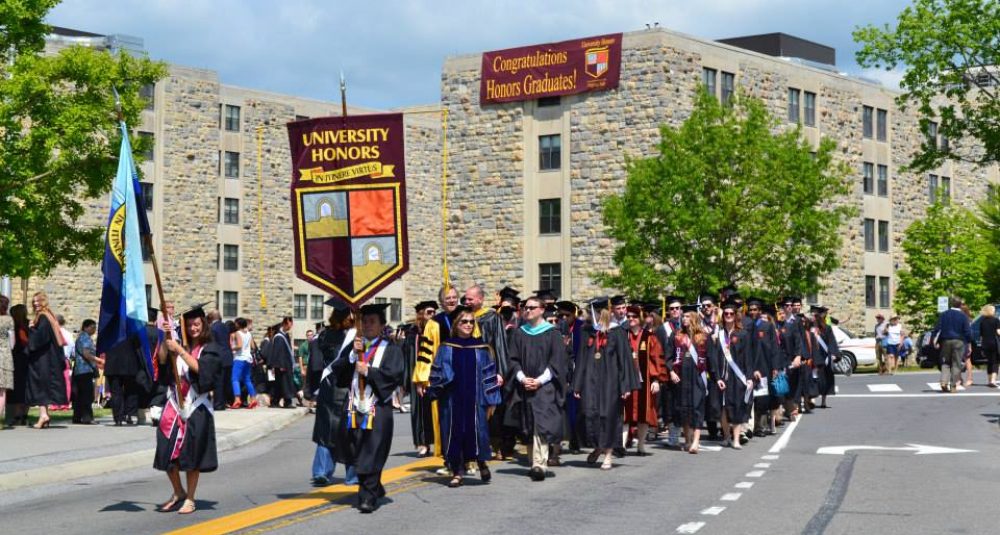
Kansas Honors Grads: Program is Great for Knowledge, Great for Careers

The results of the annual exit survey of honors program graduates at the University of Kansas reveals both the personal and career value of pursuing an honors education.

Based on the responses of 49 honors graduates, the survey shows that 100 percent are either pursuing a career (50 percent); attending medical school (11.1 percent); going to law school (3.3 percent); or pursuing other graduate degrees (35.6 percent).  Of those attending graduate or professional school, 73.5 percent are receiving financial support from the institution.

Perhaps most important, 94.1 percent of students agreed with the following statement: “The University Honors Program provided many opportunities that enhanced my KU education.”

Below please additional comments from students:

“Entering college, I knew I wanted to do big things. But I never dreamed that I would be one of the top two Truman Scholarship Finalists for the state of Kansas! If the KU Honors program hadn’t spent countless hours encouraging me and preparing me, I definitely wouldn’t be where I am today. The advisors in the Honors program are genuinely invested in my success, and they are mentors who I hope to stay friends with for years to come.”-Hannah Sitz, junior, Truman Finalist

“The Honors Program is about so much more courses. My honors advisor pushed me to really consider my passions, my goals, and my experience which lead to an internship on Capitol Hill. It was the best, most exciting time of my college career.”-Danielle Onions, senior

“The Honors Program has been the backbone of my education.  It makes the university feel like home. The staff invests in each and every student and exposes them to opportunities that can’t be found anywhere else.”-Natalie Scott, junior

“My work in lab has led to competitive summer internships and scholarships, and has given me a head start in my career path.  Unlike undergraduates at other universities, I am able to work on my own project and actually advance scientific knowledge.”-Rodi Torres-Gustavo, senior, Goldwater winner

“Without the KU Honors Program, I might have never had the incredible opportunity to travel to Switzerland for a truly international research experience at CERN, the European Organization for Nuclear Research.  The Honors Program gave me the financial support, advising, and connections I needed to make this dream come true.”-Brittany Krutty, senior, Goldwater winner

“The Honors Program provided me both the impetus for choosing to study abroad and part of the scholarships that made it feasible. My semester in Costa Rica was central to my undergraduate experience, and the Honors Program certainly helped facilitate it.”-Bailey Reimer, senior

“The superb instruction and personal attention from my professors in my Honors classes, especially during my freshmen year, were central to my success as a student. Without the extra challenges and resources that they provided, I’m not sure I ever would have felt like KU was a good fit for me.”-Bailey Reimer, senior


South Carolina Honors College: More Prestigious Stamp Scholarships Are Available

By Megan Sexton, msexton@mailbox.sc.edu, 803-777-1421

Five additional students will be named Carolina Scholars — the University of South Carolina’s most prestigious in-state scholarship — with the help of a gift from the Stamps Family Charitable Foundation.

The gift will allow the university to expand the pool of Carolina Scholar freshmen recipients by five, bringing the total number to 25 a year, starting in 2013-14. These additional five recipients will be Stamps Carolina Scholars, and will receive a $10,000 annual scholarship for four years, plus an enrichment fund of $8,000 to use for endeavors such as study abroad, leadership scholar projects, internships and undergraduate research. The Stamps Family Charitable Foundation will pay for half of these five scholarships, with other donors providing matching funds.

“Carolina Scholar students are representatives of the best our state has to offer,” university President Harris Pastides said. “We are pleased to be able to extend the scholarship to additional South Carolina students through the generosity of the Stamps Family Charitable Foundation.”

The students will become part of the university’s prestigious Carolina Scholars program, started in 1969 to celebrate the virtues of a world-class education and keep the state’s most academically talented students in South Carolina. Through private support, the university expanded from nine students in the first year to more than 80 on campus today. Carolina Scholars receive automatic entrance into the South Carolina Honors College, recently ranked as the nation’s top public honors college.

Each Carolina Scholar award provides an annual scholarship of $10,000, a laptop computer, preferred freshmen housing and parking privileges. In addition, the Office of Fellowships and Scholar Programs provides recipients with advising, mentoring and a comprehensive calendar of events during their four years at Carolina.

“We are thankful for this gift from the Stamps Family Charitable Foundation and the trust the Stamps have placed in our university. These new Stamps Carolina Scholar scholarships will become the top-tier in-state award at USC and will help us continue to attract South Carolina’s most talented students,” said Steve Lynn, dean of the South Carolina Honors College.

The Stamps Family Charitable Foundation, founded by Penny and E. Roe Stamps IV of Miami, selected USC as its newest partner in offering premier scholarship opportunities to incoming freshmen. The foundation partners with 33 universities and supports nearly 300 students. This year’s 120 new Stamps Scholars were chosen from more than 160,000 applications across the country.

The original schools in the Stamps scholarship program were Georgia Tech and the University of Michigan, the alma maters of E. Roe Stamps and Penny Stamps. Other schools receiving the scholarship funding include the universities of Chicago, Georgia, Virginia, Florida and Southern California.

“We started on an ‘ad hoc’ basis at Georgia Tech,” said Roe Stamps, a venture capitalist with undergraduate and master’s degrees in industrial engineering from Georgia Tech and a master’s degree in business administration from Harvard Business School. “As we got to know our students and followed their progress, we were increasingly impressed with the quality of the scholars and the personal growth they enjoyed. Our experience was similar at Michigan, and, with the programs well-established at both schools, we decided to branch out to a number of other leading U.S. schools.”

Risk or Predictability: UT System Fixed Tuition Proposal Is No Guarantee

Despite the failure of fixed tuition plans in Georgia and Michigan, and the dubious results of similar efforts in Illinois, the University of Texas System Board of Regents is following the wishes of Gov. Rick Perry and ordering all UT System campuses to come up with proposals to set four-year fixed tuition rates for future entering freshmen.

Perry has been pushing a variety of alleged reforms in Texas, most of them in line with recommendations from groups that have an ideological agenda that is a threat to excellence in public universities.  For the last year and a half, Perry and his followers on the System board, along with right-wing “think tanks,” such as the Texas Public Policy Foundation and the Center for College Affordability and Productivity, have been attacking UT Austin and its president, Bill Powers.

Because of this antagonistic relationship and the poor record of fixed tuition plans in other states, UT system schools should view the latest demand with considerable skepticism.  For one thing, when a university sets fixed tuition for four years for a given entering class, the institution has no way of knowing how much (or, more likely, how little) state funding will be allocated for the same period.  So what happens is that schools set modest fixed rates and run the risk of low-balling expenses or they set higher rates to hedge against cuts in state funding.

For this reason, it is typical for the initial implementation of fixed rates to yield somewhat higher tuition increases than would otherwise have been set.  Moreover, the subsequent entering classes are still subject to higher tuition rates than the class before it.

At the University of Illinois, where fixed tuition was implemented with the support of disgraced former Gov. Rod Blagojevich in 2003, “fixed” tuition rose 9.5 percent for the class of 2010, over the previous class, and then rose another 4.8 percent for the class of 2011.  How much of this increase was needed to offset the fixed rates for previous classes is anybody’s guess.  And four-year graduation rates have not substantially improved, according to university officials.

In Georgia and Michigan, state universities had to forgo their fixed tuition plans because the volatility of state funding and the complexity of budget forecasting made the process to complex to sustain.   University officials emphasized that stable, continuing state funding support was necessary to successful implementation, but the financial crisis led to sharp cuts.

One motive for the UT System plan, aside from providing politicians with what appear to be nice talking points, could be a desire to make UT Austin more vulnerable to state decision-makers and micro-management, since the fixed plans will likely restrict institutional autonomy.

Perry and his supporters point to the UT Dallas as the exemplar of the fixed tuition approach.  While it is true that the four-year graduation rate for UT Dallas has increased from 46 to 51 percent since the implementation of the plan in 2007, it is also true that UT Dallas has the highest tuition of any public university in the state–14 percent higher than UT Austin and 31 percent higher than Texas A&M.

Supporters of fixed tuition say that UT Dallas has so many business and science majors that their costs are necessarily higher.  A review of the variable tuition rates at UT Austin confirms that students majoring in business pay about 6 percent more tuition than the average tuition at the school; engineering majors pay about 4.8 percent more.  Aside from nursing, these are the most expensive majors.

According to U.S. News, the most popular major at UT Dallas is, indeed, business, with 32 percent of students enrolled.  But at Texas A&M, 18 percent of students major in business, and another 14 percent in engineering.   Since there appears to be relatively little difference in the cost of educating business and engineering majors, both UT Dallas and Texas A&M have the same proportion of students in high-cost majors; yet average tuition at UT Dallas is much higher.

Gov. Rick Scott of Florida, who frequently follows Perry’s lead on university “reform,” is also advocating fixed tuition in Florida.  Ohio University is also looking at fixed tuition options.  Yet amid all the change in higher ed these days, no option is without risk, even (or especially) when the goal is predictability.


Decline of the Residential College Experience: A Risk to ‘Emerging Adulthood’?

Amid rising college costs and sharply reduced state funding, many actual and would-be reformers view the dramatic expansion of online instruction as the best way to save money and improve access to higher education.  While online classes are a great advantage for non-traditional students and perhaps for traditional students who can take them in place of some large lecture courses, their overuse may have a negative impact on the personal development of students in the 18-29 age group.

Thus far, the arguments for online instruction have been so influenced by the current financial angst that the impact of true “distance learning” on the personal development of college-aged students has not been at the forefront of the debate.  Yet with generations of highly successful residential college students standing as testament to the value of the traditional college experience, both in the U.S. and abroad, we should take care not to permit the perceived financial advantages of distance learning to overwhelm the developmental advantages of residential learning.

Instead of focusing exclusively on whether cheaper online instruction can impart knowledge as effectively as a college instructor in a lecture hall, we should also take equal care to understand the impact of online instruction on the personal development of students.  This is increasingly true now that Massive Open Online Courses are being considered for college credit.  If we continue to speak in developmental terms, we could say that the atomization of the college experience may only be in its infancy, and we are far from certain about the impact of its growth.

The online revolution is not the only factor that has reduced the proportion of students who participate in the residential college experience.  According to “The American Freshman 2012,” the fascinating work of the Higher Education Research Institute at UCLA, fewer college-aged students are living in dorms now and more are living at home with parents.  The UCLA report also shows that more students are acceding to the wishes of their parents now when it comes to which college to attend and whether to live at home, largely because of financial reasons.

While it is understandable that the economic crisis has forced parents and students alike to be more realistic, we are still left with the question whether, in the long term, we want to see further declines in residential college life.

At least since 2004, when Oxford University Press published Emerging Adulthood: The Winding Road from the Late Teens through the Twenties, by Jeffrey Arnett, psychologists have recognized a distinct development phase between adolescence and adulthood

Arnett convincingly argues that this phase, emerging adulthood, has come about because of the “rise in the ages of entering marriage and parenthood, the lengthening
of higher education, and prolonged job instability during the twenties…. This period is not simply an ‘extended adolescence,’ because it is much different from adolescence, much freer from parental control, much more a period of independent exploration.”

Well before Arnett’s influential work, eminent scholars such as A.W. Astin, founding director of the influential Higher Education Research Institute at UCLA, had written in the 1970s about the importance of the college years to the development of personal identity.  Other scholars who have contributed to our understanding of the college years as a time of critical personal development include Arthur W. Chickering (Education and Identity, 1969), among many publications.

Chickering identified seven “vectors” of development during the college years:

1. Developing intellectual, social, and physical competence.
2. Learning to manage emotions.
3. Moving through autonomy toward interdependence.
4. Developing mature interpersonal relationships.
5. Establishing identity.
6. Developing purpose.
7. Developing integrity.

The list begs the question: Can’t these “vectors” be followed outside of the residential college experience?  The answer is yes, but at what levels of interdependence, with what high or low purpose in mind?  The context of the development is critical.  Other researchers have also pointed to a phenomenon called the “environmental press,” which is a nice way of describing how our peers can push and challenge us.  Will some of our old high school friends challenge us in the same way as our smartest friends and classmates in college, not to mention our professors?

Although the UCLA study tells us that more students are arriving at college feeling “overwhelmed,” it also reports that students with such feelings are more likely than others to find positive support in college that reduces this kind of pressure and enables them to succeed amid the “environmental press” of classwork.  Students living at home may experience only the classroom “press” while lacking the support of student groups and counselors.  These students, in turn, are more likely to turn to their parents at just the time in the students’ lives when they should be pursuing the “vectors” described by Chickering.

Other recent research on college peer relationships, by Lisa M. Swenson, Alicia Nordstrom, and Marnie Hiester, looks at the relationship of college freshmen with their former high school classmates.

“Peer relationships are an integral part of adolescents’ and emerging adults’ lives,” the authors conclude. “In this study, we identified specific ways in which close peer relationships are associated with adjustment to college. Maintaining ties with high school friends can help a new college student adjust during the initial transition period, but it is also important for these college students to make new friends in their new environment if they want to improve their chances of success. Given the serious implica­tions of failure in college, this study provides empirical evidence for the importance of friendships in the transition to college.”

Without considering the personal development of the “emerging adults” who enter college and the ways their peers and professors can affect the remainder of their lives, reformers who are keen to increase access and reduce costs via distance learning may discover that, contrary to their dreams of producing more highly-trained students for the market place, they will be sending young people into the world who have yet to emerge from their early adult phase, and must then “emerge” on the job.  Do we really want to wait so long for this to happen?

–John Willingham, Editor


Gates-Funded Reform Plan: More Low-Income Aid, Fewer Merit Grants, No Tax Credit

More than five years ago, the Bill and Melinda Gates Foundation decided to fund projects and research aimed at doubling by the year 2025 the number of low-income students who graduate from college or from some other post-secondary institution.  The Gates-funded proposals that have come forward in recent weeks share this profoundly egalitarian focus and, if implemented, would have a revolutionary impact on higher education.

While the egalitarian goals are laudable, it is also true that if all the recommendations are implemented, middle-class parents and students will for the most part find it more difficult to pay for college.  The message we receive from these initiatives is that the foundation believes that the nation as a whole is at great risk because too many low-income students are falling behind, and that ameliorating this problem is worth some sacrifice on the part of the middle class.

One such initiative is from the Committee for Economic Development, which proposes that current federal non-loan programs (e.g., Pell Grants) be replaced by need-based federal-state matching programs.  This proposal has received some media attention, but after reading the entire 32-page report, we believe its potential impact has been insufficiently understood.

The CED report argues that the current higher education system is inefficient because too little financial aid goes to those who are most in need.  There is an implicit recognition in the report that “broad-access” institutions will be the most affected, while elite public and private institutions will have to make fewer adjustments.

The report is critical of colleges that regard federally-funded grants and loans as the only means of increasing access to low-income students, meanwhile preferring to use state and institutional funds for the purpose of merit-based aid to high-achieving students who will raise college profiles.  Middle- and even upper-class students who now enjoy merit aid may find that the matching requirements recommended by the CED will dramatically reduce the availability of merit funds.

“Our concern,” the CED says, “is that institutions are engaged in a kind of ‘arms race’ for academically qualified students….This drives an ongoing process of increasing financial aid to students who will go to college regardless of the level of aid they receive.”  One reason for this “arms race” is the focus on student selectivity in college rankings, especially the U.S. News annual best college issue.  Bill Gates has directly criticized this emphasis on “inputs” versus “outputs,” such as improving the skills of under-prepared students.

Clearly the rising cost of attending college has hit low-income students the hardest.  The CED recognizes that state cuts to public colleges and higher operating costs are the principal factors driving higher costs, but sees little on the horizon to change the current lack of public support.  Therefore, the only option is to use student aid funds more efficiently.

The aid funds themselves cannot be increased to cover the increasing costs.  The CED notes that two presidents in a row have funded Pell Grants at record levels (now $35 billion), but the proportion of tuition and fees covered by the grants has gone down.

The specific recommendations of the CED report would transform the college financial aid system, especially grants:

  • Grant funds for a state would be determined by the number of low-income young people in the state, not by the number of high school graduates or college students.
  • Individual grant aid would be determined by the IRS based on tax returns.
  • Grants would be portable across state lines.
  • In-state tuition would not increase more than median family income.
  • State and institutional grant funds would have to match federal funds at 20 percent.
  • Merit-based awards could still exist, but only after this 20 percent matching level has been met.
  • States could refuse to participate, but then would lose the 80 percent federal grant contribution.
  • The tax credit for families with college students would be eliminated and the $18 billion in savings would be used for incentive programs (using financial aid to increase graduation rates; tying financial aid work-study to local job market).
  • Aid applications would be simplified.
  • Loans would be repaid based on income.

The report acknowledges that reduced merit aid and the elimination of the college tax credit will hurt middle-income families, but says that some of this harm will be offset by the requirement that colleges could increase tuition and fees only to the extent of any increase in median family income.

The CED says that this requirement will force state legislatures and college administrators to reach “durable” agreements about how much state appropriations may change or about how much tuition and fees might increase.


Berkeley Chancellor to Lead National Effort on Behalf of Public Universities

Our thanks to Larry Gordon of the LA Times for the story reprinted below about a new national effort to preserve and strengthen the nation’s public universities, to be led by outgoing UC Chancellor Robert Birgeneau.

By way of preface, we note that on the state level similar organizations have been created to deal with the most damaging budgetary and philosophical attacks on public universities, including most of the leading flagship and land-grant institutions. Not only Texas, but Virginia, Florida, and Wisconsin have all faced or survived ill-advised attempts on the part of would-be reformers to use the recent financial crisis as a pretext for implementing a radical agenda that would diminish the excellence of outstanding public universities.

University leaders from UCLA, Michigan, UT Austin, and CUNY will assist Birgeneau, which is an initiative of the American Academy for Arts and Sciences.   Levi-Straus Chairman Emeritus Robert D. Haas is also on board (see below).

The article by Mr. Gordon is below.

By Larry Gordon, Los Angeles Times

January 28, 2013

After he retires as chancellor of UC Berkeley in June, Robert J. Birgeneau will head up a national effort to study and help public universities in an era of reduced tax support, new technology and changing student demographics.

Birgeneau, a physicist, is to lead the American Academy of Arts and Sciences’ new initiative that will propose ways for the federal government, private industry and foundations to better aid state institutions, along with developing reforms the schools could undertake. It is being called “The Lincoln Project: Excellence and Access in Public Higher Education” — named for President Lincoln, who in 1862 signed the Morrill Act granting federal lands for the establishment of public universities.

The announcement is scheduled to be made Monday at UC Berkeley at an academy symposium about higher education.

Birgeneau, who is 70 and has led UC Berkeley since 2004, said he wanted to help develop “workable plans that will help reverse the progressive disinvestment we have seen in public higher education across the country.”

He said that will not occur by just urging more state funding but will need a wider range of government and private supporters. “The long-term civic and economic welfare of the country depends heavily on a robust public higher education system,” Birgeneau said in an interview, adding that it is too soon to discuss specific goals or plans.

The position is a part-time, unpaid one for Birgeneau, who will begin a sabbatical from UC in June and return at a later date to teach and conduct research. He said he hopes to have the first Lincoln Project proposals ready in a year and that the effort probably will last three years. Previously, Birgeneau was president of the University of Toronto, Canada’s largest public university, and science dean at the Massachusetts Institute of Technology.

The American Academy of Arts and Sciences is a policy research center and honorific scholarly organization headquartered in Cambridge, Mass. Its president, Leslie C. Berlowitz, described Birgeneau as “a dynamic and highly respected leader in higher education” and noted his efforts to broaden financial aid for middle-class families and for undocumented students.

Other advisors on the project include UCLA chancellor Gene Block; Mary Sue Coleman, president of the University of Michigan; Matthew Goldstein, chancellor of the City University of New York; William Powers Jr., president of the University of Texas at Austin; and Robert D. Haas, chairman emeritus of Levi Strauss & Co. and a noted donor to higher education.


Smart Money: Public Grads Get Best Pay Relative to Cost of Tuition, Fees

Smart Money Magazine, a publication of the Wall Street Journal, issues annual rankings of the universities whose grads earn salaries that are high relative to the cost of tuition and fees.  The top 17 schools on the list are all public universities, and 21 of the top 50 are public.

This return on investment analysis is different from the annual Kiplinger Best Value Report, which ranks colleges based on cost and student indebtedness on the one hand, and the academic ranking of the school on the other.  The resulting “value” is not expressed in dollar terms but in the quality of education derived from the investment.

But Smart Money is all about the bottom line: the pay derived from the investment.

Below is a list of the top 25 public and private universities on the top 50 list, showing their rank, four-year cost, median salary of new grads, and median salary of mid-career grads.  The figures are based on starting tuition and fees for the class of 2009, so be aware that tuition and fees for some of these schools have gone up dramatically since 2005.  Unfortunately, the salary figures probably have not gone up much at all.

1. Georgia Tech: cost ($87,810); new grad pay ($59,000); mid-career pay ($102,000)

2. Florida: cost ($73,476); new grad pay ($46,200); mid-career pay ($80,800)

3. UT Austin: cost ($91,596); new grad pay ($48,800); mid-career pay ($90,800)

4. Georgia: cost ($77,957); new grad pay ($41,100); mid-career pay ($79,200)

5. Illinois: cost ($91,382); new grad pay ($51,400); mid-career pay ($95,900)

6. Washington: cost ($86,540); new grad pay ($47,600); mid-career pay ($90,300)

7. Clemson: cost ($85,362); new grad pay ($45,300); mid-career pay ($86,900)

8. Purdue: (cost $86,538); new grad pay ($51,800); mid-career pay ($87,200)

9.  Colorado School of Mines: cost ($90,334); new grad pay ($64,200); mid-career pay ($105,000)

10. UC Berkeley: cost ($104,717); new grad pay ($52,100); mid-career pay ($103,000)

11. Miami of Ohio: cost ($94,784); new grad pay ($46,600); mid-career pay ($85,500)

12. Indiana: cost ($87,065); new grad pay ($42,400); mid-career pay ($80,000)

13. Penn State: cost ($93,108); new grad pay ($48,600); mid-career pay ($83,000)

14. Oregon: cost ($74,481); new grad pay ($39,500); mid-career pay ($76,600)

15. Michigan State: cost ($95,372); new grad pay ($44,300); mid-career pay ($78,000)

16. William & Mary: cost ($103,799); new grad pay ($44,000); mid-career pay ($97,100)

17. Virginia: cost ($107,395); new grad pay ($50,200); mid-career pay ($89,400)

18. Princeton: cost ($131,740); new grad pay ($58,300); mid-career pay ($137,000)

19. Colorado: cost ($97,918); new grad pay ($45,000); mid-career pay ($87,100)

20. New Hampshire: cost ($93,615); new grad pay ($42,600); mid-career pay ($75,600)

21. Carnegie-Mellon: cost ($143,540); new grad pay ($59,800); mid-career pay ($104,000)

22. Williams: cost ($138,770); new grad pay ($53,600); mid-career pay ($113,000)

23. Dartmouth: cost ($137,364); new grad pay ($54,100); mid-career pay ($111,000)

24. Harvard: cost ($136,977); new grad pay ($50,700); mid-career pay ($111,000)

25. Colgate: cost ($145,340); new grad pay ($49,700); mid-career pay ($111,000)


Publics with Low Tuition–or Low Percentage Increases in Tuition

Below please see the public universities we follow that have the lowest tuition and fees for 2012-2013–AND a separate list that shows the schools with the smallest percentage increase in tuition since 2006.  Our thanks to the Wall Street Journal for providing much of this information.

Please note that some schools with smaller percentage increases since 2006 may nevertheless have relatively high rates.  The Journal reported that the average in-state tuition among the 72 schools surveyed was $8,655 for 2012-2013.

Major public universities with lowest in-state tuition and fees for 2012–2013:

New Mexico–$6,049

Florida–$6,170

Central Florida–$6,247

Mississippi State–$6,264

South Florida–$6,334

Florida State–$6,403

Alabama Birmingham–$6,798

LSU–$6,996

Major public universities with lowest percentage increases in tuition (in-state), 2006–2012:

Maryland, 12.7 percent, from $7,906 to $8,909

Cincinnati–13.6 percent, from $9,489 to $10,784

Ohio State–15.8 percent, from $8,667 to $10,037

Montana State–18.3 percent, from $5,673 to $6,710

Missouri–19.1 percent, from $7,784 to $9,272

Texas A&M, 22.1 percent, from $6,966 to $8,506

SUNY Albany, 26.7 percent, from $5,939 to $7,525

North Dakota State, 27.5 percent, from $5,767 to $7,353

UT Austin, 28.4 percent, from $7,630 to $9,794

Arkansas, 30.1 percent, from $5,808 to $7,564

SUNY Buffalo, 30.4 percent, from $6,168 to $7,989

Iowa, 31.3 percent, from $6,135 to $8,057

Rutgers, 31.3 percent, from $9,958 to $13,073

Iowa State, 31.8 percent, from $5,860 to $7,726

South Carolina, 34.3 percent, from $7,808 to $10,488

Stony Brook, from $5,630 to $7 ,560

Houston, from $5,680 to $7,638


Kiplinger Best Value 2013 Plus Honors Value Added

Below is the most recent list of the honors programs that have the most value-added impact on their universities and that are within universities listed in the Kiplinger top 100 “Best Values In Public Colleges” report of 2013.

We estimate the honors impact by comparing the ranking of each university as a whole with our evaluation of the honors program.  If our ranking places an honors program or college higher than the national ranking of the university as a whole, then the honors program provides value added.

For example, if University A honors college ranks 24th in our evaluation of 50 programs and colleges, and the university as a whole ranks 34th among the 50 universities we considered in the U.S. News rankings, then University A’s honors college has significant value added.

The value-added programs that we are listing in this post are those at South Carolina,  Arkansas, Georgia, Michigan State, Delaware, Stony Brook, Minnesota, Missouri, Oregon, Nebraska, and Indiana.  We will also note if their Kiplinger value is up from 2012, a difficult standard to meet, given the cuts to state schools and the resulting rise in tuition and student loans.

Congratulations to South Carolina, Stony Brook, Minnesota, Missouri, and Indiana for raising their average Kiplinger rankings in 2013 and for having value-added honors programs!

Since all of these universities are also included among the top 100 best values in the annual Kiplinger report, this means that the honors programs at these schools are a “value-added to the value-added” because the honors programs significantly enhance the value that already exists in the universities as a whole.

The annual Kiplinger special report is a well-known and influential publication. The report presents a cost/value analysis, comparing the academic reputation of selected public universities to the total net costs of attending, using both in-state and out-of-state tuition as benchmarks. Kiplinger begins with 500 public colleges and universities, eventually honoring the top 100 as best values.

Kiplinger does not directly consider the value added by public honors programs, although it is certain that the qualifications and achievements of honors students are an important contributor to a university’s academic excellence.

Below is the name of the university, its Kiplinger best value rankings for in-state and out-of-state tuition, and its honors program impact rank among the 50 leading state universities we reviewed. The lower the number in honors impact, the greater the value-added factor of the honors program.

University of South Carolina
In-state tuition (35); out-of-state tuition (50); honors impact rank (2).  Kiplinger average value is UP from 2102.

The University of Arkansas
In-state tuition (65); out-of state tuition (78); honors impact rank (3).

University of Georgia
In-state tuition (15); out-of-state tuition (24); honors impact rank (7).

Michigan State University
In-state tuition (46); out-of-state tuition (66); honors impact rank (7).

Stony Brook
In-state tuition (22); out-of-state tuition (9); honors impact rank (9).  Kiplinger value is UP from 2012.

University of Delaware
In-state tuition (29); out-of-state tuition (26); honors impact rank (10).

University of Minnesota
In-state tuition (45); out-of-state tuition (12); honors impact rank (11).  Kiplinger value is UP from 2012.

University of Missouri
In-state tuition (66); out-of-state tuition (74); honors impact rank (12). Kiplinger value is UP from 2012.

University of Oregon
In-state tuition (98); out-of-state tuition (99); honors impact rank (12).

University of Nebraska
In-state tuition (75); out-of-state tuition (87); honors impact rank (14).

Indiana University
In-state tuition (39); out-of-state tuition (64); honors impact rank (15). Kiplinger value is UP from 2012.

Gates Foundation: No More Cuts for Colleges, but More Productivity from Pell Recipients

The Bill and Melinda Gates Foundation has released a summary of their recommendations for dealing with the budget crisis in public universities, and key to their findings is that while state funding cuts have been severe and should go no further, the success rate for Pell Grant recipients is not high enough in relation to the cost.

The Foundation does not subscribe to the idea that college for most people isn’t worth the cost anymore.

“The returns to the individual from education are very clear,” the summary says. “In short, the more education you get, the more money you earn, and the less likely you are to be unemployed. This pattern holds true at every rung up the educational ladder, from high school dropouts to students who earn professional graduate degrees.”

The public still concurs: college enrollment has risen 17 percent over the last five years–but states have responded by higher education funding cuts of 13 percent.

While the report does not lay all the blame for rising tuition costs and student debt on state budget reductions, there is no doubt that the Foundation believes further cuts are not the solution. “The cost of a public education has been going up steadily for years,” the summary says, “and the rate of increase has spiked since disinvestment at the state level.”

Of course rising tuition has filled part of the gap, but the Foundation is especially concerned that increasing reliance on student loans, specifically Pell Grants, are not yielding a strong return on the public investment.

“So individuals and the government are spending all this money they don’t have on college, which it turns out is about a 50/50 proposition,” the report says. The Foundation is now trying to find ways to improve the graduation performance of Pell recipients.

Aside from putting an end to state funding cuts and improving Pell performance, the Foundation believes that it is necessary to “keep redesigning the higher education experience to fit the changing demographics of the student population.

“As enrollment goes up, the typical student profile changes. College students today are working and raising families while attending school, and they are often going part time. We should not expect to educate them the same way we educate single 18-year-olds living on campus and focusing only on classes.”

Not surprisingly, this leads to an encouraging message about the effectiveness of online learning.  The Foundation wants even more focus on “developing technologies that can improve learning and increase personalization while lowering costs. And we have to focus on developing technologies that are effective with the least advantaged students.”

The Foundation has funded Carnegie Mellon’s Open Learning Initiative (OLI).  OLI has developed interactive courseware that “got very compelling results with Carnegie Mellon students, but the question always existed about whether the results would hold for less well prepared and self-motivated students.

“We funded OLI to work with community colleges and their students. Recently, a random control trial proved that OLI-powered blended learning at public universities serving a cross section of student produced the same or better results than traditional models while getting students through the material in less time. The results point the way to significant cost savings and high-quality learning together.”

We believe that however the introduction of online learning plays out, the Foundation’s concern for public higher education is laudable as well as necessary if we are indeed to “maintain our higher education system as an engine of growth and social justice.”