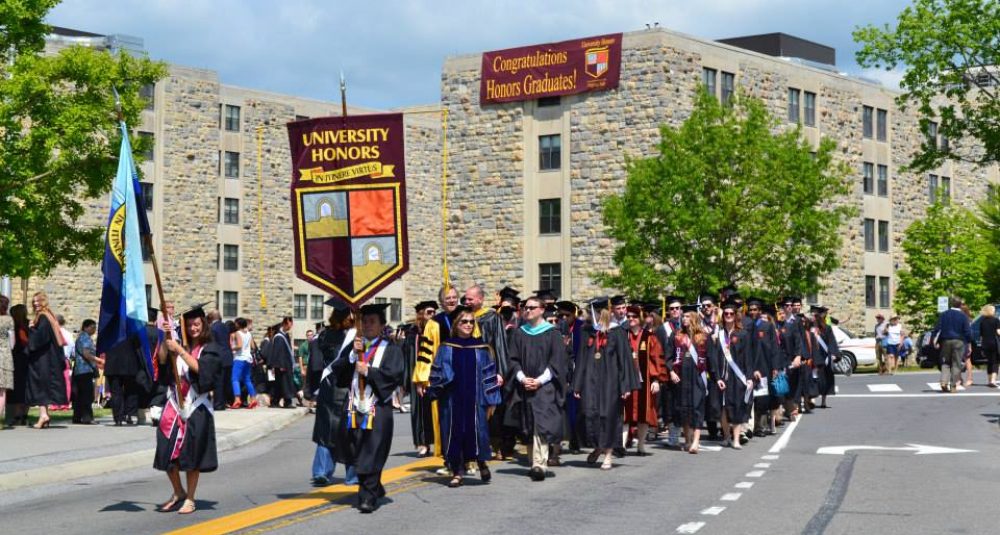
Only a couple of years ago, the emerging Purdue Honors College enrolled about 1,000 students and was still in the process of transitioning from the Honors Program, which began back in 2005.
But now the enrollment is up to 1,800 students–and the College has announced other changes as part of a major expansion. The Honors College will soon have a $90 million, 311,000 square foot Honors College and Residences complex.
“This facility will provide a home for the College, inaugurated in the Fall of 2013. Providing over 800 beds, the complex will house the offices, innovation forum, classrooms and labs for the honors students. The Purdue Honors College has 1800 students who will be served by the facility that is among the first in Indiana – and Purdue’s first- to be built using the efficient construction manager as constructor (CMC) process.
“The new home will provide opportunities for enhancing the living learning experiences for honors students.”
The Honors College, under the leadership of Dean Rhonda Phillips, has already made a name for itself. In our 2014 edition of A Review of Fifty Public University Honors Programs, the College achieved a 4.5 mortarboard rating on the basis of its curriculum, staffing, class size, and excellent six-year graduation rate of 94 percent.
FAFSA Will No Longer Share Your College Choice with Other Schools
In what is welcome news to college applicants and their parents, the musical chairs game of prioritizing your list of school on the FAFSA form–and hoping that schools will not hold it against you if don’t list them first–now seems to be over.
“…it’s all behind us,” says consultant and web columnist Nancy Griesemer. “In the single biggest change for 2016-17 federal financial aid programming, the list of colleges a student includes on the FAFSA will not be shared except with the student’s state agency—not with other colleges.”
But if you are applying to an in-state public university, you would be wise to list that choice first in order to qualify for state aid. According to the FAFSA website:
“For purposes of federal student aid, it does not matter in what order you list the schools. However, to be considered for state aid, several states require you to list a state school first. Therefore, if you plan to list a state school in your state of residence as one of the schools in this section, you might want to list it first. After the first school, you may wish to list additional schools in alphabetical order.
So far, I have been unable to identify the states that require applicants in-state to list an in-state university first. So…if you’re applying to one in your state, why not go ahead and list it first, especially since your other choices won’t receive that information now.
“You can list up to 10 schools on the online FAFSA or up to four schools on a paper FAFSA. (You can add more schools to your FAFSA later.) Schools you list on your FAFSA will automatically receive your FAFSA results electronically.”
Have you ever notice that the Academic Reputation scores in the U.S News Best Colleges ranking can be very high for several public universities although their overall ranking is much lower than other schools with less stellar reputations?
Of course, there can be good reasons for this discrepancy: larger class sizes in public universities, lower graduation rates, etc. But…honors colleges and programs within the larger institutions offset the negatives and offer their students opportunities to take advantage of the factors contributing to the strong academic reputations.
First, these are factors to consider if the state university’s academic reputation is much stronger than its overall ranking:
1. The overall rankings penalize public universities for their typically larger class sizes, but the average class size in the 50 major honors programs we track is only 21.2 students, much smaller than the average class size for the universities as a whole. Most of these honors classes are lower-division, where the preponderance of large classes is the norm. Result: the relatively poor rating the whole university might receive for class size is offset for honors students.
2. The overall rankings hit some public universities hard for having relatively low retention and graduation percentages, but freshmen retention rates in honors programs are in the 90% range and higher; meanwhile six-year grad rates for honors entrants average 89%–much higher than the average rates for the universities as a whole. Result: the lower rates for the universities as a whole are offset for honors students.
3. All public universities suffer in the overall rankings because U.S. News assigns ranking points for both the wealth of the university as a whole and for the impact that wealth has on professors’ salaries, smaller class sizes, etc. This is a double whammy in its consideration of inputs and outputs separately; only the outputs should be rated. Result: the outputs for class size (see above) are offset for honors students, and the wealth of the university as an input should not be considered in the first place.
4. For highly-qualified students interested in graduate or professional school, academic reputation and the ability to work with outstanding research faculty are big advantages. Honors students have enhanced opportunities to work with outstanding faculty members even in large research universities, many of which are likely to have strong departmental rankings in the student’s subject area. Result: honors students are not penalized for the research focus of public research universities; instead, they benefit from it.
5. Many wealthy private elites are generous in funding all, or most, need-based aid, but increasingly offer little or no merit aid. This means that families might receive all the need-based aid they “deserve” according to a federal or institutional calculation and still face annual college costs of $16,000 to $50,000. On the other hand, national scholars and other highly-qualified students can still receive significant merit aid at most public universities. Result: if a public university has an academic reputation equal to that of a wealthy private elite, an honors student could be better off financially and not suffer academically in a public honors program.
But…what if the academic reputation of the public university is lower than that of a private school under consideration? In this case, the public honors option should offer the following offsets:
1. The net cost advantage of the public university, including merit aid, probably needs to be significant.
2. It is extremely important to evaluate the specific components of the honors program to determine if it provides a major “value-added” advantage–is it, relatively, better than the university as a whole. Typically, the answer will be yes. To determine how much better, look at the academic disciplines covered by the honors program, the actual class sizes, retention and graduation rates, research opportunities, and even honors housing and perks, such as priority registration.
Honors News is a regular (not always daily) update, in brief, of recent news from honors colleges/programs and from the world of higher ed. Occasionally, a bit of opinion enters the discussion. These brief posts are by John Willingham, unless otherwise noted.
The SAT redesign has independent college consultants worried. Now, 99% of them are recommending that high school juniors take the ACT, and 71% are advising students to skip the revised SAT for at least the first go-round.
Nancy Griesemer, who writes great columns for the Washington Examiner, goes into greater detail. She and other consultants are concerned that the unknowns and increased rigor of the revised SAT could make for unpleasant surprises for the first group of students to take it.
“Despite efforts by the College Board to provide substantial advance information about the new test, counselors are uneasy about the Board’s ability to pull it all together in time for next year’s juniors,” she writes. “In fact, the vast majority of IECs surveyed (87%) indicated they were changing the advice they ordinarily give students about which college admission exams to take and when.”
One possible strategy: take the old SAT test this fall, and then the ACT in the spring. Then…in the senior year think about re-taking the tests and even tackling the revised SAT.
Honors News is a regular (not always daily) update, in brief, of recent news from honors colleges/programs and from the world of higher ed. Occasionally, a bit of opinion enters the discussion. These brief posts are by John Willingham, unless otherwise noted.
August 11, 2015–Exciting news from Rutgers New Brunswick: a new Honors College, along with its own central living/learning community, is welcoming approximately 500 “of the highest achieving students from New Jersey,” according to Dean Matt Matsuda.
“Our students come from across the undergraduate schools at Rutgers-New Brunswick– Arts and Sciences, Environmental and Biological Sciences, Engineering, Business, Pharmacy, and Fine Arts,” the Dean reports. Membership in the Honors College is a four-year experience.
The new living/learning facility, “situated at the heart of the New Brunswick campus and opening this fall,” houses all first-year students in the Honors College, “as well as administrative and advising offices, six seminar rooms, plentiful lounge and study areas for programming, and three live-in faculty apartments. We are ready to welcome our inaugural class this fall as Rutgers, The State University of New Jersey, celebrates its 250th anniversary.”
Building on the success of the SAS (Arts and Sciences) Honors Program, the new Honors College “expands honors education at Rutgers-New Brunswick, by redefining interdisciplinary education. While the school-based honors programs will continue as they have in the past, the new Honors College invites students from across the liberal arts and professional schools to live and work together to tackle global issues.
“The Honors College is a community where intellectual curiosity, hands-on knowledge, diversity, collaboration, and giving back are central to its philosophy.”
August 11, 2015–Although there are few hard and fast rules regarding honors programs, honors curricula and completion requirements are, as one might think, the most important components of an honors program. Here’s why: More honors classes, and the requirement that honors students must complete 25-40 hours of credits in honors, place students in a learning environment together more frequently, and reinforce their contacts with professors and research opportunities. Lower levels of completion, while still providing the advantage of replacing many Gen Ed courses with smaller honors sections, can (but not always) lead to a student’s declining interest in honors.
Living/learning communities, clubs, honors benefits (e.g., priority registration) and volunteer activities are also vital components of honors education–but in the end what happens in the classroom, and how frequently it happens, are the most important factors in sustaining the honors experience.
Honors News is a regular (not always daily) update, in brief, of recent news from honors colleges/programs and from the world of higher ed. Occasionally, a bit of opinion enters the discussion. These brief posts are by John Willingham, unless otherwise noted.
August 10, 2015–The response to Frank Bruni’s column yesterday on the public honors option has been strong and enthusiastic, but a bit of clarification is in order.
First, the distinctions between honors colleges and honors programs are not always pronounced. Many honors programs have been around longer than honors colleges and have, for various reasons, chosen to retain their original names and structure. Among these many prominent programs are the University of Michigan LS&A Honors Program, the UT Austin Plan II Honors Program, and the UVA Echols Scholars Program. All are rated at 5.0 “mortarboards” on a scale of 5.0. They join ASU Barrett Honors College, Penn State’s Schreyer Honors College, the South Carolina Honors College, and the Kansas University Honors Program to round out the group of seven colleges/programs rated 5.0.
Our page Top Honors Programs also lists an additional 14 honors colleges and programs that received a 4.5 rating.
Second, we do not rank programs or colleges (from now on we will use the generic term “programs”) because, after attempting to do so in 2012, I realized that ordinal rankings, especially with respect to honors programs, are more likely to exhibit artificial distinctions rather than reflect any qualitative differences. That is why we “rate” with the 5 mortarboard system and do not “rank” numerically.
Honors News is a regular (not always daily) update, in brief, of recent news from honors colleges/programs and from the world of higher ed. Occasionally, a bit of opinion enters the discussion. These brief posts are by John Willingham, unless otherwise noted.
Editor’s Note: The following is one of our relatively rare opinion pieces.
Another presidential election year is approaching, and another presidential candidate is taking aim at the public university system in his state, and boasting of his budget cuts and alleged reforms.
This time around it’s Scott Walker of Wisconsin; in 2012 it was Rick Perry of Texas.
Opportunistic politicians and ideologues found major public universities to be an easy target for criticism and budget cuts during the great recession, and governors long opposed to the “liberalism” in higher ed embraced the opportunity to whack away at funding for research and disciplines they didn’t like.
In the aftermath of the recession, the partisan ideology driving attacks on public higher education remains strong, and in the state of Wisconsin, Scott Walker has doubled down on efforts to cut funding for the University of Wisconsin system even as other states are reinvesting in their own universities.
Rick Perry embarked on a similar crusade against the University of Texas and Texas A&M systems several years ago, only to be outwitted and ultimately defeated by staunch supporters of both systems. Like Walker, Perry sought to bring a business model to the higher education systems, and by business he meant the interests of business: sacrificing the intellectual impact of higher education to the immediate and often shortsighted “needs” of business and industry.
Productivity was the buzzword in Texas, and the biggest enemies of productivity were the disciplines that brought in little money and allegedly offered no vocational advantage to students: the humanities and social sciences.
The latest developments in Wisconsin are that the UW system now has $250 million less in the current state budget, and some safeguards protecting faculty and academic programs have been eroded. That this is happening in Wisconsin is of special concern because “The Wisconsin Idea,” enshrined in state law for more than a century, articulated a high and noble purpose for public universities.
“The legislature finds it in the public interest to provide a system of higher education…” the state statute begins, but a Walker staffer proposed deleting this opening clause and replacing it with “There is created a system of higher education…”, as if placing the public interest at the forefront of the statute somehow overlooked a more important purpose.
That more important purpose becomes clear in the next section, where the staffer wrote that the primary mission of the UW system was “to meet the state’s workforce needs,” rather than “to discover and disseminate knowledge.” The staffer then struck these final words of the section:
“Inherent in this broad mission are methods of instruction, research, extended training and public service designed to educate people and improve the human condition. Basic to every purpose of the system is the search for truth.”
In the end, the proposed changes did not take hold following media scrutiny and public opposition; but the changes in the language illustrate just how far the discovery of knowledge, improving the human condition, and the search for truth have fallen in the eyes of self-serving ideologues.
This is not to say that universities, public and private, should not offer majors that have a clear vocational focus. UW Madison certainly does so, with high ranking programs in both business and engineering. The reformers would doubtless see these as ways to improve the individual’s condition economically, and thereby worth funding. But what about the individual’s sense of values, understanding of the nation’s past, appreciation of both the threats and advances of other cultures? What about research that improves health care, legal services, and education?
UW Madison now faces the loss of about 400 employees as a result of the budget cuts. The tenure protection once guaranteed by state statute has now been watered down as part of a move to make the system operate more like a corporation, with greater freedom to define and limit programs and cut faculty positions. Guess which programs will suffer? Not business, not engineering, not the hard sciences perhaps, but those pesky humanities and social sciences with all their unsettling ideas and pointed references to the lessons and values of the past.
Yes, these disciplines can wander far afield on occasion and come up with what are, or appear to be, bizarre arguments and interpretations. But here’s the thing: you never know where the most important ideas and insights will come from, and limiting the scope of higher education to vocational pursuits is far riskier than allowing scholars in all the major disciplines to pursue their research.
Ideologues are quick to urge bright students to attend elite private universities, all of which encourage and, often, lavishly fund research in all disciplines. Can you imagine Harvard without strong departments in English, history, philosophy, sociology, and psychology? Yale? Chicago? Does anyone seriously believe these schools would retain their generally deserved credibility if they were to make it their primary mission “to meet workforce needs”? They exist to challenge bright students in all major areas of inquiry. The result: leaders not only in “the workforce” but also in every other facet of life.
It is weirdly shortsighted that the governor of Wisconsin, a state without a high-profile private university, does not want the citizens of the state to have reasonable access to the highest levels of education. Like other “reformers,” he seems to operate under the assumption that there are enough elite private schools to accommodate the smartest students, even if they have to go out of state. (And, if UW Madison is significantly reduced, they will. Surely the governor can appreciate the power of a “brand” and what happens when it is lost. )
But in fact there are not enough prominent private universities to provide places for all the brightest students, and why would a governor promote policies that tend to drive these students out of his state anyway?
Thus do political opportunism and ideology lead ultimately to the worst kind of academic outcome: a brain drain.
Editor’s note: The following article is by Peter Jacobs of Business Insider. We are posting it here because it is a great illustration of the main advantage of many public honors colleges and programs–merit aid for highly talented students that they cannot receive at most private elites.
After some thought and consideration of all the schools’ offers, Nelson decided it wouldn’t be worth the financial strain to use this money on his undergraduate education. He plans on going to medical school after college, and knows he’ll be faced with more tuition costs.
“With people being in debt for years and years, it wasn’t a burden that Ronald wanted to take on and it wasn’t a burden that we wanted to deal with for a number of years after undergraduate,” Ronald Sr. said. “We can put that money away and spend it on his medical school, or any other graduate school.”
University Alabama Quad Denny Chimes Campus
Looking long term, Nelson doesn’t think his decision will impact his chances of getting in to a top medical school or other graduate program. After speaking with his teachers and guidance counselors, Nelson said, he realized that “any undergraduate school can prepare you for a graduate program. It’s just determined on how much work you’re willing to put in.”
At UA, Nelson will be part of the university’s “Fellows Experience” through its honors college. A visit to Tuscaloosa, Alabama, as part of the program’s multiround interview process helped seal the deal for UA. He got to meet other students he would study with over the next four years and was impressed by them.
“It was kind of amazing being around so many like-minded students, which is why I think I’ll be able to have a similar situation [to an Ivy League school], considering the type of students they’re attracting,” Nelson said.
The financial incentive for attending Alabama was high. Due to his high standardized-test scores on the SAT and ACT, UA waived Nelson’s out-of-state fees and covered his tuition costs. Through the fellows program and his National Merit scholarship, Nelson will also have stipends for extra campus costs and potentially studying abroad.
While some people may see his decision to turn down schools such as Harvard, Princeton, Yale, and Stanford as ill considered or shortsighted, Nelson said he’s received a ton of support for choosing UA. One teacher, he told Business Insider, complimented him for “making such an informed decision” about where to work towards his undergraduate degree.
“I’ve had a lot of people questioning me — ‘Why are you doing this?’ — but after I explain my circumstances, they definitely understand where I’m coming from,” Nelson said.
Overall, though, Nelson doesn’t appear to have any regrets about his decision and seems excited to start college in the fall.
“The Ivy League experience would certainly be something amazing, to make these connections, and have these amazing professors,” he said. “But I really do think I’ll be able to make the same experience for myself at the college I chose.”
Editor’s Note: The following is excerpted from the most recent issue of The Alcalde, the alumni publication of the University of Texas at Austin. The automatic admission of a student in the top 10 percent of his or her high school class, in place since 1997, has had unintended consequences for minority students and non-minority students alike.
By 2008, more than 80 percent of incoming freshman at UT-Austin were admitted under the [10 percent] rule, leaving the university to choose less than 20 percent of its own incoming class. Then-chancellor Francisco Cigarroa and UT-Austin president Bill Powers appealed to the 2009 Texas Legislature to cap automatic admissions at 50 percent of each incoming class. Without action, they predicted, UT wouldn’t be able to admit any students from outside the U.S. or Texas by 2015.
Legislators intervened specifically for UT-Austin, but compromised on a 75 percent cap. Since then, the university has admitted the top one percent, two percent, and so on until it reached the cap, which means that for the incoming class of 2019, UT-Austin’s top 10 Percent Law is really a top eight percent rule.
As ProPublica notes, the competition for non-automatic admission to UT in 2008 was tougher than getting into Harvard.
While applications from minority students more than doubled in the first 10 years of the law, its success is still debatable. A 2012 Princeton study of UT and Texas A&M concluded that the law actually benefited white students more than Hispanic students. While test scores rose at smaller state universities, applicants at the flagships came from more affluent, less diverse high schools and graduates from poorer schools, particularly Hispanic graduates, were less likely to apply.
In a state-required report compiled in the fall of 2014, UT officials noted that between 2013-14, African-American and Hispanic representation actually decreased, as did the number of admitted and enrolled first-generation students and those from lower socioeconomic groups.
One of the barriers to coming to UT, presumably, is cost. If, for example, you come from San Perlita, at Texas’ southern tip, where more than half of residents under 18 live below the poverty line, heading more than 300 miles north just to pay tuition, rent, and buy books for at least four years is a daunting prospect. In response to the declining numbers from populations meant to be served by the law, UT has launched the Texas Advance scholarship program, which the university says could essentially offset tuition when paired with state and federal aid.
While a handful of bills relating to the rule have been filed during the 2015 legislative session, only one would fundamentally change it, even then only altering it to automatically admit students from the top eight percent. That rule wouldn’t change much at UT, which is already essentially a top eight percent institution. Despite questions of its effect and effectiveness, it seems the law will stick around, at least for a while.
Tayo Sanders II was a talented high school student with a passion for science and an eye toward a career in medicine or engineering the first time he stepped onto the University of Wisconsin-Eau Claire campus.
While bright and ambitious, at that time the word research didn’t mean a lot to Sanders, nanoscience sounded like a foreign language, he’d barely traveled outside of Wisconsin, and he’d never even heard of the Rhodes scholarship.
Tayo Sanders: "I can't imagine myself as a Rhodes Scholar if I had gone to school anywhere else."
But a friend’s father who was a physician and a UW-Eau Claire graduate convinced him that his alma mater, a regional public university with a nationally known chemistry program and highly accessible professors, would be a good fit for Sanders, a first-generation college student with limited financial resources.
Turns out, his friend’s dad could not have been more right.
In November 2014, Sanders was named one of 32 American students who will make up the 2015 Rhodes scholar class. In October — after graduating from UW-Eau Claire and then completing a summer internship at an investment firm in Washington, D.C. — he will begin his studies at Oxford University in England, where he will pursue his doctoral degree in materials while immersed in research alongside some of the world’s most respected scientists.
As a Rhodes scholar, Sanders joins an elite group that includes U.S. presidents, members of Congress, artists and others who are known internationally for their contributions to their chosen professions.
“In many ways, it still hasn’t fully sunk in,” says Sanders, who is one of just a handful of students from a public regional university to ever be selected as a Rhodes scholar, arguably the most prestigious scholarship program in the world. “When my professors suggested that I apply to be a Rhodes scholar, I didn’t even know what it was. And once I looked into it, I didn’t think I had a chance. But they convinced me to try and helped me believe it was possible.”
“I can’t imagine myself as a Rhodes scholar if I had gone to school anywhere else.”