Georgia Tech Honors

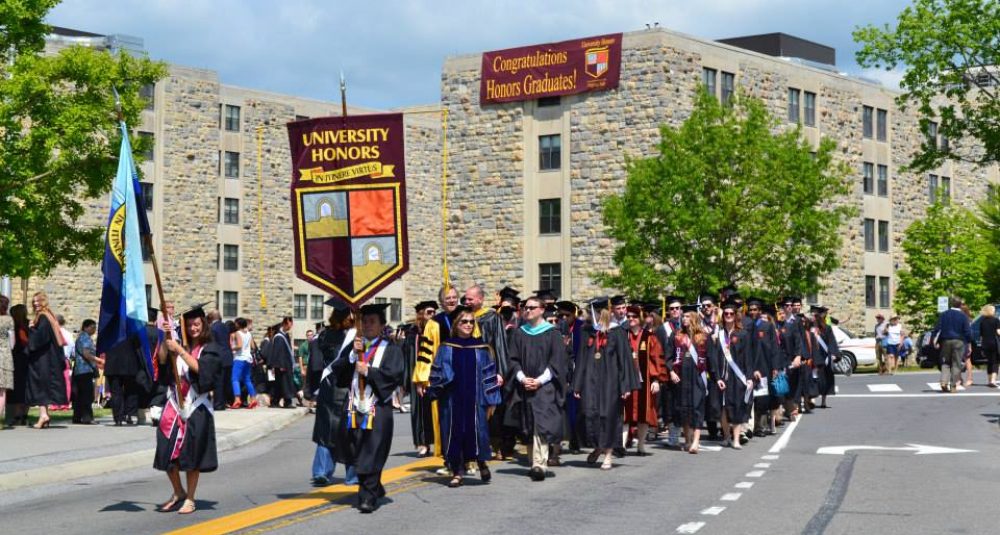
The young Georgia Tech Honors Program saw its first class graduate in 2010, and it was a class marked by excellence. Out of 55 students in the first class, 98 percent graduated with a 3.0 GPA or greater. Twelve students earned a 4.0 GPA, a remarkable accomplishment given the well-known difficulty of the university’s undergraduate programs, especially in the fields of technology and engineering. Some 89 percent of the graduates earned academic honors: 35 with highest honors; 7 with high honors; and 7 more with honors.

The early accomplishments of the program contributed to a remarkable increase in entrants for Fall of 2010. The program considered 2,000 applications, issued 309 invitations, and enrolled 113 new honors students. The program now uses admissions criteria that “rely less on numerical measures (e.g., GPA and SAT scores) but instead emphasize evidence of passion and success in areas of extracurricular life.”

Incoming freshmen live in Field Hall, near the football stadium and close to a dining hall used by all Georgia Tech students so that honors students will have frequent contact with both honors and non-honors students.

The core curriculum now features five courses, two in the first semester and three more during the second year or beyond. Honors students attend regular symposiums that feature Nobel laureates as well as the president of the university.

The Georgia Tech program will have a profile in the upcoming guidebook, but because of its recent arrival on the honors scene, it will not be compared to other programs.

Honors College, Honors Program? Prestigious Scholarships, By Category

Of the fifty public universities in our survey, 19 have honors colleges (38%), and 31 have honors programs (62%). Below is comparison showing the number of prestigious undergraduate and graduate scholarships awarded, by category.

For purposes of the comparison, we are using the whole history of Rhodes scholarships; Gates and Marshall scholarships since 2001–2011; Churchill Scholarships since 1963; and all Truman Scholars since 1977. Fulbright scholarships are not included in the comparison because those totals have been adjusted for the size of the undergraduate population and raw numbers would be misleading in this comparison. They will be considered in the final review of programs and colleges.

We considered looking only at awards during the last ten years or so, but decided on a combined approach, using all Rhodes awards, for example, because of their prominence in the public mind and because they are the most difficult to earn, given the small number (32 this year) that are awarded to U.S. students. However, we are only counting more recent Marshall awards, as noted above. Postgraduate awards for UC campuses have been adjusted to take into account the dates on which they commenced operations.

The figures reveal that universities with honors programs have a higher proportion of prestigious scholarship winners than do universities with honors colleges, although the latter come close to proportional equality in the category of undergraduate scholarships. One possible explanation for the greater proportion coming from honors programs is that honors colleges are typically a more recent development in honors education; in some cases, the universities of which they are now a part did not have an existing pattern of receiving a large number of prestigious scholarships before the inception of the honors colleges.

On the other hand, the Goldwater Scholarships (1989) and the Udall Scholarships (1996), both for undergraduate research, are relatively recent additions that have given the newer honors colleges an opportunity to prove their value by over-performing in Udall Scholarships and holding their own in Goldwater Scholarships.

Here are the figures, bearing in mind that Honors Colleges are 38% of our Fifty, and Honors Programs are 62% of the Fifty:

Honors Colleges, Udall Scholarships, 44.1% of the total.
Honors Programs, Udall Scholarships, 55.9% of the total.

Honors Colleges, Goldwater Scholarships, 35.2% of the total.
Honors Programs, Goldwater Scholarships, 64.8% of the total.

Honors Colleges, Postgraduate Scholarships, 31.8% of the total.
Honors Programs, Postgraduate Scholarships, 68.2% of the total.

What About Berkeley and William & Mary?

Submitted on 2011/11/16 at 10:26 am

Why aren’t the University of California at Berkeley and the College of William & Mary included in the list of fifty universities whose honors programs are under review?

Berkeley considers itself an honors university as a whole, and even though it has departmental honors and other programs, it does not offer a separate honors college or program with its own curriculum and separate requirements. Having said this, a prospective student should be confident that Berkeley without an honors program remains the nation’s leading public university. Of the fourteen subject areas (humanities, social sciences, natural sciences, business, etc.) being listed in the narrative portion of our guidebook, Berkeley is one of only four public universities that have elite rankings in all fourteen subject areas. (The other three universities, which are covered in the guidebook, are Michigan, Texas, and Wisconsin.)

William &Mary is a unique case. With fewer than 6,000 undergraduates, it is by far the smallest of the major public universities in the country, and it is certainly among the best. Even though William & Mary has special honors offerings, the fact that the enrollment is low makes the distinction between being in honors and not being in honors relatively minor. A big part of the appeal of a public honors program is that it makes a big campus seem smaller, more like a liberal arts college planted in a large research university. William & Mary is not, primarily, a research university, and its small size already yields the benefit of more collegiality. W&M, though certainly larger than Wesleyan or Colgate, probably resembles them more than it does the typical research university/liberal arts hybrid.

Finally, if a visit to either Berkeley or William & Mary feels “right” for you, and you are accepted, either one is an excellent choice, regardless of honors programs.