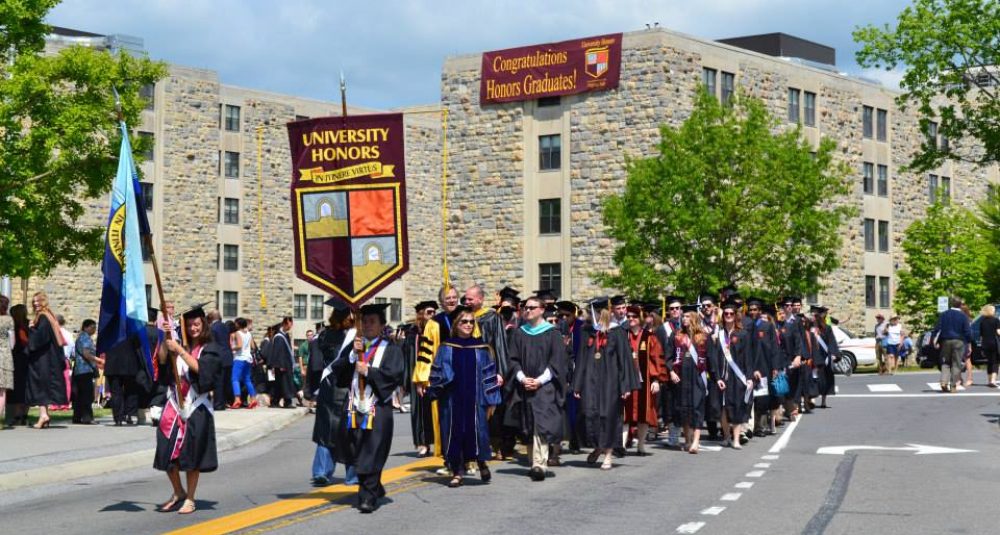
Often it appears that college honors programs are known more by their differences than by their similarities. This is certainly true when it comes to the varying sizes of honors colleges and programs among the fifty universities we are reviewing.
Indeed, for four of the universities we are reviewing, we can’t even determine the size of their honors programs. But for the other 46, the mean honors enrollment is 1,762 students.
Total honors enrollment in all fifty universities is in excess of 80,000 students.
The mean enrollment for honors colleges is 1,958; the mean for honors programs is 1,624. The smallest programs are those at Binghamton (c. 175) and Stony Brook (c. 250). The largest are at Ohio State (6,500), Iowa (5,000), Indiana (4,000), Arizona State (3,500), Massachusetts (3,100), and Maryland and Texas A&M (3,000).
Clustered relatively close to the mean are Alabama (1,650), Iowa State (1,600), Washington (1,450), Delaware (1,850), Florida (1,800), and Penn State (1,877).
Some of the Southern colleges with newer or more consolidated facilities cluster around 1,100: Mississippi (1,135), South Carolina (1,200), and Clemson (1,000).
These enrollment numbers may vary somewhat from actual numbers in a given year. (Revised March 12, 2012.)
Does the size of an honors program or college matter? Some of the really large programs will consider the top 15% of applicants to the university as eligible, thereby significantly increasing a prospective student’s chances of being admitted.
Of the more selective honors programs, Connecticut, Delaware, Florida, Georgia, Michigan, Minnesota, and Penn State have honors enrollments greater than 1,850 students. The Connecticut, Delaware, Florida, and Penn State enrollments are on the lower end of this range, with about 1,800–1,850 honors students. Georgia, Michigan, and Minnesota all have more than 2,000 students.
Other selective honors programs are much smaller. UC Irvine has about 625 students, and Texas (Plan II only) has about 700 students. Kansas has about 1,100, Virginia about 1,000, and North Carolina 1,200. Wisconsin enrolls 1,300 honors students, and Washington has 1,450.
Therefore, even if SAT and GPA requirements are equivalent, acceptance rates vary significantly. The UT Austin Plan II program accepts less than 8% of applicants, a number which translates to much less than 1% of the undergraduate student body. At Wisconsin, on the other hand, the top 7.5% of all students in the College of Letters and Sciences are eligible. This figure translates to about 4% of the undergraduate student body.
So, when it comes to size, the odds are more in your favor when you go for a larger honors program or college, as you would expect. The larger question is what size program appears to be optimal for honors learning? Stay tuned; we might have a tentative answer later.
One of the premier universities–public or private–in the nation, the University of Michigan, through its LSA Honors Program, also provides excellent housing opportunities for it students.
Most live in South Quad, one of the best locations on this large campus, with a dining hall, pizzeria, and a cafe. South Quad is near State Street in Ann Arbor, the site of festivals, restaurants, pubs, theaters, bookstores, and many other events and attractions.
About 35 percent of students in South Quad are in honors program, living in contiguous halls. The presence of both honors and non-honors students in the same residence halls allows a broader range of associations on a regular basis, while maintaining the relative peace and quiet in the honors halls. South Quad is a traditional dorm, meaning that baths are shared by all residents of a corridor.
South Quad, despite its name, is actually in central campus, convenient to most classes and facilities, including the student union. It is also the home of the student-run cable TV station, WOLV.
“South Quad was built in 1951 and won an award from the Michigan Society of Architects. At the time, South Quad was a trendsetter in college residence halls,” according to the university housing department. “Although it was originally an all-male residence, South Quad went co-ed in 1964 when half of its male residents traded places with half of Markley Hall’s female residents.”
Honors women also have the opportunity to live in Martha Cook Hall, “a small, traditional, independent house for women in the Central Campus Housing Neighborhood; it features beautiful rooms, traditional events, and a warm community for its residents.”
“Martha Cook is home to 140 first years to graduate women. Located in the heart of central campus, it is only steps away from the Diag, Grad Library, UgLi, Law quad, Michigan Union, Business School and School of Education. Martha Cook opened to female students in the fall of 1915 as the first dormitory on campus, a gift of alumnus William Cook. Over the past century the building has been home to thousands of University of Michigan women, who have left their mark on the building, the University and the world.”
Honors students at Maryland have four possible options for housing: Ellicott, Hagerstown, and La Plata Halls, all a part of the north-central Ellicott housing community, or Anne Arundel Hall, a much smaller dorm located on South Campus. It appears that most honors students may be assigned to Hagerstown Hall.
The Ellicott houses are generally considered to be more centrally located, and they share the North Campus Dining Hall and The Diner, a popular eating spot on campus. Of the three Ellicott houses, only one is air conditioned: La Plata. All have corridor bathrooms shared by all students living on a hall, usually 33 residents.
Anne Arundel only houses just over 100 students in its South Campus location. The hall is air conditioned, and baths are shared by 9 students. Anne Arundel is housed in the most aesthetically pleasing structure.
The honors-related Gemstone program is housed in Ellicott Hall. The Entrepreneurship and Innovations Program and Integrated Life Sciences Program students are in Laplata Hall. Hagerstown Hall is home to the University Honors Program, while some honors offices, conference spaces and team rooms are in La Plata Hall. All three Ellicott dorms are near the campus recreation center.
The Dining Hall is a part of the Ellicott community, and a convenience store is only a few minutes away. Most academic buildings and libraries are less than a 15-minute walk away and the university shuttle makes frequent stops in the community for overall safety and convenience.
Located in South Campus at Penn State, the two honors halls–Atherton and Simmons–are right by College Avenue, a great location for social activities and the closest residence halls to downtown. On College Avenue, students can find bookstores, theaters, pharmacies, pizza and hamburger joints, restaurants, and pubs.
The two honors halls are south-central on campus, not as close to most classrooms as North and West campus dorms, perhaps, but still a great location. The honors halls are adjacent to the nationally-recognized Schreyer Honors College offices and share the neighborhood with three dining halls, one on site, and many private restaurants.
The halls are traditional, meaning that residents share rooms, mostly doubles, and also share corridor bathrooms. Atherton has a 24/7 computer room that has a printer and 29 computer terminals for student use. The Schreyer Honors College administration offices are also in Atherton. The mail room for both halls is in Simmons. Some students consider Simmons to be the best dorm on the entire Penn State campus. Both halls also have a grand piano.
Each hall has laundry facilities, and Atherton has a TV lounge and a 24-hour study room called the “Zombie Lounge.” Simmons has two TV lounges and a “cultural/coffee house lounge” as well.
You might not know it without some research, but the University of Virginia, which prides itself on its deserved reputation for the excellence of its entire study body, also now provides special honors housing for Echols Scholars in arts and sciences and Rodman Scholars in engineering.
Good housing is especially important for UVA freshmen because they are required to live in campus housing during their first year.
The “New Dorms” on Alderman Road–the name comes from the fact that they were built “recently,” in the 1960s–have been remodeled. The two halls for honor students are Balz-Dobie and Watson-Webb; seven other halls make up the Alderman Road Residence Area.
The two honors halls house about 460 students. Though not as conveniently located as the “Old Dorms” on McCormick Road, the New Dorms have air conditioning; the Old Dorms are smaller and have no AC. The Alderman Road Area is still a good location, however, better than most others outside the Old Dorm area. There is also a commons between the two honors halls.
A UVA official told the campus paper that “the buildings add something to the residential experience.” They are “very rich in spaces that allow for social gathering and in support of academic pursuits,” she said. On the first floor of each building, the paper reports, there are “multiple lounges for private study, multipurpose rooms and a large open lounge that can be partitioned into two smaller spaces, along with laundry and vending areas.”
Rooms are configured so that up to five double bedrooms share a large bath area, so that only 10 or so students are involved versus the 30 or more that sometimes have to share corridor baths. There is a separate study room that allows one or more students to hit the books without disturbing their roommates. Some of the rooms even have balconies.
The New Dorms for honors students have received their share of attention on campus. A student reviewer expresses both the admiration and the jealousy felt by some UVA students:
“I have personally been in [Balz-Dobie] and it is a hotel. The toilets flush up and down (up for #1, down for #2), have motion-sensitive lighting, and beautiful lounges. I believe they are LED-certified buildings, and this statement makes me jealous: ‘The air handler has an energy recovery wheel that captures the heat from exhaust air and recycles it, and the whole precinct is fed by steam from McCormick Road and chilled water from the Aquatic and Fitness Center.’ It’s like the environmentally-friendly version of caviar and Perrier.”
In the recent Review of Fifty Public University Honors Programs, some 20% of the total score for each university will be for the special benefits that each provides for honors students.
Of this 20%, honors housing will count for 10%; study abroad for 7.5%; and priority registration for honors students for 2.5%. Note: many programs do not regard study-abroad programs as a “benefit” but as an essential part of the curriculum.
Some honors educators believe that an over-emphasis on benefits detracts from what should be the primary focus of honors education: learning at the highest level, but without too many perks. A few of the best public universities do not offer priority registration for honors students, for example, because these universities believe in the high quality of their student bodies as a whole and think that cohesion and mutual respect are more important to their mission than perquisites for the few.
On the other hand, students themselves value the benefits, especially if their university is extremely large and bureaucratic, or the campus is far-flung, or they have a keen interest in foreign study, or simply prefer more peace and quiet than most college students. A significant number of student comments suggest that priority registration is the main reason that the students participate in some honors programs. This is not typical, but even when “perks” are not primary, they are appealing to most honors students.
The universities among our fifty who scored the highest in the combined metric for honors housing, study abroad, and priority registration are listed below. (Please note that the score for the combined metric does not mean that all of the universities listed below have priority registration for honors students, though almost all of them do.) This list was revised on April 4, 2012.
1. Arizona, Delaware, Vermont
4. Ohio State
5. Georgia, Kansas, Texas
8. Michigan State
9. Arizona State, Mississippi
11. Texas A&M
12. Virginia
13. Penn State
14. Illinois, Minnesota, UCLA
Close behind are Indiana, Iowa, South Carolina, and Washington State.
As we get closer to completing our research on fifty leading public university honors programs, we will release some of the results prior to publication of the guidebook A Review of Fifty Public University Honors Programs in April. In this post, we will list the top universities among the fifty for study-abroad opportunities.
The data we used are a composite of university-wide and program-specific information, depending on the degree of cooperation from the honors programs and colleges.
Some of the best study-abroad programs have an extremely high level of participation from honors students: as many as two-thirds of all honors students study abroad, many for a significant period of time. About half of the fifty universities in our study have received some form of recognition for study-abroad programs.
The universities below all received the maximum score in the study-abroad category (revised April 4, 2012):
Arizona, Delaware, Illinois, Indiana, Kansas, Michigan State, Minnesota, UCLA, UT Austin, Washington, Wisconsin, and Vermont.
Close behind are Georgia Tech, UC Irvine, UC San Diego, and UC Santa Barbara.
Watch out for the ghosts. Well, anyway, watch out for the Neihardt student residents who pretend to be ghosts each year around Halloween. Hundreds of people turn out for the Neihardt “ghost tours” each year.
Max Walling, Neihardt’s residence director, told the campus newspaper that the ghost tours are a “long-standing tradition.” Most of their stories, he said, come from a thesis written in 1997 by Jessica Kennedy, titled, “Folklore and Ghost Stories on the University of Nebraska-Lincoln City Campus: A Compilation.” Kennedy wrote all about the campus. She explored the ghosts of the Temple Building, the Lewis-Syford House at 700 N. 16th St. and Selleck Quadrangle. However, many of those stories written in her thesis were from Neihardt.
The last tale, according to the paper, is performed as much as told by Derek Shafer, a senior (in 2010) and biological systems engineering major. “[Shafer] emerged from a coffin in the basement of Neihardt, representing a coffin that was found in Neihardt’s basement by maintenance workers years ago.”
“The residents of Neihardt,” the paper notes, take the ghost tours very much “to heart” when they recite their ghost stories.
Ghosts aside, or above, or wherever they may be, the Neihardt Residence Hall offers a prime location for the 400 honors students who live there. For one thing, the office of the honors program is on the first floor, a handy location for the residents who live on the second, third, and fourth floors. In addition, the nation’s most prominent organization for university honors education, The National Collegiate Honors Council, is also located there.
Below are many more reasons why students enjoy Neihardt:
• Student-to-student staff (RA) ratio is low
• Outstanding leadership opportunities through floor government and hall government
• Neihardt Council recognized as one of the most successful hall governments with active participation in service/philanthropy activities, social activities
• Easy access to Honors program faculty and staff
• Neihardt is full of members of the two most prestigious academic honoraries (Innocents Society, Mortar Board)
• Staff sensitive to high demands placed on Honors students…most of the RA Staff are Honors
• Residents of Neihardt develop lifetime friendships
• Coed
• More students return to Neihardt than any other hall on campus • Centrally located, convenient to the Nebraska Union, academic buildings, Love Library, faculty offices, Campus Rec fields, basketball, tennis and sand volleyball courts
• Close to downtown Lincoln restuarants, and movie theaters
• Residents love the sinks in the rooms located in the Love, Heppner, Raymond sections of Neihardt
• First floor offers a variety of study environments/locations: Honors computer lab, Honors group study rooms, classrooms in the building. A variety of relaxing study spaces like your living room at home.
• The Sun Room
• Neihardt traditions include camping trip, ghost tours, steak feed, philanthropy auction, professor pizzaz, professor pancakes
• Neihardt has a community kitchen with baking and cooking supplies available for check out at the Neihardt desk
• GFL (Good, Fresh and Local) menu focus of the Cather-Pound-Neihardt Dining Service
• An historic building coupled with state of the art amenities (T-3 internet, Andover access system, Onity room door locks)
• The Lounge – snack shop with a coffee house atmosphere
• Beautiful interior courtyard
Recently, President Obama called for a series of reforms directed at reducing the cost of tuition at the nation’s universities. Most public institutions are already operating with minimal state support, and these latest demands to cut costs and improve efficiencies, are, one hopes, an attempt by the president to take over the reform agenda from those who use it as part of a larger plan to reduce the role of government in all areas of life.
Some members of this alleged reform effort also champion private, for-profit online colleges as an effective means to make college education more available and affordable, despite the low graduation rates and high student loan burdens that are frequently associated with these institutions.
Of course these schools rely almost entirely on distance learning. Whether or not they are effective, overall, as educational tools, rather than as inexpensive delivery systems, is a matter of debate. But for those whose only bottom line is the one with dollar signs, distance learning will always be appealing.
The president’s proposal gives a strong nod to the role of technology in reducing costs:
“Through cost-saving measures like redesigning courses and making better use of education technology,” the president argued, “institutions can keep costs down to provide greater affordability for students.”
So how will the reforms affect honors education, especially the emphasis on distance education? It is possible to see at least three scenarios:
(1) public research institutions could use distance learning and even campus online courses to lower the cost of education for most students, thereby allowing the universities to maintain honors programs as they are, with small, personal classes and the best professors; or
(2) honors programs will have to ride the technology wave and include online learning to the same extent as the university as a whole; or
(3) An approach that includes somewhat more online instruction but retains the essential, more personal quality of an honors education will generally prevail.
Some universities, notably the University of Central Arkansas and the University of Maine at Augusta, already use distance learning in honors education, with good results. Many others require honors students to develop digital portfolios that involve the students in a process of reflection; this process not only allows students to collect and synthesize what they have learned but also to discover new connections along the way.
Even so, too much emphasis on digital learning will change the essential nature of the public honors hybrid. The combination of high-level research and a liberal-arts atmosphere would surely suffer if direct personal contact became significantly less frequent.
By John Willingham, Editor PublicUniversityHonors.Com
In his State of the Union address last week and then again in his speech on January 27 at the University of Michigan, President Obama made it clear that he has joined the fight to cut college tuition costs and reform the way universities operate so that they can deliver better “value” to students.
Value. The word is everywhere these days. Often it is measured by “outcomes,” another word of the times, less elegant but probably more relevant, suggesting a basic functionality that value may, at least on occasion, transcend.
When it comes to higher education reform, the two words have had a disquieting tendency to converge in meaning, so that what many alleged reformers mean by value is merely a quantitative increase, literally more “out-come” from whatever has been involved in production. In this way, value becomes productivity.
An emphasis on productivity, however, instead of on quality and excellence is a major threat to public university honors programs, where value is qualitative, deriving from smaller—not larger, more “functional”–classes; from outstanding teaching and support; and from the opportunity to work one-on-one with professors on undergraduate research.
Honors graduates benefit their states by often remaining near home and boosting the local economies, and they benefit their universities by improving graduation rates. This is the best form of value, in which the practical, the good of the whole, and the individual’s personal development all come together. But honors programs and colleges already find it difficult, if not quite impossible, to fund the type of education that fosters this true, best value.
The use of the word value in the context of university reform has been circulating for years, but more recently the conservative critics of public universities have indeed used the word as a synonym for “productivity,” by which they mean education on the cheap for as many students as possible. Some of these critics, most notably Richard Vedder of the aptly-named Center for College Affordability and Productivity (CCAP), candidly display their bias against public funding of, well, almost anything.
In addition to being a professor at Ohio University and a proponent of the Austrian school of economics, Vedder is the director of (CCAP) and a senior fellow at the Texas Public Policy Foundation (TPPF). The TPPF is a conservative think tank that, with Vedder’s help and Gov. Perry’s support, launched an attack on Texas universities in 2010.
On December 21, 2010, Vedder commented in Forbes magazine that “there is no doubt in my mind today that governmental subsidies to higher education are excessive–our nation would be better off if we spent less. Indeed, I suspect no governmental spending commitment at all would be preferable to the situation today (although the optimum may be greater than zero).” [Emphasis added.]
It is fitting that the quote is from Forbes, because Vedder is also the man behind the annual Forbes‘ “America’s Best Colleges” list, which makes the private university bias of the annual U.S. News rankings look like an amicus brief on behalf of public colleges. Looking at the Forbes rankings of the 34 public research universities that are members of the prestigious American Association of Universities, we find that their average ranking is…243.
Forbes ranks Georgia Tech at 397—or 362 places lower than the university’s U.S. News ranking.
University leaders in Texas are well aware of Vedder because of his work for the TPPF. The foundation and Vedder led the attack on UT-Austin and Texas A&M last year. Vedder wrote a so-called study that criticized UT Austin, especially, for spending too much on academic research and for not requiring faculty to teach enough classes. An A&M professor later argued convincingly that the study was based on sloppy research and poor statistical analysis.
Gov. Perry and the TPPF claimed during the debate in Texas that it was possible to provide a bachelor’s degree to Texas students at a total four-year cost of $10,000. In light of the governor’s campaign for the presidency, the claim does not seem quite so astonishing as it did a year ago.
What is Value for the President?
But now, with President Obama’s recent emphasis on the public university reform issue, the overriding question becomes: What does value mean to the president and to Congress. Will the conservative business definition of productivity take hold, or will the proposed reforms do as little damage as possible to the hard-won gains in quality that most public universities have achieved?
“We are putting colleges on notice,” the president said in his Michigan speech. “You can’t assume that you’ll just jack up tuition every single year. If you can’t stop tuition from going up, then the funding you get from taxpayers each year will go down.”
While prestigious and wealthy private universities can keep pace with expenses because of huge endowments, most public universities cannot, especially after the dramatic cuts in state funding over the past two decades.
It is encouraging that, in his State of the Union speech and in news releases, the president discussed a “shared approach” to control tuition costs, requiring coordinated actions on the part of the federal government, the states, and the public universities themselves.
One part of this shared approach is to make more financial aid available to universities that do the following:
(1) “Setting responsible tuition policy, relatively lower net tuition prices and/or restraining tuition growth;
(2) “Providing good value to students and families, offering quality education and training that prepares graduates to obtain employment and repay their loans; and
(3) “Serving low-income students, enrolling and graduating relatively higher numbers of Pell-eligible students.”
So there’s that word value again, in paragraph 2. One hint from that paragraph is that post-graduation pay and employment will be key measures of value. (And evidence that loans will be repaid.) Indeed, the additional details already provided about the president’s plans make it clear just how important pay and employment will be:
“The President will call for a college scorecard for all degree-granting institutions, designed to provide essential information about college costs, graduation rates, and potential earnings, all in an easy-to-read format that will help students and families choose a college that is well-suited to their needs, priced affordably, and consistent with their career and education goals.” [Emphasis added.]
If the statement above is not a clear enough indication of the importance of income as a value metric, the detailed plan adds the following:
“The President is also proposing to begin collecting earnings and employment information for colleges, so that students can have an even better sense of the post post-graduation outcomes they can expect.” Yes, outcomes.
One reason that the president’s focus on pay causes some disquiet is that Richard Vedder and other conservative critics of public universities likewise cite pay as a critical outcome. But pay, if it is used at all as a measure of educational value, requires careful consideration of geographical factors as well as a deep respect for the differing missions that public universities may have.
Our research at PublicUniversityHonors.Com shows that while postgraduate pay, at entry level and at mid-career, correlates to Forbes and U.S. News rankings, pay does not correlate with some measures of excellence, such as the number of prestigious undergraduate and postgraduate scholarships earned by graduates, or the depth of honors curricula. It is noteworthy that the scholarships and honors curricula DO correlate significantly, as they should if one is concerned about the highest levels of excellence.
If there is in fact an over-emphasis on pay as a metric to determine federal and state support, universities will eventually be forced to reduce resources for the humanities and social sciences, and even some hard sciences, because students who graduate with majors in these disciplines do not earn as much as business, engineering, and computer science graduates.
Honors programs and colleges are already hard-pressed to integrate honors curricula with the demanding departmental requirements for some remunerative majors. With fewer honors and non-honors faculty and course offerings in the less remunerative disciplines, the brightest students may emerge from their public universities with a huge disadvantage as compared to their counterparts from private elites, who will continue to benefit from smaller classes and the development of critical thinking.
No longer will public honors programs be able to compete with the elite private institutions, unless the honors programs or colleges have large private endowments. Few are so fortunate. Public universities as a group will increasingly be identified as training institutions rather than true universities committed to excellence across the disciplines.
The president, to his credit, said that the states “have to do their part by making higher education a higher priority in their budgets…We know that these state budget cuts have been the largest factor in tuition increases over the past decade.”
Yet how realistic is it to hope for stronger state support now that the state legislators and governors have become accustomed to forcing universities to take the brunt of criticism for tuition increases. With legislative support for some flagship universities now below 15 percent of total operating costs, just how far are we already from Richard Vedder’s dream of zero funding?
The productivity crowd has, for the moment, defined what value is. If the president and Congress agree with them, public university graduates may be lucky to get what Rick Perry predicted: a degree worth, maybe, ten grand.