Honors Update Feb 29, 2016

Dare we say it–we are leaping forward to the third edition of our review of honors programs and colleges. The posts during this time are few and far between because most of our efforts are focused on research and data crunching for the 2016 edition, which will have detailed ratings of 60 (versus 5o previously) public honors programs.

Here’s what we’re doing now:

–Analyzing the honors course sections in the 60 programs under review. This is the most time-consuming and the most important thing that we do. For the book, each profile will discuss the number of sections, by discipline, and list the actual class enrollment average. We also classify each program according to its type: core, blended, or department-based. In order to do the classification, we must know the number of sections that are seminars, the number that are departmental, and the number that are mixed (honors and non-honors students).

For the first edition in 2012, we did not do this sort of in-depth analysis. Since then, we have determined that this is the best way to develop a true sense of what each program or college is really like. So far, we have completed this analysis for six programs out of 60 under review.  When all is said and done, we will have reviewed about 9,000 class sections. During the review, we choose the most interesting (to us) sections and provide descriptions in the profiles featured in the book. The deadline for all programs to provide the raw material for this analysis is April 15, 2016. Stay tuned! Below is a sample of the matrix we use for this process:

CourseTotalSeminarSectDeptSect
SectionsSectionsEnrollSectionsEnroll
Honors Critical Thinking2216
15
World Thought and Experience I5516
12
16
16
16
Themes in Amer Experience1124
World Thought and Experience II5513
15
16
16
16
Adventures in Data Analysis1119
Honors Precalc118
Honors Calculus I1119
Honors Calculus II1123
Honors General Psych1124
Honors Macroeconomics1119

(This is actually a simplified matrix; the full matrix also takes into account the number of credit hours for each section and the number of non-honors students enrolled.)

–Preparing a summary of the most prestigious and lucrative scholarships offered by each university and honors program. We might do a separate post on some of these before publishing the third edition in fall 2016.

–Gathering the latest stats on the number of students from each of the 60 universities who have won the following awards: Goldwater, Udall, Boren, Gilman, Rhodes, Marshall, Churchill, Gates Cambridge, Truman, NSF, and Fulbright Student scholarships. This, too, is a long and somewhat tedious project. Next up: data for latest Fulbrights and NSF grants.


Univ of Arizona Honors Students Win Churchill Scholarships, Show Value of Undergrad Research

Editor’s Note: This post is by Jill Goetz, Karna Walter, and Emily Kotay of the University Arizona College of Engineering and Honors College and was first published on January 17, 2016, on the UA News site.

Two University of Arizona seniors have won prestigious Churchill Scholarships to complete a one-year master’s degree program at the University of Cambridge in England.

UA College of Engineering majors Travis Sawyer and Jeannie Wilkening, both students in the Honors College, are two of only 15 Churchill Scholars selected in 2016-2017 for outstanding academic achievement and proven research talent in science, engineering or mathematics.

Both are the third and fourth UA students to receive the award since it was first granted by the Winston Churchill Foundation of the United States in 1963.

The UA is able to nominate only two students to apply for the Churchill Scholarship each year, and this year is the first time that both UA nominees have been awarded the scholarship.

Churchill Scholarships range from $50,000 to $60,000 and cover a year of tuition and fees at Cambridge University’s Churchill College. Scholars also receive travel and living allowances and may get additional funding for presentations at international conferences and visits to other universities.

Capturing Magic From Van Gogh’s Paintings

Sawyer is majoring in optical sciences and engineering, a program jointly administered by the College of Optical Sciences and College of Engineering. He is developing visual recognition software using different wavelengths, such as infrared and X-ray, to help scientists capture more detailed images for making discoveries in fields as different as art preservation, astronomy and medicine.

Travis Sawyer (photo credit Graeme Hunt)

Travis Sawyer (photo credit Graeme Hunt)

For his master of philosophy, or MPhil, degree in physics, he will conduct research on applying hyperspectral imaging for detecting early-stage cancer with Cambridge scientist Sarah Bohndiek, whose lab is affiliated with the Cancer Research UK Cambridge Institute.

An Optics Ambassador with a 4.0 grade-point average throughout college, Sawyer came to optics in an unusual way. He was misdiagnosed with leukemia his freshman year and became fascinated with the optical instruments doctors used to examine him and, ultimately, ensure he was healthy.

Sawyer’s rising stardom was recognized in 2014 with a $10,000 Astronaut Scholarship, which he won again in 2015 — a first-ever feat at the UA. In 2015, he also won a Goldwater Scholarship, and his UA student team won the Robert S. Hilburn Memorial Optical Design Competition for its camera system to be sent to Saturn’s moon Titan.

“Hopefully, I can make a contribution or invent a technology that helps someone in the same way optics helped me,” Travis Sawyer says.

Sawyer credits his research mentors for their guidance. After Cambridge, Sawyer plans to pursue doctoral and postdoctoral work and establish his own research lab as a university professor.

Engineering for a Healthier Planet

Chemical engineering student Jeannie Wilkening studies how human activity affects biogeochemical cycles, the movement of water and other compounds through the atmosphere, hydrosphere and biosphere. She is particularly interested in how these processes relate to climate change and in developing models for more environmentally sustainable technologies.

“My experiences over the past four years have been instrumental in getting me to this point. I’ve been surrounded by incredible faculty, friends and classmates who have supported me, challenged me and taught me so much,”  Wilkening says.

Jeannie Wilkenning (photo courtesy Univ of Arizona College of Engineering)

Jeannie Wilkening (photo courtesy Univ of Arizona College of Engineering)

For her MPhil in earth sciences, she will conduct research with Cambridge scientist Alexandra Turchyn on carbon, sulfur and iron cycling in marshes and climate implications.

The Churchill Scholarship is the latest in a string of top honors and internships for Wilkening. She entered the UA as a National Merit Scholar and Flinn Scholar and, like Sawyer, won a Goldwater Scholarship in 2015.

She won a NASA Space Grant and interned at Princeton University and the University of Michigan through the National Science Foundation’s Research Experiences for Undergraduates Program. She belongs to the Tau Beta Pi and Omega Chi Epsilon engineering honor societies, is an Ambassador for both the Honors College and the College of Engineering and is president of the UA chapter of the Society of Women Engineers.

“Since I was a child, I have been incredibly fortunate to be surrounded by great female role models who instilled a passion in me for science and engineering,” Wilkening said.
One of them was her mother, Betsy Wilkening. After earning her own bachelor’s degree in chemical engineering from the UA in 1982, she became a popular science teacher at Richard B. Wilson Jr. Middle School. Two of her students there were Wilkening and Sawyer.

After Cambridge, Jeannie Wilkening plans to return to the U.S. to pursue a Ph.D. in environmental engineering and then an academic career, teaching and conducting research.

Univ of Arkansas Honors Student and Prof Publish Paper on Proteins Related to Alzheimer’s

Editor’s Note: The post below comes to us from Kendall Curlee, director of communications at the University of Arkansas Honors College.

FAYETTEVILLE, Ark. — A University of Arkansas research team has published a paper in ChemBioChem, a top European journal of chemical biology, based on groundbreaking experiments led by undergraduate honors student Armin Mortazavi. The paper contributes to the understanding of the molecular properties of membrane proteins, which play critical roles in cell signaling, both for diseased states and basic biological functions.

“It could be useful in understanding how proteins aggregate, which is characteristic of some neurodegenerative diseases like Alzheimer’s or Parkinson’s – but that’s long down the line at this point,” Mortazavi said.

Armin Mortazavi and faculty mentor Roger Koeppe examine deuterium magnetic resonance (NMR) results. Photo: Matt Reynolds.

Armin Mortazavi and faculty mentor Roger Koeppe examine deuterium magnetic resonance (NMR) results. Photo: Matt Reynolds.

“Our main purpose is to understand how they interact in the body.”

Mortazavi, from Hot Springs, is an honors chemistry and physics double major, a Bodenhamer Fellow, and the recipient of the Goldwater Scholarship. He is listed as first author on the article, giving him primary credit for performing the experiments that led to the discoveries. Roger Koeppe, Distinguished Professor of chemistry and biochemistry in the J. William Fulbright College of Arts and Sciences, is Mortazavi’s faculty mentor and director of the study.

The paper is titled “Juxta-Terminal Helix Unwinding as a Stabilizing Factor to Modulate the Dynamics of Transmembrane Helices.” The U of A team used nuclear magnetic resonance spectroscopy to alter the amino acid sequences of model peptides and incorporated deuterium labels to study how the peptides move within a model for the outer membrane of a cell.

Mortazavi’s research builds on earlier work by honors student Kelsey Sparks, who studied the role aromatic rings play in the movement of the same family of peptides. Sparks was the first author on a paper published in 2014 in Biochemistry and is a coauthor on this paper.

Previous work in Koeppe’s lab found that a similar peptide helix might be unwound or “frayed” at the end. Mortazavi has confirmed that there are multiple peptides that fray at the end, limiting their extent of motion and helping to anchor them within a lipid membrane.

“What Armin has found suggests that there may be more importance to the loops within membrane signaling proteins, which have largely been ignored up to now,” Koeppe said. “His work may point us in a new direction.”

Mortazavi presented his work at the 2015 meeting of the Biophysical Society and will present his latest results at the February 2016 meeting in Los Angeles.

Koeppe has mentored more than 25 honors students, with six of them publishing their research.

“To this point, I’ve not had a student publish before they graduate,” he said. “Armin started research early, in his freshman year. ­He’s well organized, dedicated, hardworking, and he’s produced a lot of results.”

Mortazavi’s work has been supported by a State Undergraduate Research Fellowship and Honors College research and travel grants. Other members of the research team who are coauthors on the article are graduate student Venkatesan Rajagopalan and research associate professor Denise V. Greathouse.

About the Honors College: The University of Arkansas Honors College was established in 2002 and unites the university’s top undergraduate students and professors in a learning environment characterized by discovery, creativity and service. Each year the Honors College awards up to 90 freshman fellowships that provide $70,000 over four years, and more than $1 million in undergraduate research and study abroad grants. The Honors College is nationally recognized for the high caliber of students it admits and graduates. Honors students enjoy small, in-depth classes, and programs are offered in all disciplines, tailored to students’ academic interests, with interdisciplinary collaborations encouraged. Fifty percent of Honors College graduates have studied abroad – three times the national average – and one hundred percent of Honors College graduates have engaged in mentored research.

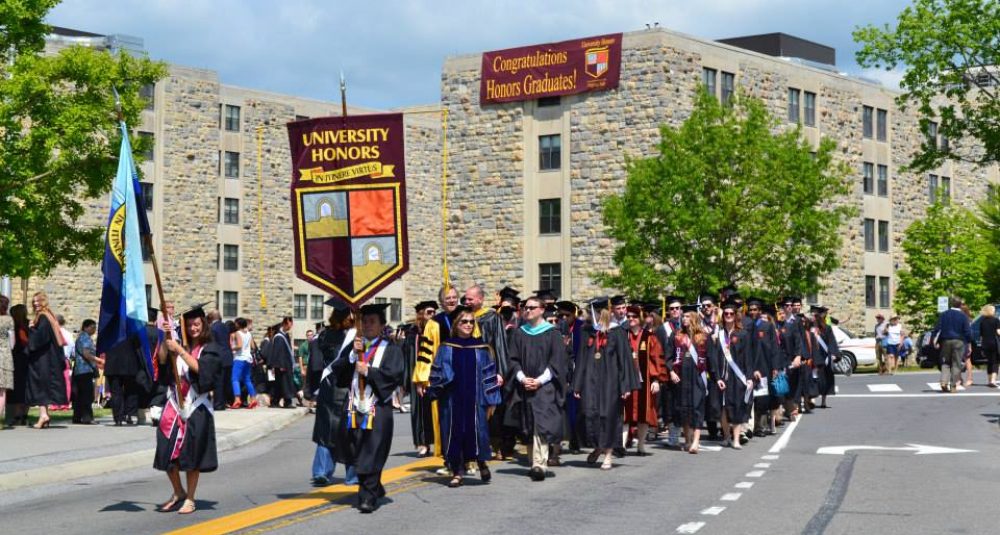
Virginia Tech Will Move from Honors Program to New Honors College

Editor’s Note: The big news in the honors community is that Virginia Tech will build on its current University Honor Program and develop a new Honors College. Tech joins the University of Kentucky as the most recent prominent state universities to expand honors programs to honors colleges. The post below is by Virginia Tech writer Alison Matthiessen.

BLACKSBURG, Va., Feb. 5, 2016 – Virginia Tech President Tim Sands announced the university’s plan to transition the University Honors program to an Honors College.

Paul Knox, University Distinguished Professor and senior fellow for international advancement, will provide leadership for the transformation, directing the current University Honors program while engaging with the university community to build an Honors College. VaTechSands has tasked Knox with aligning the transformation process with the university’s Beyond Boundaries visioning process, Destination Areas discussion, and InclusiveVT, supporting the university’s vision for a more diverse undergraduate population.

“Virginia Tech’s University Honors program is well positioned to move into the top echelon of Honors colleges within the United States,” Sands said. “The Honors residential communities, the Presidential Global Scholars program offered through the Steger Center for International Scholarship, the flexible curriculum that encourages interdisciplinary and innovative plans of study, and strong faculty commitment to the Honors program provide the foundation for an honors college.”

Knox will convene a steering committee to look at the transformation process that will engage constituents and stakeholders across the Virginia Tech community. In addition, he will meet with relevant commissions as well as alumni and friends to build private support for this initiative. Once built, a transition plan will be presented to University Council and to the Board of Visitors. Upon the completion of the transition, Sands said Knox will become founding dean of the Honors College.

“I believe an Honors college, with high expectations and a collegial atmosphere that encourages risk and flexibility, will significantly enhance the university’s commitment to the open exchange of ideas and the shared belief, regardless of discipline, in a generalized, coherent, communal set of attitudes that are collaborative and intellectual,” Knox said.

Provost Thanassis Rikakis said a Virginia Tech Honors College will not award degrees or create a specific curricular structure that would prevent some students from joining based on their chosen major. “We want to ensure the continued collaboration between University Honors and the academic colleges to provide the opportunity for students to build innovative plans of study and to engage in a cross-university collaborative educational curricula and experiential learning environments,” Rikakis said.

As a first step in the process, the current honors residential community housed in East Ambler Johnston will be renamed the Honors Residential Community. The name change will not impact the community’s programming or services. This living-learning community as well as the Hillcrest Community will remain part of the new University Honors structure.

“We are excited to have Paul Knox lead this transition,” said Christina McIntyre, who has been serving as interim director of the program and will return to her position as senior associate director. “He is a renowned scholar and has already been an active participant with University Honors and its students. He has the skills and vision to take us to the next level.”

“During this interim period for the program, Christina and the rest of the University Honors team never stopped their good work to recruit the best students and cultivate relationships with them to ensure their success here at Virginia Tech and beyond,” said Rachel Holloway, vice provost for undergraduate academic affairs. “The university is thankful for their work and look to see them do even more under Paul’s leadership and during this transition.”

As the transition unfolds, the university community will be invited to provide feedback and participate in the process.

Knox joined Virginia Tech as a faculty member in urban affairs and planning in 1985. He served as dean of the College of Architecture and Urban Studies from 1997 to 2006, before stepping down to focus on teaching and research and serve as senior fellow for international advancement. In that capacity he has served as interim director of the Virginia Bioinformatics Institute and coordinated efforts at Virginia Tech to build long-range strategic plans, including the current Plan for a New Horizon. He is currently a member of the Beyond Boundaries steering committee.

University of Texas Chancellor Opposes Top 10 Percent Admission Rule

As a former Navy Seal and admiral in command of all U.S. Special Operations forces, UT System Chancellor Bill McRaven spent three decades serving and leading the most elite military forces in the world. He has made it clear that he now wants the state flagship to join the best of the best among the nation’s public universities.

But after seeing the system flagship turn away thousands of the state’s elite students because they did not make the top 10 percent (actually 7 percent at UT Austin this year) in the graduating classes of the state’s most competitive high schools, the chancellor sees the automatic admission rule as a major obstacle to keeping the brightest students in Texas–and at UT Austin.

“Candidly, right now what is holding us back is the 10 percent rule,” McRaven told state higher ed leaders recently.

The motives of the Top 10 proponents are certainly worthy–to increase the enrollment of high-achieving minority students at UT Austin. But what makes the rule (sort of) work is that it is predicated on the fact that many of the state’s high schools remain almost entirely segregated. Sometimes this is because an entire region is heavily Latino (the Rio Grande Valley); but elsewhere the segregation in urban centers is based on race and income.

Many of these high schools are among the least competitive in the state. Graduating in the top 7 percent of a high school that offers no AP or honors sections and that has low mean test scores is far different from reaching the top 7 percent of a graduating class of 800 students that has 70 National Merit Scholars.

What can happen to suburban students at very competitive schools is that an unweighted high school GPA of 3.9 (high school rank top 11 percent) and an SAT score of 1440 might not make the cut at UT Austin. Three-fourths of the school’s admits are from the top 7 percent pool; the other 25 percent of admits face a pool that is as competitive as many of the nation’s most selective private colleges.

And, McRaven would say, too many of these students are going out of state, where it costs them more and where they might remain rather than return to Texas. Moreover, the chancellor believes the rule is part of the reason that UT Austin, despite having a stellar faculty, is not rated as highly as it should be among the nation’s public universities.

“Candidly, I think we need to take a hard look at some of the ways that we address higher education, particularly at our flagship program. Your flagship, your number one university in the state of Texas is ranked 52nd on the U.S. News & World Report. To me that’s unacceptable. A lot of things drive that. The 10 percent rule drives that,” he told higher ed leaders.

While he did not specify exactly how the rule contributes to lower rankings, the graduation rate metric used by U.S. News might be lower for UT Austin in part because of the relatively lower standards in many poor and mostly segregated high schools. (It is possible that the chancellor also sees the large size of UT Austin as another issue.)

If the chancellor can find a way to maintain or improve minority enrollment and do away with the Top 10 rule, he might prevail. If the U.S. Supreme Court does not scrap the university’s current holistic admissions policy for students outside the top 7 percent, he might have a better chance; otherwise, his task will be as difficult as many he faced as a military leader.

“[The Top 10 Rule] is a very very sensitive topic,” State Rep. Robert Alonzo told McRaven. “It is a topic that we have discussed at length from all different aspects, and I would hope that we have put it to rest for a while.”

McRaven was undeterred. “I am a new chancellor, so I am going to take that opportunity to re-open that look again,” he said. “Because my charge is to make us the very best, and I think there are some obstacles to doing that.”

Alonzo replied: “Well, I accept the challenge, sir.”

Stay tuned, for this could be a big battle indeed.

Honors College, Honors Program: Differences Revisited

In an earlier post, Honors College, Honors Program: What’s the Difference, we wrote about the sometimes minor differences between honors colleges and honors programs, while noting that, in general, honors colleges tend to have more structure, somewhat smaller classes, more staff support, and more state of the art residence halls.

In that post, the focus was on stats and structural differences. In this post, we want to highlight another reason that several flagship institutions have, and will continue to have, honors programs rather than honors colleges. Undoubtedly, the current trend in higher ed is to develop new honors colleges or to integrate existing honors programs into a separate honors college. This can lead to the perception that honors colleges are inherently better, more advanced, or more in tune with the need to create centers of excellence in public universities.

In the case of most of the public universities with an average U.S. News ranking of 70 or higher, however, the overwhelming preference is to offer an honors program–or programs–rather than establish a separate honors college within the universities. It is no coincidence that these schools, most notably Michigan, UCLA, UNC Chapel Hill, Virginia, Illinois, UW Madison, Washington, UT Austin, and Ohio State have very strong overall academic reputations and high faculty rankings across all major disciplines.  (UC Berkeley and William and Mary do not have any university-wide honors programs at all.)

When greater selectivity is combined with outstanding academic reputation and stellar faculty, students with Ivy-ish ambitions can say, with confidence, that the smaller communities and classes created by the honors programs at these schools are the final steps that bring them to substantive equivalence with elite private universities. The academic rep is present, and the faculty is strong even in non-honors classes. There is no real need to establish a separate, often larger honors college in order to concentrate the academic resources there, because those resources are university-wide.

There are exceptions, of course. When highly-ranked public universities receive generous private endowments or donations to establish honors colleges, they have done so. The Schreyer Honors College at Penn State is an outstanding example.  The Purdue Honors College is another that has benefited greatly from private donations.

The University of Maryland Honors College is another exception. Though not named for wealthy benefactors, the college was created almost half a century ago, in 1966, making it one of the oldest and most respected honors colleges in the nation.

Private endowments can also fund large honors colleges within flagships that are not rated among the top 60 public universities, making those honors colleges so notable that they often compete with public and private elites. Examples include ASU’s Barrett Honors College, the University of South Carolina Honors College, Clark Honors College at the University of Oregon, and the Sally McDonnell Barksdale Honors College at Ole Miss.


Pitt Honors College Offers Maximum Flexibility and High Quality

Although the University Honors College (UHC) at the University of Pittsburgh has many things in common with other honors colleges and programs at other leading public universities, the UHC opens itself to all students at Pitt “who choose to challenge themselves beyond the normal academic requirements” at the university.

The Cathedral of Learning at Pitt is the largest university building in the western hemisphere.

The Cathedral of Learning at Pitt is the largest university building in the western hemisphere.

Here’s what the UHC at Pitt has in common with other honors colleges:

“Like the honors colleges at many other universities with a similar mission, the UHC offers honors courses (approximately 80-100 per year) and operates honors residence halls (housing around 700 students per year in three facilities),”according to honors staff.

But it is the flexibility of the UHC approach that sets it off from most honors colleges and programs, although some others, most notably the Echols Scholars Program at UVA and the Michigan State Honors College offer a lot of flexibility as well.

Unlike most programs, the special opportunities offered through the UHC “are open to all academically talented and committed undergraduate students who choose to pursue them,” the college reports.

“Second, students design their honors experience and can take honors courses or not as they wish.”

In addition,the UHC offers a range of specialized advising, several distinctive research programs, and even offers a unique interdisciplinary major (“Politics and Philosophy”) and a degree bestowed by the UHC itself: a Bachelor of Philosophy (BPhil) degree.

Here are some of the outstanding accomplishments of Pitt UHC students:

• 369 prestigious national and international awards won by students mentored through the UHC’s national scholarship office since 2008.
• 241 BPhil degrees earned by students since 2008.
• 639 Brackenridge Research Fellowships completed by students since 2001.
• 73% of the 202 students mentored by UHC pre-health advisors in 2013 accepted and matriculated into the professional program of their choice (vs. the national benchmark average of 42%)

“The five foundational programs of the UHC – honors courses, honors advising, honors research programs, the BPhil degree, and honors housing – offer a mix of opportunities for undergraduate students to obtain an enriched education,” the UHC tells us.

“These excellent programs are supported by a committed UHC staff of 16 who work effectively and collegially, and by the UHC Faculty Fellows (currently 45 Pitt faculty who are most active in honors programming) and UHC Student Ambassadors (currently 48 Pitt undergraduate students) who volunteer their assistance.”

Pitt began an Honors Program in 1978 and formally converted this program to the University Honors College in 1987. The open access, non-membership policy was initiated by Dr. G. Alec Stewart, the Program Director, who later became the first Dean of the UHC, a position he held until he passed away in 2010. Dr. Edward M. Stricker was appointed the second Dean of the UHC in 2011. Dr. Peter Koehler joined the UHC in 2012 as Academic Assistant to the Dean, and Dr. Gordon Mitchell was named UHC Assistant Dean in 2014.

The UHC, along with other highly flexible programs at UVA, Michigan State, Cincinnati, and UCLA will be reviewed more extensively in our 2016 Review of Sixty Public University Honors Programs.

Iowa Student, with Honors Mentoring, Wins Rhodes, Truman, Boren, and Udall Awards

Editor’s Note: The following post was written by Tricia Brown of the University of Iowa.

University of Iowa student Jeffrey Ding says he’s unsure yet how being named a Rhodes scholar will change his life, but he’s already getting more than the usual number of friend requests on Facebook.

Jeffrey Ding: Rhodes Scholar, Truman Scholar, Boren Scholar, and Udall Scholar

Jeffrey Ding: Rhodes Scholar, Truman Scholar, Boren Scholar, and Udall Scholar

Ding, a senior from Iowa City, was selected as one of 32 American Rhodes scholars on Nov. 22 from a field of 869 applicants; 90 are named worldwide. He’ll receive $50,000 annually for two years and will have the opportunity to attend Oxford University in England.

“I feel a mix of excitement and gratefulness,” Ding writes via email from Beijing, where he’s enrolled in Peking University’s School of Economics. “I’m excited to make the most of this opportunity to study about the world at Oxford, and I am grateful to all the people who made this opportunity possible.”

Ding, a member of the Honors Program and a student in the UI’s Henry B. Tippie College of Business and the College of Liberal Arts and Sciences, will graduate in May with degrees in economics (B.B.A.), political science (B.S.), and Asian languages and literature (B.A.), along with a certificate in international business.

He adds the Rhodes scholarship to his cache of other awards and honors. Earlier in 2015, he was awarded the Udall scholarship and the Truman scholarship. He is the only UI student to have received all three. He arrived at the UI as a first-year presidential scholar, the highest award the UI gives to incoming undergraduates. He’s also the recipient of the Stanley undergraduate award for international research and was named a Boren scholar through UI International Programs.

A total of 19 UI students have been awarded Rhodes scholarships since 1905. The university’s most recent Rhodes scholar was Renugan Raidoo, in 2011.

“Jeffrey has had an incredible experience here at Iowa,” says Kelly Thornburg, director of scholar development at the UI Honors Program. “Being a part of the Rhodes scholar community will help him make what he was already doing that much more extraordinary. More than the money, it’s really about the greater connection to other people who are like him and who care about the world in the same way and will challenge him to do more in ways he might not have considered.”

The Rhodes scholarship is a well-deserved honor for Ding, and for the entire campus, says P. Barry Butler, UI executive vice president and provost.

“Jeffrey’s achievements exemplify the world-class academic experience available at the UI,” he says.

Ding has been involved with the UI Climate Narrative Project, for which he presented in-depth research and performed field studies and personal interviews with farmers and agricultural experts. He served as vice president of the UI Student Government and is a member of the Chinese Church of Iowa City.

Thornburg says that aside from being “very, very smart,” Ding is just like other people his age.

“He’s not an intellectual snob,” she says. “He loves tennis and plays video games and is pretty obsessive about sports. He’s very good at choosing where he spends his time. He’s also a lot of fun and a good friend.”

She says she thinks Ding won this award because he makes getting to know people a priority, and he seeks out ways he can help others. He has also cultivated strong relationships with many UI faculty members and takes a genuine interest in their research.

“He really sees people,” she says.

At a time when UI athletics is receiving so much attention—the football team was named champion of the Big Ten West division after defeating Purdue on Nov. 21—Thornburg says Ding’s award is a testament to the quality of the university as a whole.

“The University of Iowa offers really incredible opportunities to undergraduates. It is amazing that we are doing so well in football, and it is so wonderful to have this very prominent example of what our students are able to do as scholars and leaders on our campus,” she says.

Ding is approaching this honor with modesty. He says people aren’t surprised when they learn he is from Iowa.

“I have so much love and pride for both Iowa and the University of Iowa that people who know me and find out that I received the Rhodes already see Iowa as a part of who I am,” he says.

UGA Honors Student: Honors, Mentoring, Research Lead to 2016 Marshall Scholarship

Editor’s Note: The following post comes from the University of Georgia and staff writer Camie Williams.

Athens, Ga. – University of Georgia Honors student Meredith Paker has been named a recipient of the Marshall Scholarship to pursue graduate studies in the United Kingdom. Up to 40 Marshall Scholars are selected each year, and Paker is UGA’s third student in the last decade to earn the award and the seventh in the university’s history.

Meredith Paker

Meredith Paker

Paker, a native of Madison, Wisconsin, and a recipient of UGA’s Foundation Fellowship, plans to pursue a master’s degree in economic and social history from the University of Oxford. She will graduate in May with a bachelor’s degree in economics from the Terry College of Business and a minor in mathematics from the Franklin College of Arts and Sciences.

While at UGA, Paker has conducted economics research with faculty members Jonathan Williams, David Bradford and William Lastrapes. Contributing to a growing literature on the prevalence and impact of off-label prescriptions in the U.S. pharmaceuticals market, she has recently presented her work at the International Health Economics Association conference in Italy and at the UGA Center for Undergraduate Research Opportunities Symposium. After completing her master’s at Oxford, her goal is to pursue a doctorate in economics and begin a career as an academic economist.

“The University of Georgia is very proud of Meredith for this accomplishment,” said President Jere W. Morehead. “Her selection as a Marshall Scholar is a testament to the quality of UGA students and the benefits of undergraduate research. I am confident that Meredith will excel in her studies at Oxford University and that she will make a significant impact on the field of economics throughout her career.”

The Marshall Scholarship, established by an Act of Parliament in 1953, is one of the highest academic honors bestowed on American post-baccalaureate students. More than 900 students from across the U.S. apply annually. The program, which was created in gratitude for U.S. assistance to the United Kingdom during World War II under the Marshall Plan, provides funding for up to three years of graduate study at any United Kingdom university in any field.

“I am so pleased for Meredith, and I am appreciative of the excellent faculty mentoring she has received,” said David S. Williams, associate provost and director of UGA’s Honors Program. “I think it is important to note that Meredith is not only a gifted thinker and researcher, but it is clear that she is also deeply passionate about using her intellect for the betterment of society.”

In addition to being a recipient of the Foundation Fellowship, UGA’s premier undergraduate scholarship, Paker is an inductee to the Phi Beta Kappa and Phi Kappa Phi honor societies. She has studied abroad at Oxford and in Tanzania, where she summited Mount Kilimanjaro in 2014.

“I am so excited to explore a new area of my field for the next two years,” said Paker. “With the Marshall Scholarship, I will become the best economist I can be. I can’t thank the Honors Program and my research mentors enough for their support.”

Paker has served as an Honors teaching assistant for first-year Honors students and is vice president of the UGA Economics Society. She leads a Girl Scout troop through Campus Scouts and hosts a weekly radio show on UGA’s student-run radio station, WUOG 90.5FM.

“Earning this prestigious honor is the byproduct of Meredith’s hard work in two different, but critical, arenas,” said Jessica Hunt, major scholarships coordinator in the UGA Honors Program. “Meredith has been committed to academic excellence, undergraduate research, and civic engagement throughout her four years at UGA, and she has also spent several months successfully navigating the arduous application and interview process. The Marshall award is a testament to her talent, her dedication to the field of economics, and her desire to positively impact local, national, and international communities.”

Purdue Honors Student and Rhodes Finalist: “I have lived the immigrant experience.”

Editor’s Note: The following post comes from Rosanne Altstatt at the Purdue National and International Scholarships Office.

Purdue University student Brenda Ramirez has been named a Rhodes Scholarship finalist.

"I have lived the immigrant experience." Brenda Ramirez

“I have lived the immigrant experience.” Brenda Ramirez.

Ramirez was born in Mexico and immigrated to the United States as a child, gaining U.S. citizenship in 2012.

Ramirez, of Romeoville, Illinois, is a senior in the College of Liberal Arts and Honors College majoring in law and society and corporate communication. After she graduates she plans to study refugees and migration from a global perspective. She is planning a future in law and public policy with the goal of improving how immigrant populations are supplied with needed services and resources.

“I have lived the immigrant experience, and it is imperative for me to give a voice to others like me,” she said.

“We are thrilled for Brenda. She was one of the Honors College’s first mentors, lending peer support and guidance to others,” said Rhonda Phillips, dean of the Honors College. “Brenda exemplifies what we strive to help our students develop – leadership skills, interdisciplinary knowledge, and a commitment to global and community engagement.”

Ramirez’s programs of study are in the Brian Lamb School of Communication and the Department of Sociology.

“Brenda is an outstanding liberal arts student who leads by example in the classroom on campus and beyond,” said David Reingold, the Justin S. Morrill Dean of Liberal Arts. “She represents the very best at Purdue University and her passion for addressing global issues is powerful and her determination to succeed and help others is inspiring.”

NISO develops student-scholars’ skills as they prepare their applications for Purdue’s nominations for prestigious awards. The office also guides students through their applications with info sessions, writing workshops, one-on-one meetings, mock interviews and all the details of scholarship competitions.

Source: Rosanne Altstatt, Purdue National and International Scholarships Office, altstatt@purdue.edu

VIDEO: Brenda Ramirez: https://www.youtube.com/embed/o49aVMS4dKI